Mercy is when you can't even explain how you're still surviving, yet you are. You don't have it all figured out, but every day, God provides the strength, help, and grace you need right on time.
🚨‼️The book of Proverbs does not just describe wisdom, it describes men. This chart breaks down the different kinds of men found in Proverbs: the wise man, righteous man, diligent man, humble man, prudent man, faithful man, foolish man, wicked man, slothful man, proud man, angry man, deceitful man, and ungodly man.
Proverbs shows that a man is known by his fear of God, his words, his work ethic, his humility, his friends, his discipline, and his response to correction. Some men walk the path of life. Others are walking straight into destruction.
This chart is a mirror. Every man should look at it and ask, “Which one am I becoming?”
#KJV #Proverbs #BibleStudy #VerseQuest #MenOfProverbs #KingJamesBible #Wisdom #ChristianMen
THIS NEEDS TO BE PRAYED OUT LOUD:
Father, I lay down every financial burden, every debt, every wrong decision, and every season of lack before You.
I surrender every mistake I have made financially and every opportunity I lost through ignorance, fear, delay, or disobedience.
Lord, by Your mercy, restore me.
Rebuild every area of my finances that has been broken.
Renew my mind concerning money, stewardship, and provision.
Where there has been dryness, let there be abundance.
Where there has been delay, let there be speed.
Where there has been struggle, let there be divine help.
Father, open doors no man can shut.
Give me wisdom to create, manage, and multiply resources.
Disconnect me from financial cycles of loss and frustration.
I decree that lack will not define my future.
I will not drown in debt.
I will not live in fear concerning provision.
Jehovah Jireh, arise and show Yourself strong in my life.
Let restoration locate my finances, my business, my work, and my household.
What took years to lose, restore by Your power.
Give me grace to recover, rebuild, and rise again.
In Jesus’ Mighty Name, Amen.
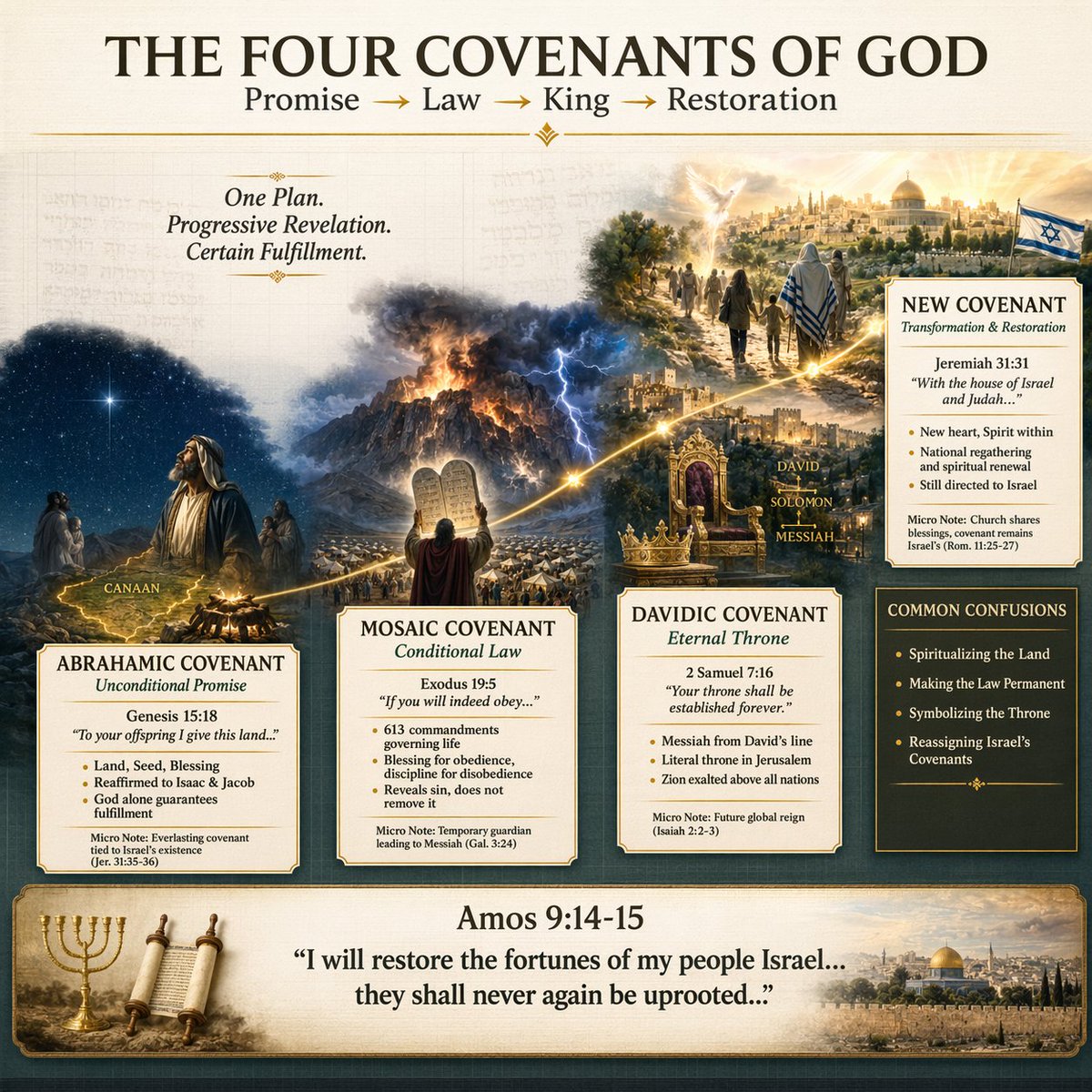
Did God redefine His covenants… or are His promises to Israel still unfolding exactly as spoken?
From Genesis to the Prophets, Scripture reveals not one vague agreement, but four distinct, interconnected covenants made with Israel. When they are blurred or reassigned, prophecy collapses. When they are read plainly, a powerful, unified story emerges.
Each covenant does not replace the previous—it builds, clarifies, and moves the promise forward toward its final fulfillment.
❖ The Abrahamic Covenant — The Unbreakable Foundation
God begins with promise, not law.
Genesis 12:2–3
“I will make of you a great nation… and in you all the families of the earth shall be blessed.”
Genesis 15:18
“To your offspring I give this land, from the river of Egypt to the great river, the river Euphrates.”
This covenant is unconditional. In Genesis 15, God alone passes between the pieces. Abraham does not. The promise rests entirely on God.
And it wasn’t stated once, it was reaffirmed repeatedly:
Genesis 17:7–8
“I will establish my covenant… as an everlasting covenant… I will give… all the land of Canaan.”
Genesis 26:3 (to Isaac)
“I will establish the oath that I swore to Abraham your father.”
Genesis 28:13 (to Jacob)
“The land on which you lie I will give to you and to your offspring.”
This repetition matters. God is not revising, He is reinforcing.
Jeremiah 31:35–36
“If this fixed order departs… then shall the offspring of Israel cease from being a nation before me forever.”
▶️ The covenant is tied to creation itself. If Israel is redefined, then God’s language has no stable meaning.
John Walvoord:
“Israel’s covenants are not canceled by the Church; they await literal fulfillment in the future kingdom.”
This promise sets the stage for everything that follows.
❖ The Mosaic Covenant — The 613 Commands and the Need Revealed
At Sinai, God gives Israel the Law—traditionally counted as 613 commandments.
Why so many?
Because the Law was not merely moral, it governed every aspect of life: civil, ceremonial, dietary, priestly, and moral. It set Israel apart as a holy nation among the nations.
Exodus 19:5
“If you will indeed obey my voice… you shall be my treasured possession…”
Deuteronomy 28:1–2
“If you faithfully obey… all these blessings shall come upon you.”
Deuteronomy 28:15
“If you will not obey… all these curses shall come upon you.”
This covenant is conditional. It does not secure the promise—it tests and exposes the human heart.
Galatians 3:24–25
“The law was our guardian until Christ came…”
The 613 laws reveal something profound: not that Israel could achieve righteousness—but that no one could.
The Mosaic Covenant does not replace the promise.
It reveals the need for redemption within it.
❖ The Davidic Covenant — The Throne That Will Not Move
God now advances His plan—from promise, through law, to a King.
2 Samuel 7:16
“Your house and your kingdom shall be made sure forever before me. Your throne shall be established forever.”
Psalm 89:34–36
“I will not violate my covenant… his throne as long as the sun before me.”
This is not symbolic language. It is covenant certainty.
Luke 1:32–33
“The Lord God will give him the throne of his father David…”
If this throne is not literal, then no promise in Scripture can be read with certainty.
And Scripture tells us where this throne will be established:
Isaiah 2:2–3
“In the latter days the mountain of the house of the Lord shall be established as the highest of the mountains… For out of Zion shall go forth the law.”
Zechariah 14:9
“The Lord will be king over all the earth.”
The Davidic throne will be in Jerusalem, on Mount Zion, exalted above all. Not metaphorically—geographically, visibly, globally.
Chuck Missler:
“God means what He says, and says what He means. The covenants with Israel are not poetic—they are contractual.”
A real King. A real throne. A real reign.
❖ The New Covenant — Offered to Israel, Fulfilled in the Future
After failure under the Law, God promises transformation, not replacement.
Jeremiah 31:31–33
“I will make a new covenant with the house of Israel and the house of Judah…”
This language is precise. It is never used for a spiritualized group.
Ezekiel 36:24–27
“I will take you from the nations… bring you into your own land… I will give you a new heart…”
Notice the order:
Regathering → Cleansing → Renewal → Obedience
This covenant was offered to Israel, and it still stands.
Yet many assume it was transferred entirely to the Church. That assumption cannot stand under the text.
Jeremiah 31:35–37 (partial)
“If the heavens above can be measured… then I will cast off all the offspring of Israel…”
Romans 11:25–27
“A partial hardening has come upon Israel… and in this way all Israel will be saved…”
This is not God abandoning His people—it is God ensuring their ultimate restoration.
The Church partakes in all the spiritual blessings through Messiah, but it is never called the nation to whom these covenants were sworn.
❖ Where the Confusion Begins
The issue is not Scripture—it is misreading it.
When the Abrahamic Covenant is made conditional, promise weakens.
When the Mosaic Covenant is made permanent, law replaces grace.
When the Davidic Covenant is made symbolic, the throne disappears.
When the New Covenant is reassigned, Israel vanishes from its own promises.
❖ The Chain Reaction
Spiritualized land → God no longer means what He says
Symbolic throne → Messiah never rules from David’s line
Redefined Israel → Covenant identity is erased
Collapsed prophecy → Scripture loses predictive authority
❖ The Prophetic Anchor
Zechariah 14:4
“On that day his feet shall stand on the Mount of Olives…”
This is not symbolic. It is visible, geographic fulfillment—exactly where God said it would happen.
❖ The Story God Is Telling
These covenants are not competing—they are unfolding.
The Abrahamic Covenant establishes the promise.
The Mosaic Covenant exposes the need.
The Davidic Covenant secures the King.
The New Covenant restores the people.
❖ The Prophetic Crescendo
Amos 9:14–15
“I will restore the fortunes of my people Israel… I will plant them on their land, and they shall never again be uprooted…”
God does not revise His covenants.
He fulfills them, exactly as spoken, in the place He promised, to the people He named.
The seven sanctifying gifts of the Holy Spirit are supernatural endowments bestowed upon the faithful to perfect the virtues and enable a deeper union with God. These gifts—wisdom, understanding, counsel, fortitude, knowledge, piety, and fear of the Lord—elevate the human soul beyond natural capacities, allowing it to respond more fully to divine grace and navigate the complexities of the spiritual life with supernatural insight and strength.
Wisdom grants a profound taste and relish for divine truths. It enables the soul to judge all things according to their eternal value in relation to God, fostering a contemplative appreciation of God’s goodness and ordering one’s life toward ultimate beatitude. Through the gift of wisdom, the believer experiences an intimate knowledge of God that transcends mere intellectual assent, leading to peace and joy even amid temporal trials.
Understanding complements wisdom by illuminating the intellect to penetrate the meaning of revealed truths. It provides clarity in discerning the deeper significance of faith’s mysteries, such as the Incarnation or the sacraments, without necessarily resolving all difficulties but rather allowing the soul to grasp them with supernatural light. This gift sharpens the mind to distinguish truth from error in spiritual matters, promoting a more profound adherence to doctrine.
Counsel offers supernatural prudence in practical decision-making, particularly in matters of salvation. It acts as an interior guide, assisting the soul in resolving doubts, choosing rightly in moral dilemmas, and discerning God’s will amid conflicting options. Unlike natural prudence, counsel draws directly from the Holy Spirit, ensuring judgments aligned with divine purposes and safeguarding against rash or self-centered choices.
Fortitude imparts courage and endurance to overcome obstacles in the pursuit of holiness. It strengthens the will against fear, fatigue, or persecution, enabling the faithful to persevere in virtue and undertake difficult tasks for God’s glory. This gift transforms natural bravery into a supernatural resolve, supporting martyrs and ordinary believers alike in facing life’s spiritual battles with steadfastness.
Knowledge equips the soul with a correct judgment regarding created things in their relation to the Creator. It reveals the vanity of worldly attachments and the true purpose of creatures as means to glorify God, thereby directing the intellect away from error and toward a proper hierarchy of values. Through this gift, one discerns the path to sanctity by recognizing both the goodness and the limitations of temporal realities.
Piety cultivates a filial devotion toward God, inspiring reverence, love, and obedience as a child to a father. It extends this affection to all that pertains to God, including the Church, the saints, and fellow believers, fostering a spirit of worship and mercy. Piety perfects the virtue of religion, transforming duty into joyful communion and promoting harmony in interpersonal relations grounded in divine love.
Fear of the Lord, often described as the foundation of these gifts, instills a profound awe and reverence for God’s majesty, coupled with a wholesome dread of offending Him through sin. It is not servile fear driven by punishment but a chaste, filial fear that motivates fidelity and purity of heart. This gift anchors the soul in humility, deterring presumption while encouraging total dependence on divine mercy.
Collectively, the seven sanctifying gifts operate under the influence of the Holy Spirit, sanctifying the recipient by rendering the soul docile to grace. They do not supplant human effort but elevate it, working in harmony with the theological virtues of faith, hope, and charity, as well as the moral virtues. Their full development typically occurs through prayer, the sacraments, and a life of virtue, culminating in the soul’s transformation into a more perfect image of Jesus Christ.
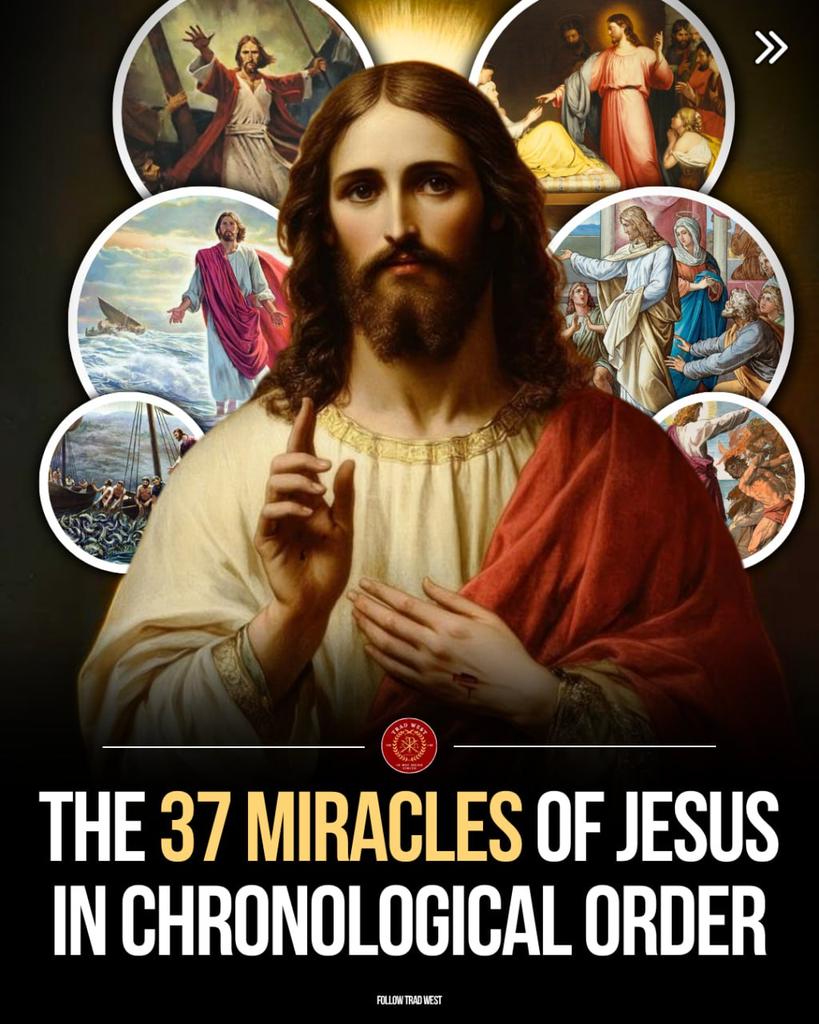
Here is the full chronological list of the 37 miracles recorded across the four Gospels:
1 Turning Water into Wine
2 Curing the Nobleman's Son
3 The Miraculous Catch of Fish
4 Casting out an Unclean Spirit
5 Healing Peter's Mother-in-Law
6 Healing Many Sick at Evening
7 Cleansing the Leper
8 Healing the Centurion's Servant
9 Healing the Paralytic
10 Healing the Withered Hand
11 Raising the Widow’s Son at Nain
12 Calming the Storm
13 Curing the Gerasene Demoniac
14 Healing the Woman with the Issue of Blood
15 Raising Jairus’ Daughter
16 Healing Two Blind Men
17 Curing a Mute Demoniac
18 Healing at the Pool of Bethesda
19 Feeding the 5,000
20 Walking on Water
21 Healing Many in Gennesaret
22 Healing the Syrophoenician
23 Woman’s Daughter
24 Healing the Deaf and Mute Man
25 Feeding the 4,000
26 Healing the Blind Man of Bethsaida
27 Healing the Boy with an Unclean Spirit
28 The Coin in the Fish’s Mouth
29 Healing a Blind Man from Birth
30 Healing a Spirit-Oppressed Woman
31 Healing a Man with Dropsy
32 Cleansing the Ten Lepers
33 Raising Lazarus from the Dead
34 Healing Blind Bartimaeus
35 Cursing the Fig Tree
36 Healing the High Priest’s Servant's Ear
37 The Second Miraculous Catch of Fish
"And there are also many other things which Jesus did, the which, if they should be written every one, I suppose that even the world itself could not contain the books that should be written." — John 21,25