Research, write on 19th & early 20th century Georgia photographers; former archivist-special librarian; photography. genealogy. books. arts. music. food.
She photographed everything from crime scenes to congressional hearings, winning journalism prizes while shattering a glass ceiling for women at the newspaper.
https://t.co/0BW1QsGWZM
The Star-Spangled Banner is not easy to sing. It’s rangy, for one thing. One and a half octaves are a lot to ask of the average citizen, as is the chromaticism throughout the melody. Also, the words are a mouthful and easy to mangle or forget (Just google “worst renditions of National Anthem,” and strap in. The number of professional musicians who have unilaterally beclowned themselves for posterity is mind-boggling).
Personally, though, I’m more appalled by the professionals who remember all the words and hit every note perfectly but make the whole thing about themselves. This, I think, is the biggest reason most people don’t sing along as they should. It’s not because they “can’t sing” or because they’re embarrassed to sing in front of other people. It’s because of all these pop stars and professional musicians who have turned the privilege of singing our national anthem in public into a showcase for their own talent.
Consider the famous renditions from people, like Whitney Houston, Alicia Keyes, Jose Feliciano, Marvin Gaye, and most recently, Chris Stapleton. Each give excellent performances that put their talent on full display. But that’s the problem—all these performances with all these individual interpretations have turned We the People into an audience of passive meat bags, standing mutely in stadiums and arenas all over the country, when we should sing along with unbridled enthusiasm. We don’t do this, however, because our national anthem has morphed from something participatory into something performative. And that sucks.
If it were up to me, I’d require anyone invited to sing our National Anthem at a public event to do so in less than a minute. That’s right. One minute. After 60 seconds, your microphone is cut. Implementing this one, simple requirement would have myriad benefits, some of which I discuss and demonstrate in the attached video. Consider it a Star-Spangled Public Service Announcement from the Dirty Jobs Guy to all those honored to lead us in song.
Happy Birthday, America!
Mike
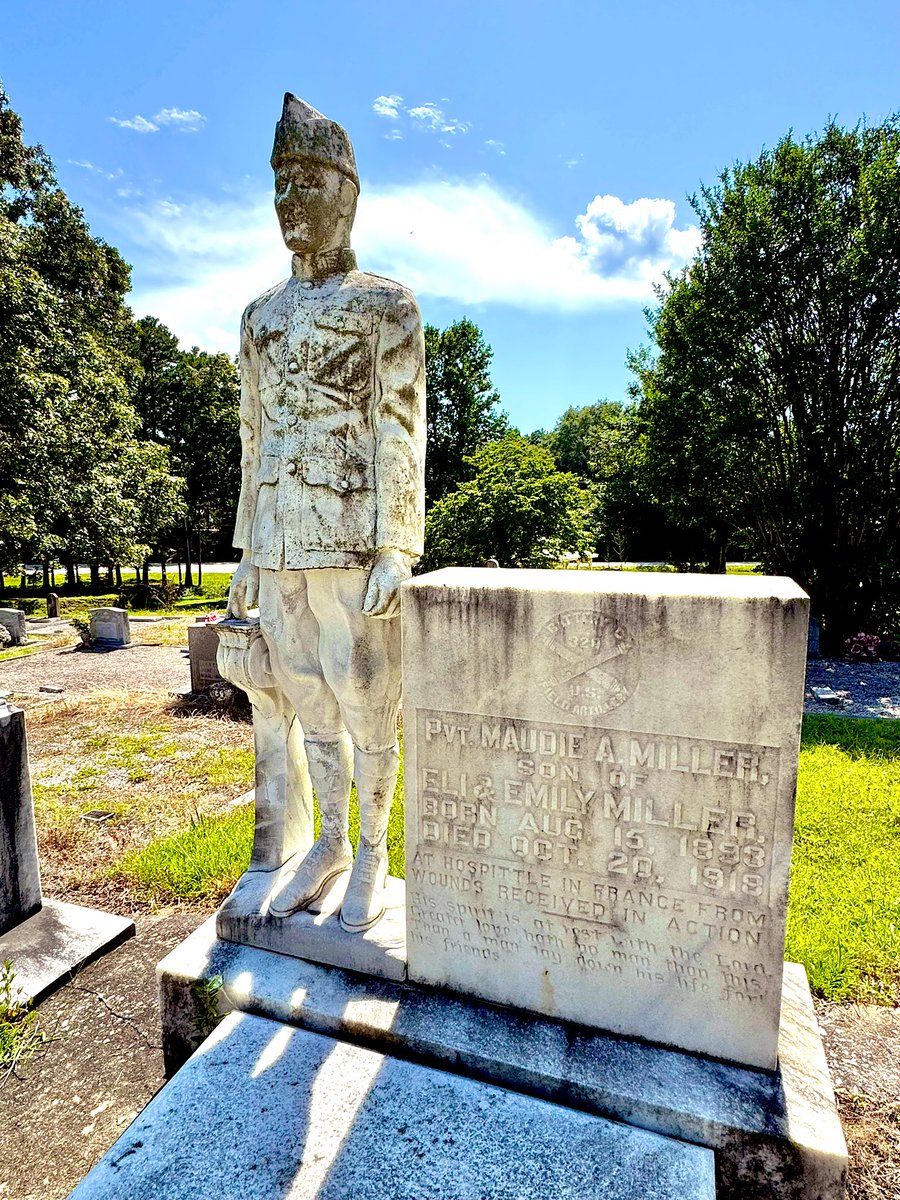
Pvt. Maudie A. Miller was assigned to Battery C, 320th Field Artillery of the U.S. Army during WW I.
He died from his wounds in a French hospital on Oct. 20, 1918.
Nearly 3 years later, he was laid to rest at Bethlehem Baptist Church Cemetery in his hometown of Lula, Ga.
Ernie C. Reese was the son of the Rev. Ambrose Reese and Celeste Reese.
He died on March 7, 1872 at age 17 after a long illness. His grave marker features a harp hanging from a ribbon with the words "Gifted in Music" under it.
Carrollton City Cemetery, Carroll County, Ga.
My last minute post for Women’s History Month. Highlighting some photographers in Athens, Milledgeville, and Savannah, Georgia.
https://t.co/yodnXtZzbO
Martha Gellhorn Gets Her Story on D-Day - she said she was there to interview nurses for Collier’s. That seemingly inane assignment did the trick, she walked onto a hospital ship at anchor, locked herself in a bathroom, ship left - she had herself a story. https://t.co/zH5g16V5Wp
#mausomonday Thomas Glenn McGarity, his son (Jr.)., and grandson (III) operated Harmony Blue Granite Co. for three generations.
All three are interred in the mausoleum at Elmhurst Cemetery in Elberton, Ga.
Elberton produces about two-thirds of all the headstones in the U.S.