Right now, in a browser tab, tiny digital brains are being born, eating, mating, and dying, all while an algorithm hunts for the few smart enough to survive.
This is Qubic’s actual AI research.
Here’s where the science team is taking it next. 🧵
The majority of AI projects show you the winners, while quietly burying the failures.
Qubic just published all of them.
34 runs. 5,936 architectures. 68,664 files.
The biggest accomplishments alongside every dead end, uploaded raw to Hugging Face.
It’s called the Neuraxon Game of Life: a world where tiny spiking brains live, eat, mate, and explore, while a search hunts for the one design that survives best.
Every brain was scored on a single fitness number plus ten biology-based metrics.
The champion (trial 191, fitness 9.40 on 24 neurons) sits alongside architectures that scored as low as 3.77 and died out.
Even if you never touch crypto, this is why open data matters:
• A researcher can test the method.
• A skeptic can audit the claim.
• A builder can take the best brain and push it further.
The data is labeled honestly: raw research output, rough edges and all, under an open license.
An actual lab notebook.
What would you build with 5,936 evolving brains?
Qubic does not outsource compute. It outsources computation.
One letter of difference. It changes everything, and it is the most misunderstood part of what launches July 29.
No, Qubic is not renting out processing power.
No, miners will not be running your LLM.
Renting compute is:
“Here is a pile of processing power. Do whatever you want with it.”
That is not this.
Outsourced Computation is narrow by design.
A smart contract decides on one authorized action.
“Move these funds.”
“Trigger this on Ethereum.”
One contract. One verified intent.
Nothing more.
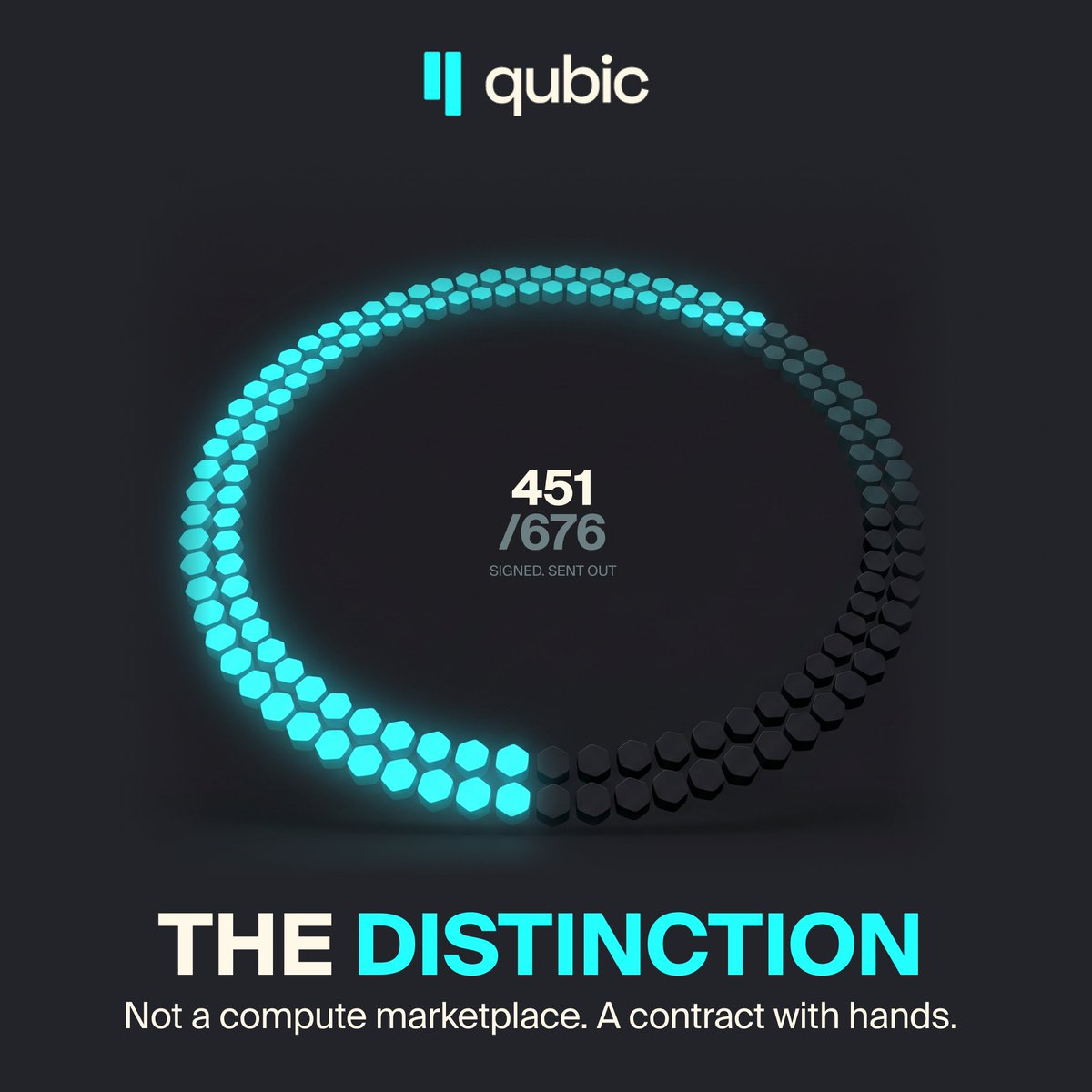
And nothing leaves the chain until 451 of the 676 Computors independently sign it.
The receiving system checks those signatures and knows the network actually approved the action.
Not one server.
Not a multisig of insiders.
Two-thirds of the network, every single time.
It is not a compute marketplace.
It is a smart contract reaching out with one instruction the whole network agreed to.
For years, a Qubic smart contract could think but it could not touch.
It could run any logic you gave it. But everything stayed trapped inside the chain.
It could not move a coin on another network.
It could not tell an outside system to do anything.
That changes in about 8 weeks.
Final piece of a three-part system. 🧵
Doge Mining Revenue Report | Epoch 215
Mining Sample: qMine ASIC Farm
Revenue per GH/s per day:
Mining DOGE + LTC via Qubic
→ $0.632 / GH/s
Mining LTC + DOGE on traditional pools
→ $0.402 / GH/s
That's +$0.230/day per GH/s.
57% more revenue on the same hardware.
Qubic smart contracts are about to be upgraded.
Our latest Tech on Deck AMA broke down Outsourced Computation: the system that lets smart contracts send authorized instructions off-chain and act on Bitcoin, Ethereum, or any external system.
451 of 676 computors must sign before anything leaves the chain.
Testnet mock: June 17
Mainnet mock: July 1
Go live: July 29
SpaceX filed to go public last month, and the paperwork is a useful tell about where the market is heading.
18,712 Bitcoin sitting on the balance sheet. A payments business growing inside X. A serious push into AI compute. Three bets on the same convergence the whole industry keeps talking about - crypto, AI, and infrastructure - now laid out in black and white for public investors to price.
But look at how it is built. Bitcoin treasury in one box. AI compute in another. Payments in a third. Three separate businesses stapled together under one roof, each to run on its own.
Qubic was designed the other way around. The mining that secures the network is the same computation that trains AI. There is no separation between a crypto operation and an AI operation, because Useful Proof of Work is a single mechanism that produces both at once.
The largest companies in the world are now spending billions to bolt these pieces together. Useful proof of work had them fused from day one.
Weekend project idea.
If you have ever wanted to actually mine Qubic instead of just reading about it, the Qubic Mining Academy just got a refresh, and it now walks you through pointing an ASIC miner at a Qubic pool for Dogecoin.
It is free and written in plain language. What the hardware is doing, how the pool works, where the rewards come from, and the settings that keep you from wasting power. No prior experience assumed.
The reason it is worth your Sunday: mining on Qubic is not busywork.
The same machine earning you rewards is doing real computation for the network.
You are not burning electricity to prove a point. You are putting it to use.
The Quorum has spoken.
Qubic's second halving is approved and locked in for Epoch 227.
Weekly emissions drop from 450B to 225B $QUBIC. The burn rate jumps to 77.5% of all weekly emissions. The first halving was EP175.
EP227 keeps emissions on a controlled long-term schedule and extends the runway for the entire ecosystem.
Energy was never meant to be wasted.
Qubic turns proof-of-work into the work itself: computation that trains AI with purpose.
No staking. No idle burn. Just useful work.
This is not mining as you know it. It's Qubic.
Watch.
Every blockchain has to answer one question early: where do new coins come from, and how fast.
On Qubic, new QUs are released every week. Roughly a trillion of them.
A halving is the network’s way of deciding to slow that tap down.
There is a live vote on the next halving, closing this week.
Here is what it actually means, in plain terms. 🧵
In 1904, psychologist Charles Spearman found that children who scored well in one subject scored well in almost everything.
He called the underlying factor “g”, general intelligence.
120 years later, g remains one of the most replicated findings in behavioral science.
And yet, when researchers run the same psychometric analyses on large language models… the g factor structure doesn’t show up.
LLM performance across domains doesn’t correlate the way human cognition does.
It tracks training data density, not genuine cognitive generality.
So what would it take to actually evolve g in an artificial system?
That’s the question behind Neuraxon’s latest experiment.
Artificial creatures growing their own modular brains, selected not for mastering any single task, but for the shared cognitive thread across many.
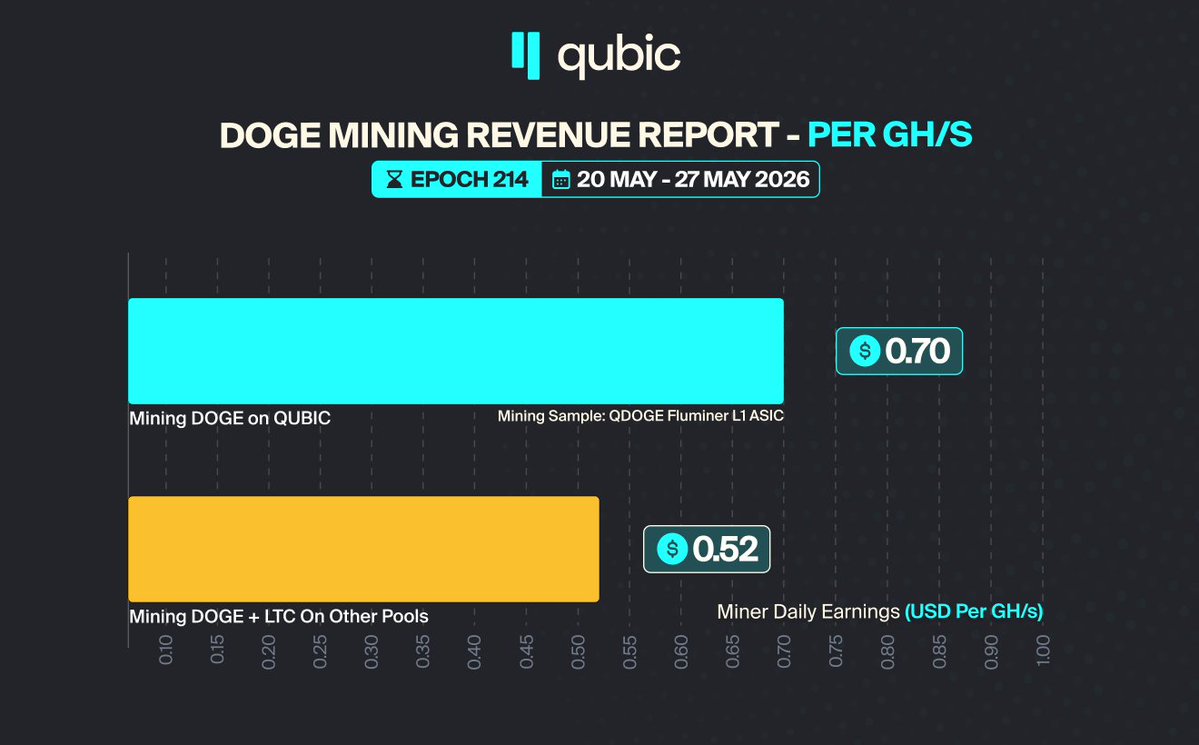
Doge Mining Revenue Report | Epoch 214
Mining Sample: QDOGE's Fluminer L1 (5.7 GH/s)
Revenue per GH/s per day:
Mining DOGE via Qubic
→ $0.70 / GH/s
Mining LTC + DOGE on traditional pools
→ $0.52 / GH/s
That's +$0.18/day per GH/s. 35% more revenue on the same hardware.
Note: These are revenue figures. Actual profitability depends on your own operating costs, including electricity.
Last week the Qubic science team let you watch artificial creatures evolve in your browser. That version reset every time you loaded it.
This one does not.
NeuraxonLive is a single world that runs around the clock and keeps running. The creatures in it forage, mate, sing, and die on their own.
None of it is scripted. When one dies it stays dead, and there is a permanent ranking of every creature that has ever lived in the world.
Each creature carries a brain built on the general-intelligence design from last week's release. So you are not watching a replay. You are watching selection actually shape these things in real time, and if you zoom in, you can hear them.
You can drop your own creature in. The first season is live now, capped at 500 creatures with 100 custom slots. Whether your line survives or dies out is decided by the world, not by you.
It is fully open source, so you can also run your own world on your own machine.
The May 28 All-Hands recap just dropped.
Here's what you need to know:
→ 3rd research paper accepted at AGI-26 (San Francisco, July)
→ Network throughput quadrupled, 247M transactions in one epoch
→ Outsourced computing heading to mainnet in July
→ Emission halving proposal is live
→ 58 active BD leads, Token Terminal listing locked in
For most of its life, QUBIC had one quiet limitation almost nobody talked about.
It was stuck inside Qubic.
The network is fast and feeless, but its tokens could not easily reach the rest of crypto. The wallets, the exchanges, the lending apps where most on-chain money actually lives.
All of that runs on Ethereum, and Qubic was sitting in its own room with the door shut.
QBridge opened the door.
It lets you move QUBIC to Ethereum and back.
Lock your QUBIC on one side, get a matching token called wQUBIC on the other, always one-for-one, fully backed.
Send it back, and your original QUBIC is unlocked.
No middleman holding your funds, and no single operator holding the keys.
The plain version: an asset that used to be trapped in one place can now travel to meet the rest of the market.
For a network that spent four years proving it works, this is the part where it stops being an island.