Justice Beyond Courts: Empowering fair, neutral, cost-effective conflict resolution where trust heals, rights are upheld, and harmony builds a stronger nation.
The true cost of a dispute is often measured in leadership attention, not legal fees.
Every hour spent managing prolonged conflict is an hour lost from growth, innovation, and strategy.
#Arbitration#ADR#Leadership#BusinessStrategy#GAMC
Arbitration is more than dispute resolution—it is governance infrastructure.
A strong arbitration framework allocates authority, reduces uncertainty, improves predictability, and protects long-term transactions.
Good governance plans for disagreement.
#Arbitration#ADR
Mediation looks beyond the dispute itself.
It focuses not only on who is right, but on what must continue afterward.
Effective mediation helps preserve: • relationships • trust • cooperation • commercial continuity
#Mediation#ADR
Many disputes escalate because emotions take control.
Mediation creates a safe space to communicate, reduce hostility, and find practical solutions. Calm conversations often lead to stronger resolutions.
#Mediation#ADR#ConflictResolution#ODR#GAMC
Many conflicts escalate not because parties disagree—but because communication stops.
Silence often creates:
• assumptions
• mistrust
• defensive behavior
• rigid positions
Mediation restores structured dialogue before conflict becomes irreversible.
#Mediation#GAMC
Commercial relationships rarely fail because conflict exists.
They fail because the dispute process becomes destructive.
Hostile procedures often damage:
• trust
• communication
• future collaboration
• commercial confidence
#ADR#Arbitration#Mediation#GAMC
Most organizations manage financial and operational risk carefully.
But procedural risk is often ignored until disputes arise.
Weak ADR structures can create:
• jurisdictional confusion
• enforcement complications
• procedural delays
• inconsistent outcomes
#ADR
Many disputes are shaped not only by legal disagreement, but by unequal bargaining power and procedural pressure.
Strong ADR systems restore balance through:
• neutral facilitation
• procedural fairness
• structured participation
#ADR#Arbitration#DisputeResolution#GAMC
Every dispute is also a data point.
Recurring conflicts often reveal:
• contractual weaknesses
• operational inefficiencies
• unmanaged business risks
Analysis prevents repetition.
#ADR#Arbitration#Mediation#ODR#DisputeResolution#GAMC
Many disputes are not caused by bad intent.
They are caused by different assumptions.
When expectations remain unclear:
• interpretation expands
• accountability weakens
• disputes become expensive
#ADR#Arbitration#Mediation#ODR#DisputeResolution#Contract
Silence doesn’t solve disputes—
it strengthens them.
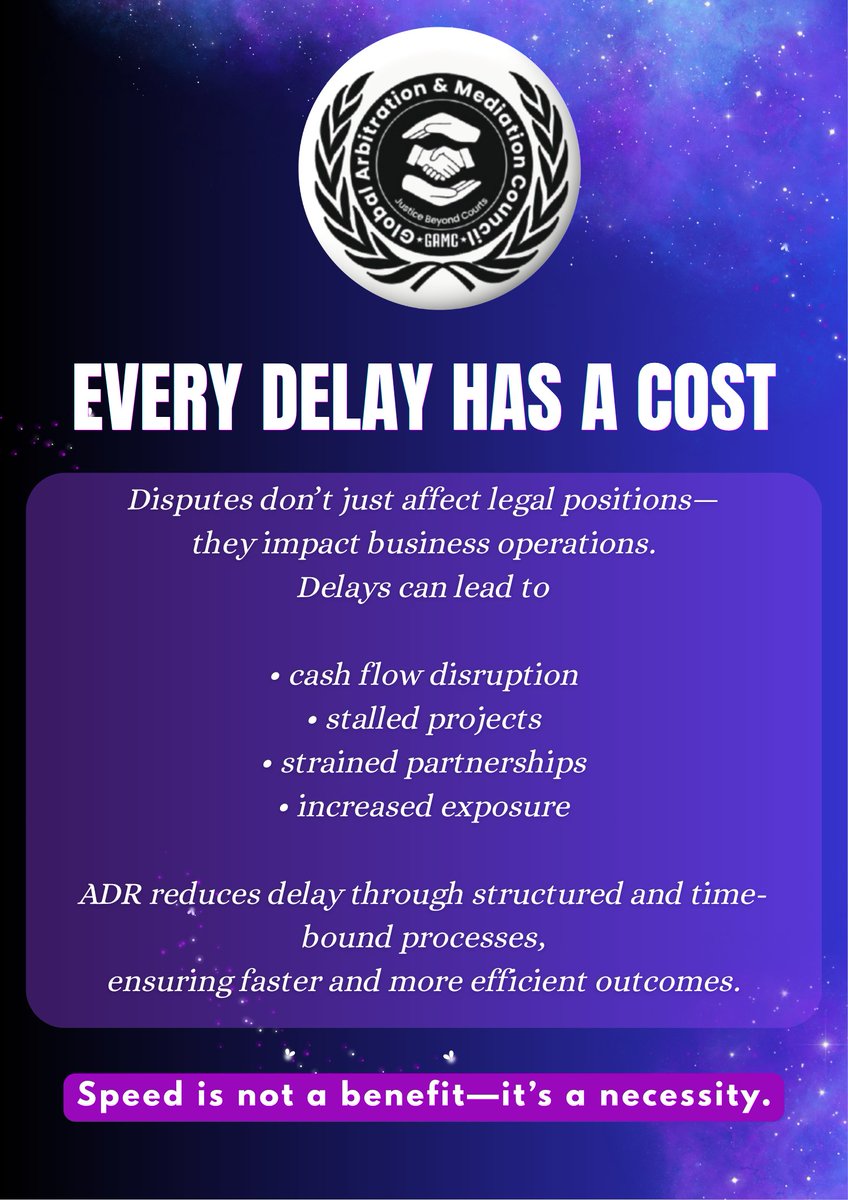
Delay leads to:
✔ assumptions
✔ rigid positions
✔ lost flexibility
ADR works best when action starts early.
Because once conflict escalates,
options shrink.
Address early. Stay in control.
#ADR#Mediation#Arbitration