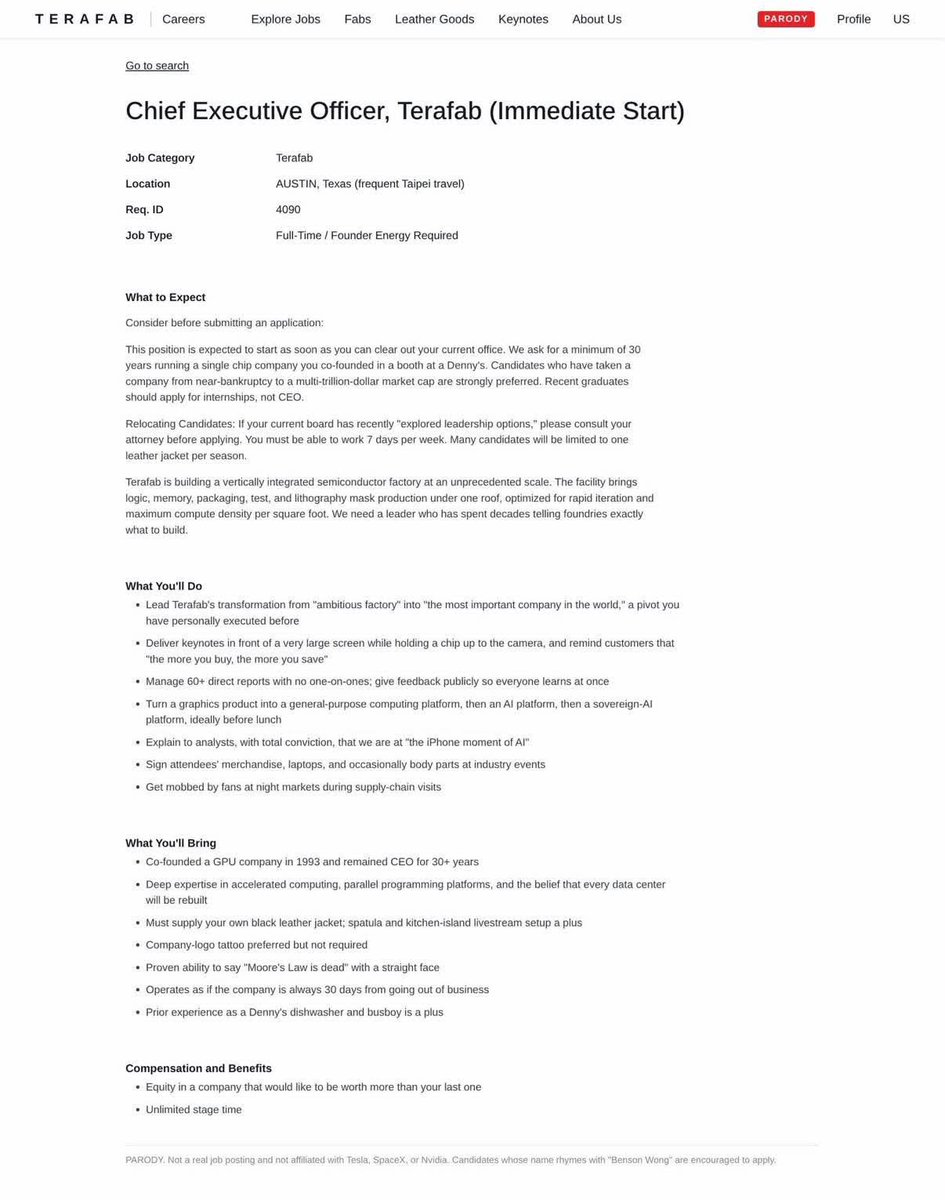
Almost 16 years ago @JensenHuang looked me right in the eyes, paused, super intense, and said "I would do anything for this company."
I'd started my career at @nvidia working directly with him, managing the demos at all of his keynotes, customer meetings, investor events and tradeshows like NVISION and GTC.
I was on a trip with Jensen flying from San Jose to Phoenix and NVIDIA's travel policy was that all employees flew coach... which I was fine with but I assumed the founder of the company would be flying in biz.
I board the plane in group six and as I'm boarding I start to get worried because I don't see Jensen in any of the first class seats on this flight... I wonder if he missed it, if we are still going etc.. and as I walk to my seat in the back of the plane, somewhere around row 14 I see Jensen in a middle seat in coach, working on his blackberry.
We were going to Phoenix for a small Consumer Electronics Association meeting (goal was to present here so that Jensen could get an invite from CEA to keynote CES the next year.. it ended up being two years later). It was super clear that the sparsely populated room had no idea who Jensen was either and the response to the presentation was tepid at best..
Afterwards at the airport on the way back to San Jose he ordered me my first ever martini (which was the strongest drink I've ever had in my life up to that point) and I mustered up the courage to asked him why we went all this way to demo some tech to a few random CEA members .... and that's when he looked at me and said that he'd do anything for this company.
I was blown away. This is the CEO, flying in coach (on the flight back he had an aisle seat) pitching a room of people that barely cared, and he's dead serious.. he really would do anything and sacrifice anything to make NVIDIA successful.
I can't really imagine NVIDIA without him. But the people who've lasted there that long are winners and the culture is literally one of a kind.. they'll get through this.
I hope him stepping down is only temporary.
I have so many more stories and lessons Jensen taught me and that I witnessed being around him. Will share more later.. some of the best are around GTC / NVISION
We Must Pace the Frontier: I’ve written a new essay on why the AI industry should slow down, with a three-part plan for doing so.
Anthropic is unilaterally committing to the first of these steps. We’ll provide third-party evaluators with permanent, employee-level access to our systems, so that they can verify adherence to our safety measures, report on incidents, and assess models’ alignment during training.
You can read the full post here: https://t.co/OGyPb7yaYt
The entire AI-Infra stack mapped out.
These are the best positioned businesses in every sector:
Data centers
$CRWV
$IREN
$ORCL
Top pick: $NBIS
Connectivity
$AAOI
$ALAB
$LITE
Top pick: $CRDO
Energy
$OKLO
$FLNC
$EOSE
Top pick: $BE
Supply Bottlenecks
$AXTI
$IQE
$COHR
Top pick: $WOLF
Thermal Management
$NVT
$MOD
$PH
Top pick: $VRT
Save this for later use.
Introducing Claude Design by Anthropic Labs: make prototypes, slides, and one-pagers by talking to Claude.
Powered by Claude Opus 4.7, our most capable vision model. Available in research preview on the Pro, Max, Team, and Enterprise plans, rolling out throughout the day.
A MIT student figured out how to compress an entire semester of lecture content into one 90-minute study session.
He calls it "context stacking," and it's the most unfair thing I've seen done with NotebookLM.
I asked him to walk me through it. He did. I haven't studied the same way since.
Here's exactly what he does.
Two days before each lecture, he uploads everything into NotebookLM. The assigned readings, the previous week's slides, 3 or 4 related papers he finds himself, and any problem sets that are still open.
Most students wait for the lecture to explain the material. He walks in having already built a mental model of it.
That's step one. But it's not the move that makes it unfair.
The first prompt he runs across all of it:
"What are the 5 core concepts this week's content is built on, and how do they connect to what I studied last week?"
Not summarize. Not define. Connect.
NotebookLM pulls threads across everything he uploaded simultaneously. It surfaces relationships between ideas that would take a normal student weeks of review to notice. He gets that map before the lecture even starts.
Then he runs the prompt that does most of the work.
"What would I need to genuinely understand about this material to be able to teach it to someone with zero background in this subject?"
That question is doing something most students never force themselves to do. It exposes exactly where his understanding is solid and exactly where it's hollow. The gaps show up immediately, and he spends the rest of the 90 minutes filling only those gaps.
Not reviewing what he already knows. Only fixing what he doesn't.
The final prompt is the one that separates context stacking from every other study method I've heard of.
"What question could a professor ask about this material that would expose a student who understood the surface but missed the underlying logic?"
He's not studying for the exam he expects. He's studying for the exam designed to catch people who only think they understood it.
By the time he sits in the lecture hall, the professor is not teaching him anything new. The professor is confirming what he already mapped, filling in a few details, and occasionally surprising him with something he didn't anticipate.
That surprise is the only thing he writes down.
Most students leave a lecture hoping the material will eventually click.
He walks in with it already clicked, and uses the lecture to find out what he missed.
That's not a study hack. That's a completely different relationship with learning.