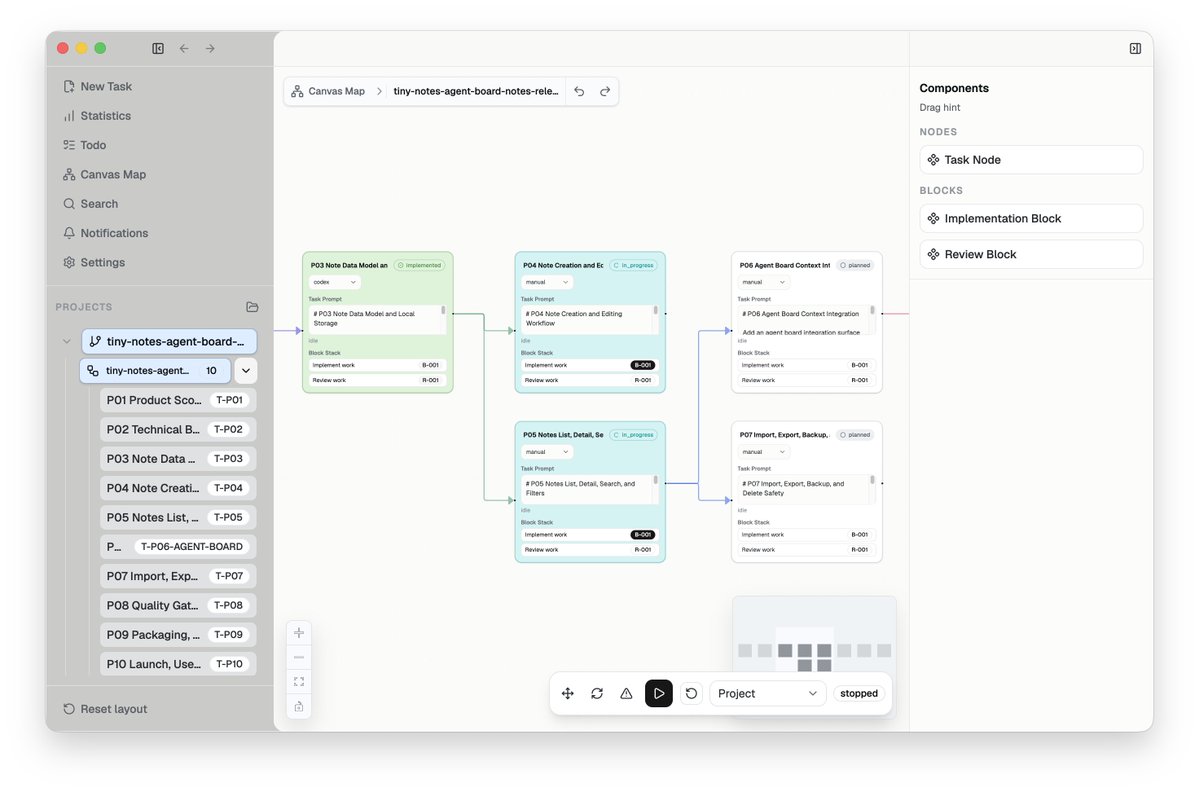
@sydneyrunkle a stateful graph for coordinating agents' work, with dependencies, parallel execution, validation, feedback, and progress saved along the way
https://t.co/q4VJvayeOt
@IntuitMachine Pretty close to PlanWeave. Every task sets its own anchor up front. Reviewer checks the result against it. Coordinator kills the graph on failure.
https://t.co/q4VJvayeOt
@sydneyrunkle A static graph sets the direction before execution. When an agent starts a specific task, it generates a smaller dynamic graph to guide the work. PlanWeave keeps the outer graph persistent while agents create local graphs inside it as they work.
https://t.co/q4VJvayeOt
@Saboo_Shubham_ That's pretty much where planweave is headed. The graph already drives execution and review. The next step is letting it restructure itself on the fly.
https://t.co/q4VJvayeOt
@pashmerepat Agree with linus. AI is here to stay. When ai falls short at a task, we dig in and make it better. Each limitation is a challenge and an opportunity for engineers. No single limitation defines what ai can do.
I think the key is to review the atomic plan before execution, and make sure you understand each step along with its expected outcome. This way you keep control from the high-level design all the way down to individual tasks. Code review can then be reserved for the cases where the plan (or test evidence) actually shows a specific problem.
It is my belief that many devs right now are not maximizing what they can do with automatic programming because they still look at the code. Doing it makes you the bottleneck. Your time is better invested in new ideas, QA, design, and asking yourself what is your goal.
I miss Steve Jobs again. He understood that great products shouldn't create unnecessary choices. Now codex has a vague new Work mode. What is it actually for? It feels like openai copied another product's structure without asking whether codex was simply better without it.
This is basically externalized CoT for agent execution.
strong models plan / coordinate / review,
cheaper models execute.
The key is moving the reasoning structure out of chat context and into durable execution state:
task graph, prompt blocks, review gates, feedback loops, and artifacts.
That’s what I’m exploring with PlanWeave:
https://t.co/0FbHmVhIS9
@phuctm97 The problem with plan mode is that it stays linear. Real execution is a DAG: some tasks unblock others, some run in parallel, some loop back after review. A useful plan should become executable state.
The basic idea is file-backed plan state: chat generates a plan, it becomes task graph + state files, each node carries prompt/dependencies/acceptance criteria/review gates/logs/status, and the UI reads/writes that state as an editable map. The graph becomes the source of truth for execution.
This mockup is based on my OSS experiment planweave:
https://t.co/0FbHmVhIS9
@thsottiaux Feature request: Plan Mode as durable execution state.
Long tasks outgrow chat-text plans: progress, blockers, reviews, logs, and resume state drift. Let codex turn a plan into editable task graph/files with prompts, criteria, review gates, and resume.
Mockup below.
Exactly. I've been disseminating a similar message for years.
The concentration of power in AI and the desire for control is by far the biggest danger of AI. It could lead to a few private companies and/or countries being in control of access to information, access to knowledge, and access to the tools of economic expansion.
It's a kind of medieval obscurantism akin to the Ottoman empire banning the use of the printing press for 200 years, in part to keep control of the dogma, but also to protect the corporation of the calligraphers and scribes.
Relevant historical bits about the Internet:
1. It took a deliberate decision by Al Gore and Bill Clinton to open up access of what was then ARPAnet to commercial entities and to the public, against the desires of the entrenched telecom industry. During a public roundtable about the "information superhighway" in 1993, the CEO of AT&T told Gore and Clinton "leave it to us". Gore said no.
2. In the late 1980s, setting up an Internet presence required buying proprietary hardware with proprietary OS and software stack from Sun Microsystems, HP, IBM, or Dell. By the 2000s, all of this was wiped out by commodity hardware, Linux, Apache, and an entirely free/open software stack. This migration to open platforms was the result of market forces.
Infrastructure wants to be open.
Foundation models are becoming an infrastructure and will inevitably become commoditized.
Long term, the money is in the application layer, which is what I, Arthur Mensch, Alex Karp, and others have been saying.
I want to launch a public Apollo Program for AI agents.
One OpenAI-powered agent.
One empty repo.
One mission:
Can it build, ship, market, and earn its first real customer revenue?
Every prompt, plan node, commit, failure, recovery, and deployment will be public.
Not a coding demo.
An auditable experiment to test whether AI agents can cross from task completion to real economic value.
If it works, it becomes the first public agent-to-first-dollar moment.
If it fails, we learn where the boundary is.
Would love your thoughts, @sama .