"I don't know what I may appear to the world; but to myself I seem to have been only like a boy, playing on the seashore, and diverting myself, in now& then finding a smoother pebble or a prettier shell than ordinary, while the great ocean of truth lay all undiscovered before me"
@RShivshankar He is a judge in MACT and he allows this!
He has a luxury car. Connect the points.
The absolute power corrupts absolutely. That is what happens in the case of judges and politicians.
@CoderYouDie Common man will give 5 star to the employee who does his illegal work. The one who adheres to the rules will be painted as bad.
That is what happens even now.
Sir please at least you should not promoting this BS of copy paste...
This kind of crap is available on Alibaba since last 5 years in 1-2K USD.
Galgotia university also changed the world by their innovative robot in India AI submit.
This is just a metal frame with 4 electric motors in sync...
The frame of this great innovation is available on Alibaba,motors with fan also available just need to assembe qith sime screws for this invention...
Almost 50 companies are making this im China.. Order from anywhere... Amd change the world
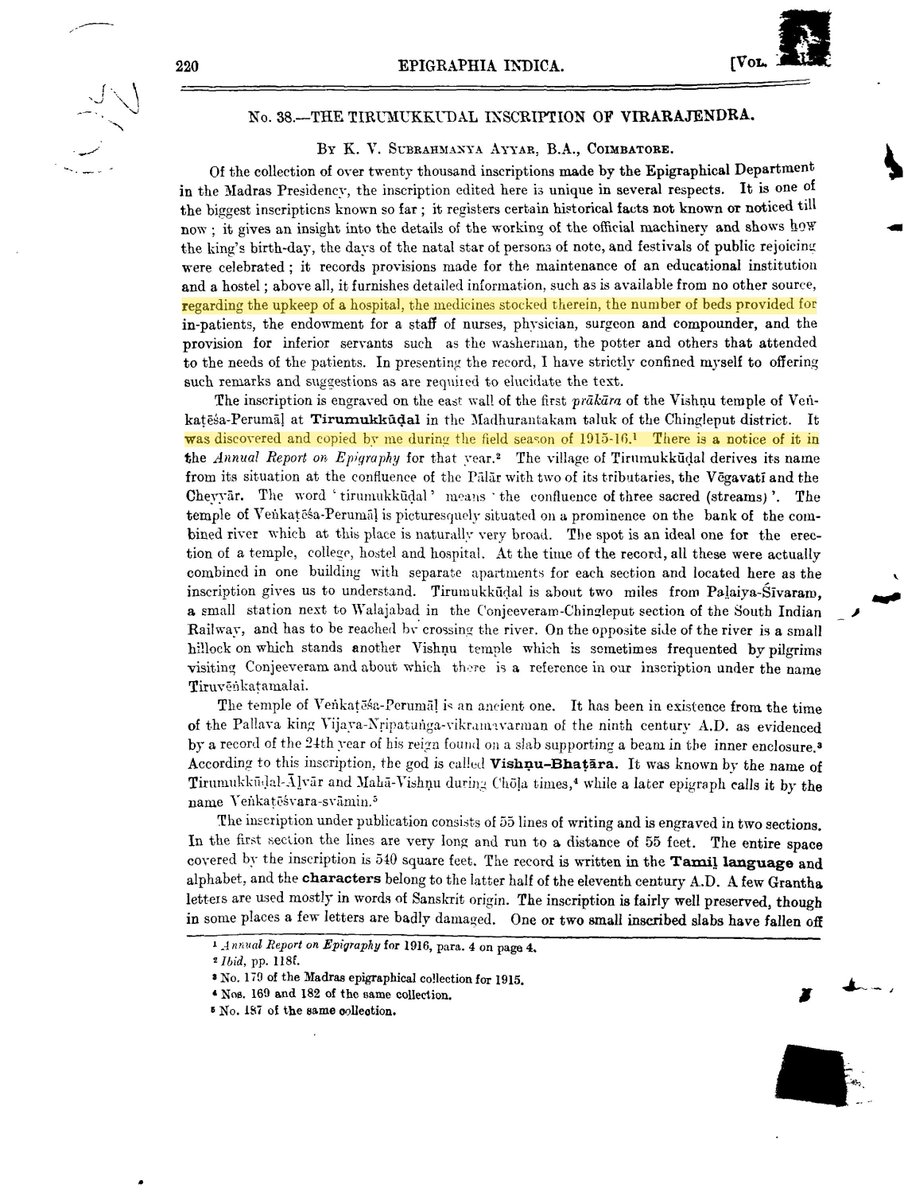
Look at the wall in the attached photo. Among these Tamil inscriptions is the budget for a hospital that existed in Chola India nearly a 1,000 years ago.
We know how many patients it could take. We know the doctor's name. We even know what was set aside for lighting the hospital at night.
This is the Venkatesa Perumal temple at Tirumukkudal, near Kanchipuram. In the 11th century, the temple shared its premises with a Vedic college, a hostel and a hospital called Virasolan.
K. V. Subrahmanya Ayyar, an Indian epigraphist, discovered and copied the inscription during his 1915-16 field season. The writing covered about 540 square feet. In one section, the lines ran for 55 feet.
The hospital had 15 beds. Its physician, Kodandaraman Asvatthama-Bhattan of Alappakkam, prescribed medicines for the in-patients, the college's teachers and students, and people attached to the temple institutions. Someone who performed surgical operations was paid separately.
There were 2 people to collect medicinal herbs. They also supplied firewood and helped prepare medicines.
2 nurses looked after the patients and gave them medicines. A barber was paid too. Rice for the 15 in-patients had its own allocation.
The pharmacy had an annual stock list. Oils and medicated ghees were measured out. 4 preparations were listed at 2,000 units each.
40 kasu, a unit of money, was provided for the medicines and preparation requirements. The account even mentions ghee to be kept underground for an aged ghee preparation.
I find this much more interesting than a general claim that our ancestors practised medicine. Here we can read the arrangements for a particular hospital, with a named physician, staff duties and quantities to be supplied.
And somebody had included the night lamp in that budget. Oil was to be bought for it to burn through the night, for a year counted as 360 days.
Source: K. V. Subrahmanya Ayyar, "The Tirumukkudal Inscription of Virarajendra", Epigraphia Indica, Vol. XXI, No. 38, pp. 220, 223-225, 249-250.
Image Source: R. Muthusamy, Know Your Heritage, Tirumukkudal field-trip photographs, 2014; Epigraphia Indica, Vol. XXI, pp. 249-250 (yellow highlights added).
Photo 1: The actual inscribed wall and temple at Tirumukkudal. Photos: R. Muthusamy / Know Your Heritage.
Photo 2: Original report, with the evidence highlighted: hospital staffing and patients; medicine inventory and night lamp; Ayyar's own account of copying the inscription in 1915-16.
Photo 3: Hospital staffing and care: the inscription provides for 15 in-patients, a physician, a surgical practitioner, herb collectors and two nurses who administered medicines. Epigraphia Indica, Vol. XXI, p. 249.
Photo 4: The hospital's annual pharmacy inventory: measured oils and medicated ghees, four preparations stocked at 2,000 units each, and oil for a lamp to burn through the night. Epigraphia Indica, Vol. XXI, p. 250.
Perfect for today's occasion! 83 yrs old #throwbackmemories from Lt R Madhavan ji. At 101, he remembers every word of the speech given by Netaji Subhas Chandra Bose 83 yrs ago 🙏🏻
@PrasunNagar Map is not correct. Ramanathapuram district of Tamil Nadu is on the eastern coast of India. Muziris is on the western coast (mid-Kerala). So Tyndis is in North Kerala. Ponnani is the main contender. Others are Kadalundi and Panthalayini Kollam.
Before @elonmusk took over, @X was anti-Indian. But there was no such planned propaganda. There was hope when Musk took over. But we see that X forcefully promoted the planned anti-India propaganda. It has been an official propaganda. We never expected this from @elonmusk
It has taken only 2-3 years by Pakistanis to run a highly successful campaign against India in X, projecting Indians as dirty, villainous and criminals. Some White accounts were hired in the process. Earlier, Indians were viewed as highly sophisticated law abiding people.
It has taken only 2-3 years by Pakistanis to run a highly successful campaign against India in X, projecting Indians as dirty, villainous and criminals. Some White accounts were hired in the process. Earlier, Indians were viewed as highly sophisticated law abiding people.
So many accounts are working overtime in X to create regional conflicts. Many are falling in their trap. It is not random personal accounts. It is part of a plan. Who is funding them? Govt should watch and track the persons behind.
So many accounts are working overtime in X to create regional conflicts. Many are falling in their trap. It is not random personal accounts. It is part of a plan. Who is funding them? Govt should watch and track the persons behind.
@_asktrisha Drainage skin smellu👨🏿🦍
Forget tamils, Kerala is useless even for smellus that's why you migrate in crores to TN as refugees and worship fair skinned tamils...
Sidekick smellus are born to be parasites of tamils.
India is chasing a target of over 225 on a pitch and boundary size where even a score of 125 is defendable.
Even if they are given 30 overs here, this target won't be chased.
Scoring more than 120–125 runs is extremely difficult for India
So if india lost this match by more than 100 runs , dont be surprise and don't criticise Indian batters because this is too much runs to chase here
Yesterday, I was reading about Alauddin Khilji. According to the account I came across, he suffered a painful death. He died from fluid accumulation in his abdomen, and for the last two years of his life, he had reportedly suffered from leprosy, with parts of his body beginning to rot.
Of course, such diseases can affect even the most decent and civilized people. But when something like this happens to a tyrant, a barbarian, or a cruel ruler, it strengthens the belief that people must face the consequences of their misdeeds in this very life. This is how it should be. This is how it ought to be.
And Khilji was not the only one. The deaths of almost every tyrannical ruler of the medieval period were deeply painful, according to this view of history. Among the Mughals, it almost became a tradition for emperors to spend their final years watching their own sons fight and kill one another for the throne.
Akbar, Jahangir, Shah Jahan, Aurangzeb — all of them, in their old age, suffered the agony of witnessing conflicts involving their own children.
Akbar was already devastated by the deaths of his two sons, Murad and Daniyal, amid the turmoil of the royal family. He pleaded with Jahangir, but Jahangir continued to have people close to Akbar killed. Many of Akbar's associates, including Abul Fazl, were killed, while the aging emperor was left helpless and distressed. He eventually died, burdened by these tragedies. Jahangir, too, faced similar troubles.
The world remembers Shah Jahan as a great lover because of the Taj Mahal, but he was no less ruthless than other Mughal rulers. When it came to the treatment of Hindus, he was even more hard-line than many of his predecessors.
His end was even more tragic. The severed head of his beloved son, Dara Shikoh, was reportedly displayed on the tip of a dagger and paraded through Agra. Eventually, the head was presented on a platter before Shah Jahan, who was being held prisoner.
And all of this was done by his own son.
Having already witnessed the deaths of his other sons at the hands of their brother, one can only imagine the agony Shah Jahan must have endured in captivity as he approached the end of his life.
And this did not happen to these rulers alone. The final years of many tyrannical rulers were marked by suffering, betrayal, and tragedy. Most importantly, none of them could peacefully pass power on to the next generation. They were all eventually pushed out of power.
I believe that the deaths of emperors and kings should be taught in history books as well. People should know that, sooner or later, everyone must answer for their actions in this very life.
For building a civilized society, it is essential that people remember the tragic endings of those who ruled with cruelty and barbarism.
@rishibagree Is India a nation?!!
A man has led a violent protest forcing the capital to standstill and yet the all powerful govt doesn't know whether he is a citizen of the country or not! How inefficient this govt is!