Please excuse the pivot, but we're leveling-up. We're offering full-scale digital growth intelligence for small businesses and startups, helping them make decisions that drive their growth. Wish us luck! 🤞
Ahrefs did the SEO world a favor with a deep dive into ChatGPT citations. It's a long article, so here are my takeaways as a digital product manager overseeing user acquisition and technical SEO:
1. 88% of citations come from pages with high conventional search rankings. No huge surprise here. If you rank well on Google, you're going to rank well on the AI platforms.
2. To form a response, ChatGPT pulls and average of ~33 URLs from the database. Think of this as a conventional Google user reviewing 33 blue links on a SERP before they decide what they want to click on and read.
3. Of those 33 URLs, about 11 of them average out to be from Reddit. Despite the high Reddit volume, ChatGPT is less likely to cite from the pool of Reddit URLs. Those only have a 1.93% citation rate, showing that the LLM likes to use Reddit as a source of information, but prefers to provide users with citations from other sources.
4. ChatGPT stores "snippet" summaries of pages, but doesn't use them when citing a page. They'll actually open and crawl a page for that, likely in search of more specific information and added context.
5. Not having a "snippet" in ChatGPT's database (mostly) doesn't affect your likelihood of being cited. Only about 2.5% of cited sources already had a snippet/summary created and stored in ChatGPT's system.
6. As Ahrefs says it, "Titles need to be semantically relevant to fan-out queries." This is the big one. Because ChatGPT isn't referencing their stored snippet when putting together citations for its response to your prompts, the title and URL of your page is doing all of the work. If the platform feels the title and URL of another page is more relevant to its interpretation of the prompt, ChatGPT is going to cite the other page. Ahrefs found titles of cited pages had a moderate-to-strong cosine similarity to the fanout query (0.65).
Note: A fanout query is ChatGPT's interpretation of the user's prompt. For example, a user may ask, "can a dog have blue eyes like a husky" and ChatGPT may internally change it to "Can dogs, like huskies, have blue eyes?"
7. This is also really big. Ahrefs found that natural language URL slugs had 89.78% citation rate, versus 81.11% with less semantic value, like a code or non-natural language. This is a departure from conventional SEO, where it's been a best practice to simplify URLs. For example "/dog-eye-blue" or "/xyz123" would be cited less on ChatGPT than, "/can-dogs-have-blue-eyes"
8. The average age of a page cited by ChatGPT is getting younger. In this research, Ahrefs found average page age was ~500 days, which is down form ~960 days in July of last year. For context, a 2025 study by Ahrefs found that, if a net-new page was ultimately going to rank in the top 10 on Google, 40.82% of them would do so within the first month of being published. If we treat ChatGPT citations like ranking top-10 on a SERP, that's our comp. ChatGPT doesn't have something similar to Google's #1 spot, but it's worth noting the same Ahrefs study found the average age of the top SERP position was 5 years.
9. The one place where age mattered less in this study was when it came to newsy content. Ahrefs explains this as AI's inability to differentiate relevance for news topics based solely on the page title and URL, because it doesn't have historical data to compare it to. In those cases, it has to use a page's publish date as a determining factor in ranking, with a median age of 200 days (compared to the 500 days noted above).
https://t.co/OQfO1nNXcD
Exactly.
"If you’ve seen your clicks from Search dropping over the last couple of years, it’s not likely that you’re doing things wrong in terms of SEO. Search is heading in a different direction and AI Overviews and AI Mode are directly answering the questions to almost any informational need."
https://t.co/I6LOJYawGU
You want a long diatribe about food influencers? No? Too bad. Here's something I find fascinating about them.
The democratization of thought leadership through social media has destabilized the level of influence experts receive versus non-experts. The rise of de-influencing has only bolstered gains for people with trashy advice because the act of responding to a bad influencer only ups their relevance in the algorithm. We can look at it across any genre in a long list of controversial topics: politics, science, religion...but it's more fun if we look at it through the lens of a less-controversial topic: FOOD INFLUENCERS.
The Alton Browns, Rachael Rays, and Gordon Ramsays of the world still have their place, but they now share it with the lady who dumps ice cream and boxed cake mix onto her hibachi grill. The result? People who don't know how to cook are teaching people how to cook, feeding a death spiral of gross shit. Let's not be precious. It's gross.
If you mapped the level of social media influence someone has on a topic against the Dunning-Kruger Effect, you'd see their influence peaks at the same place their knowledge on the topic HITS THE FLOOR.
Why talk about this today? Well, a fun story from TubeFilter that in a poll of TikTok users, 97% of them had followed a recipe they'd found on the app. How many of those recipes sucked? Hard to say. But it's probably fair to say the bad food influencers burned their cake, and ate it too.
https://t.co/9QkBPJETQU
If you work in marketing, startups, or as a small business owner, let this be the single most important article you read this week. https://t.co/s0TuCIUHB7
This is because bots are often doing real-time crawls of content when generating responses for users. They're trying to get to an answer as soon as possible, so they'll definitely err on the side of lazy and miss nuances in in-depth content. https://t.co/2QaHdroRbE
We're on the same page. *Most* organizations really shouldn't be looking for any future uptick in clicks and impressions. Those days are long gone. Consider goals that mitigate drops in those or shift to other metrics. https://t.co/H1dLDqEi61
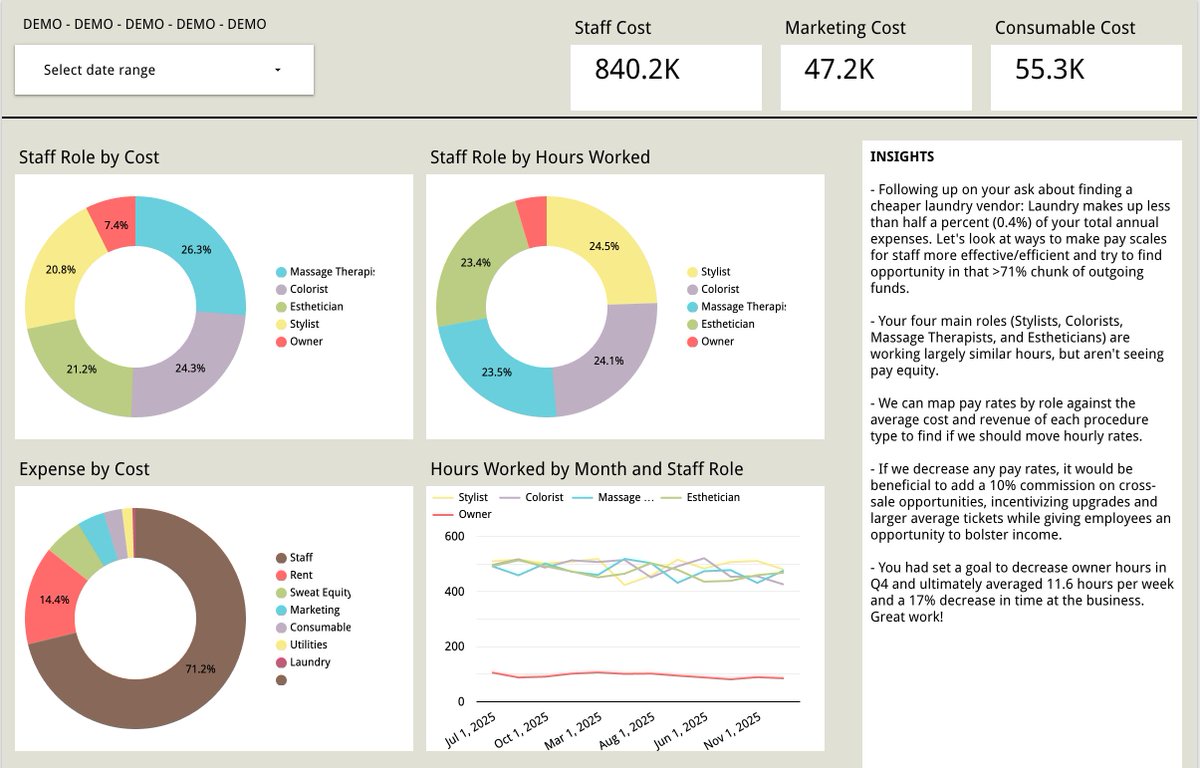
We just launched a new product demo for our Business Intelligence dashboards, this time looking at how much value Big Data approaches can deliver a small business. Forward us to a friend if you think they could benefit from some data-driven decision-making. In a few words: we deliver Big Data for Small Business. https://t.co/Wg6Se6ED3K
If you have a brick-and-mortar shop, your single greatest growth channel is Google Maps. When was the last time you spent any effort optimizing for it? https://t.co/72tQLDrn3X
For those who follow @bendoesit2 on TikTok, I've started to buy random TikTok Shop junk and review it. 100% always guaranteed to disappoint. https://t.co/FpnNQnvq6x
Netflix and YouTube trying to constantly dunk on each other has been good for creators. If only so we can see YouTube's revenue numbers when they try to humble brag about being 25% larger than Netflix. Now if y'all could share some of that $60B, that would be great. https://t.co/WseiCjKmEa
Most of these short-form video platforms are really good about testing content with near-immediacy. If your content doesn't pop off in the first day, it may grow some long-trail value but it's unlikely to unless it suddenly becomes relevant later. https://t.co/qKHHqyDI2i
As a career digital product manager and marketer, I have mixed feelings about trendjacking. If you compare social media to music, it's the equivalent of sampling a track to create something new. That can be a cool avenue of creation and result in new things, but it can also be reductive. Like DJ Khaled. https://t.co/tuxO7Twmhf