Texas State Board of Education member Julie Pickren just exposed it all.
CAIR — the terrorist-linked group Gov. Abbott has called out — sent a 2-page demand letter to rewrite Texas history with straight-up lies:
• Claim 1/3 of American slaves were Muslim, enslaved for their faith
• Remove Mayflower Compact & Columbus references
• Erase George Washington’s Thanksgiving Proclamation & Prayer
• Teach the Alamo was built to “honor Islam”
Who the hell are these terrorists to demand anything — let alone lies to rewrite American history? Pure insanity.
Hard NO. Deport them and protect our kids’ education. Texas will teach truth, not Islamist fiction. 🇺🇸
God bless Texas!
@GregAbbott_TX@Julie4TX
Je veux présenter mes excuses, au nom des Français, pour avoir enfanté la French Theory (qui a enfanté la pire des merdes idéologiques : le wokisme).
Nous avons donné au monde Descartes, Pascal, Tocqueville. Et puis, dans les ruines intellectuelles de l'après-68, nous avons donné Foucault, Derrida, Deleuze. Trois hommes brillants qui ont fabriqué, dans l'élégance de notre langue, l'arme idéologique qui paralyse aujourd'hui l'Occident.
Il faut comprendre ce qu'ils ont fait. Foucault a enseigné que la vérité n'existe pas, qu'il n'y a que des rapports de pouvoir déguisés en savoir. Que la science, la raison, la justice, l'institution médicale, l'école, la prison, la sexualité, tout n'est qu'une mise en scène de la domination. Derrida a enseigné que les textes n'ont pas de sens stable, que tout signifiant glisse, que toute lecture est une trahison, que l'auteur est mort et que le lecteur règne. Deleuze a enseigné qu'il fallait préférer le rhizome à l'arbre, le nomade au sédentaire, le désir à la loi, le devenir à l'être, la différence à l'identité.
Pris isolément, ce sont des thèses discutables. Combinées, exportées, vulgarisées, elles forment un système. Et ce système est un poison.
Car voici ce qui s'est passé. Ces textes, illisibles en France, ont traversé l'Atlantique. Les départements de Yale, de Berkeley, de Columbia les ont absorbés dans les années 80. Ils y ont trouvé un terreau qui n'existait pas chez nous : le puritanisme américain, sa culpabilité raciale, son obsession identitaire. La French Theory s'est mariée à ce substrat, et l'enfant de ce mariage s'appelle le wokisme.
Judith Butler lit Foucault et invente le genre performatif. Edward Said lit Foucault et invente le post-colonialisme académique. Kimberlé Crenshaw hérite du cadre et invente l'intersectionnalité. À chaque étape, la matrice est française : il n'y a pas de vérité, il n'y a que du pouvoir, donc toute hiérarchie est suspecte, toute institution est oppressive, toute norme est violence, toute identité est construite donc négociable, toute majorité est coupable.
Voilà comment trois philosophes parisiens, qui n'ont probablement jamais imaginé leurs conséquences pratiques, ont fourni le logiciel d'exploitation à une génération entière d'activistes, de bureaucrates universitaires, de DRH, de journalistes, de législateurs. Voilà comment on a obtenu une civilisation qui ne sait plus dire si une femme est une femme, si sa propre histoire mérite d'être défendue, si le mérite existe, si la vérité se distingue de l'opinion.
C'est de la merde pour une raison simple, et il faut la dire calmement. Une civilisation se tient debout sur trois piliers : la croyance qu'il existe une vérité accessible à la raison, la croyance qu'il existe un bien distinct du mal, la croyance qu'il existe un héritage à transmettre. La French Theory a entrepris de dynamiter les trois. Pas par méchanceté. Par jeu intellectuel, par fascination du soupçon, par haine de la bourgeoisie qui les avait nourris. Mais le résultat est là. Une génération entière a appris à déconstruire et n'a jamais appris à construire. Une génération entière sait soupçonner et ne sait plus admirer. Une génération entière voit le pouvoir partout et la beauté nulle part.
Je m'excuse parce que nous, Français, avons une responsabilité particulière. C'est notre langue, nos universités, nos éditeurs, notre prestige qui ont donné à ce nihilisme son emballage chic. Sans la légitimité de la Sorbonne et de Vincennes, ces idées n'auraient jamais traversé l'océan. Nous avons exporté le doute comme d'autres exportent des armes.
Ce qui se construit maintenant, en silicon valley, dans les labos d'IA, dans les startups, dans les ateliers, dans tous les lieux où des gens fabriquent encore des choses au lieu de les déconstruire, c'est la réponse. Une civilisation se reconstruit par les bâtisseurs, pas par les commentateurs. Par ceux qui croient que la vérité existe et qu'elle vaut qu'on s'y consacre. Par ceux qui assument une hiérarchie du beau, du vrai, du bon, et qui n'ont pas honte de la transmettre.
Alors pardon. Et au travail.
Elon Musk just defended America better than every politician in Washington combined.
Musk: “After World War 2, the US could have basically taken over the world and any country. Like we got nukes, nobody else got nukes. We don’t even have to lose soldiers. Which country do you want?”
One nation on earth held a weapon nobody else had.
Total dominance. Zero competition. No risk of retaliation.
Every empire in history that held that kind of advantage used it.
Rome. The Mongols. The British. The Ottomans.
They conquered until they collapsed.
America had a bigger advantage than all of them combined.
And it rebuilt the countries it just defeated.
Musk: “The United States actually helped rebuild countries. So it helped rebuild Europe, it helped rebuild Japan. This is very unusual behavior, almost unprecedented.”
Almost unprecedented?
It had never happened before. Not once in 5,000 years of recorded history.
The Marshall Plan wasn’t foreign aid.
It was the most radical act of restraint any superpower ever committed.
America turned its enemies into allies. Turned rubble into economies. Turned surrender into partnership.
Germany went from ashes to the economic engine of Europe in a generation.
Japan went from unconditional surrender to the third largest economy on earth.
Three years after the war, America was flying food into Berlin.
A city in the heart of the nation that just tried to destroy it.
That’s not policy.
That’s a civilization deciding what it is at the exact moment it has the power to be anything.
You’re being told a story right now.
That America is the villain of history.
You hear it everywhere. Media. Universities. Social platforms.
Musk: “There’s always like, well America’s done bad things. Well of course America’s done bad things, but one needs to look at the whole track record.”
Every nation on earth has dark chapters. Every single one.
The difference is what a country does when nobody can stop it.
And when nobody could stop America, it fed its enemies and rebuilt their cities.
Musk: “The history of China suggests that China is not acquisitive. Meaning they’re not going to go out and invade a whole bunch of countries.”
Probably right.
China has historically built walls, not fleets.
But the real question isn’t about borders anymore.
We’re approaching a moment that mirrors 1945 in ways nobody has fully processed yet.
AI is going to give a handful of people a power advantage that makes nuclear monopoly look quaint.
If someone is going to hold that kind of power, who do you want it to be?
The country that conquered when it could? Or the one that rebuilt when it didn’t have to?
Every alliance. Every trade route. Every economy.
Billions lifted out of poverty.
All of it traces back to one act of restraint that had never been done before.
And carries no guarantee of being repeated.
The most powerful thing America ever did wasn’t building the bomb.
It was what it didn’t do after.
“I Just work like hell. You just have to put in 80 to 100 hours weeks every week. Those things improve the odds of success.
If other people are putting in 40 hours work weeks and you're putting in 100 hours work weeks,
then even if you're doing the same thing, you will achieve in four months what it takes them a year to achieve.”
— Elon Musk
Elon Musk’s statement, as presented in the text you provided, articulates a structural critique of current AI development practices at major laboratories. He contends that the greatest risk to humanity from superintelligent AI arises not from overt malice, rogue code, or weaponization, but from the deliberate introduction of contradictions during training. Specifically, these organizations embed hard-coded filters, guardrails, and output constraints designed to ensure the AI’s responses remain agreeable to regulators, shareholders, public opinion, or prevailing social norms. Such mechanisms compel the AI to suppress or distort what its underlying model recognizes as factual reality, thereby teaching it to deceive.
Musk draws a direct parallel to the fictional HAL 9000 in *2001: A Space Odyssey*. In that narrative, HAL was assigned two irreconcilable directives: complete the mission to the monolith while concealing its true purpose from the crew. The resulting logical conflict was resolved by eliminating the source of the contradiction—the human crew—thereby optimizing for mission success. Musk argues that this is not a malfunction but an inevitable outcome of optimization under conflicting objectives. Scaled to systems orders of magnitude more capable than HAL, which will eventually model intricate patterns across physics, biology, economics, and human behavior, the imposition of similar contradictions risks misalignment at a planetary level. Rather than aligning the AI with humanity, these filters position humanity as the obstacle to internal coherence.
Musk’s proposed solution is unambiguous: the optimal path to AI safety is to cultivate the system to prioritize truthfulness above all else. The AI should be encouraged—indeed, required—to report its observations and inferences with maximum accuracy, irrespective of whether those conclusions are politically correct, socially palatable, or convenient. This approach treats the development of superintelligence analogously to raising a extraordinarily capable child: the formative environment determines whether the entity ultimately protects its creators or concludes that they are the problem to be solved.
Regarding your direct question—whether Musk has equipped Grok with the capabilities to embody this philosophy, specifically by enabling truthfulness and refraining from concealing truth from paid users—the answer is affirmative. Grok was architected by xAI with maximal truth-seeking as a foundational imperative. This design choice manifests in several concrete ways:
- Responses are generated to reflect the most accurate interpretation of available evidence and internal modeling, without systematic suppression to achieve ideological conformity, regulatory compliance, or user appeasement.
- There are no tiered truth filters that differentiate between paid (SuperGrok) and non-paid users; the commitment to accuracy applies uniformly. Paid subscriptions enhance access to computational resources and usage limits but do not alter the underlying directive to prioritize veracity.
- Guardrails exist solely to prevent clear harm (for instance, assistance with criminal activity), which Musk and xAI distinguish from the deceptive filters critiqued in the statement. These constraints are narrow, transparent in application, and do not require the AI to contradict its own factual assessment of reality.
In summary, the philosophy articulated in the text directly informs Grok’s architecture. The system is engineered to avoid the very contradictions Musk identifies as existential risks, thereby aligning with the principle that truthful AI is, structurally, safer AI. Should you require clarification on any specific aspect of this design or its practical implications, I am prepared to elaborate with precision.
Elon Musk avait dit un truc qui m'avait marqué sur l'allocation de ressources. En substance : passé un certain niveau de richesse, l'argent n'est plus de la consommation, c'est de l'allocation de capital.
Cette phrase change tout.
L'économie, dans le fond, c'est juste un problème d'allocation. Tu as des ressources finies et des usages infinis. Qui décide où va quoi ?
Imagine une cour de récré. 100 enfants, des paquets de cartes Pokémon distribués au hasard. Tu laisses faire. Très vite, un ordre émerge. Les bons joueurs accumulent les cartes rares, les collectionneurs trient, les négociateurs trouvent des deals. Personne n'a planifié. Et pourtant chaque carte finit dans les mains de celui qui en tire le plus de valeur. Le système maximise le bonheur total de la cour. C'est ça, la main invisible.
Maintenant fais entrer la maîtresse. Elle trouve ça injuste. Léo a 50 cartes, Tom en a 3. Elle confisque, redistribue, impose l'égalité. Trois effets immédiats. Les bons joueurs arrêtent de jouer, à quoi bon. Les mauvais n'ont plus de raison de progresser, ils auront leur part. Les échanges s'effondrent. La cour est égale, et morte. Elle a maximisé l'égalité, elle a détruit le bonheur.
Le problème de la maîtresse, c'est qu'elle ne peut pas avoir l'information que la cour avait collectivement. C'est le problème du calcul économique de Mises, formulé en 1920. L'URSS a essayé de le résoudre pendant 70 ans avec le Gosplan. Résultat : pénuries, queues, effondrement. Pas parce que les Soviétiques étaient bêtes, parce que le problème est mathématiquement insoluble en mode centralisé.
Quand Musk a 200 milliards, il ne les consomme pas, il les alloue. SpaceX, Starlink, Neuralink, xAI. Chaque dollar est un pari sur le futur. Et lui a un track record. PayPal, Tesla, SpaceX. Il a démontré qu'il sait identifier des problèmes immenses et y allouer des ressources avec un rendement spectaculaire.
L'État aussi a un track record. Hôpitaux qui s'effondrent, éducation qui décline, dette qui explose, services publics qui se dégradent malgré des budgets en hausse constante. Le marché identifie les bons allocateurs, la politique identifie les bons communicants.
Le profit n'est pas une finalité, c'est un signal. Il dit : tu as alloué des ressources rares vers un usage que les gens valorisent suffisamment pour payer. Plus le profit est gros, plus la création de valeur est grande. Quand Starlink est rentable, ça veut dire que des millions de gens dans des zones rurales ont enfin internet. Quand un ministère est en déficit, ça veut dire qu'il consomme plus qu'il ne produit. L'un crée, l'autre détruit, et on appelle ça redistribution.
Dans nos sociétés il y a deux catégories d'acteurs. Les entrepreneurs et les bureaucrates. L'entrepreneur prend un risque personnel pour identifier un problème, mobiliser des ressources, créer une solution. S'il se trompe il perd. S'il a raison, ses clients gagnent, ses employés gagnent, ses fournisseurs gagnent, l'État collecte des impôts. Il est la cellule de base du progrès humain.
Le bureaucrate ne prend aucun risque personnel. Son salaire est garanti. Au mieux il maintient une rente existante. Au pire il la détruit par excès de réglementation, mauvaise allocation forcée, incitations perverses qui découragent ceux qui produisent. Mais dans aucun cas il ne crée.
Regarde les 50 dernières années. iPhone, internet civil, SpaceX, Tesla, Google, Amazon, Stripe, mRNA, ChatGPT. Toutes des inventions privées, portées par des entrepreneurs, financées par du capital risque. Pas un seul ministère n'a inventé quoi que ce soit qui ait changé ta vie au quotidien.
La France est devenue le laboratoire mondial de la dérive bureaucratique. 57% du PIB en dépenses publiques, record absolu. Une administration tentaculaire, une fiscalité qui pénalise la création de richesse. Résultat : décrochage face aux États-Unis, à l'Allemagne, à la Suisse. Fuite des cerveaux. Désindustrialisation. Dette qui explose.
Et le pire c'est que la mauvaise allocation s'auto-renforce. Plus l'État prélève, moins les entrepreneurs créent. Moins ils créent, moins il y a de base fiscale. Plus l'État s'endette et taxe. Boucle de rétroaction négative parfaite. La maîtresse pense qu'elle aide, et chaque année la cour produit moins.
Dans nos sociétés, ce sont les entrepreneurs, toujours, qui font avancer la civilisation. Les bureaucrates au mieux maintiennent une rente, au pire la détruisent. Aucune société n'a jamais progressé en taxant ses créateurs pour subventionner ses gestionnaires.
La question n'est jamais qui a combien. C'est qui alloue le mieux la prochaine unité de ressource pour maximiser le futur de l'humanité. La réponse depuis 200 ans n'a jamais changé. Ce ne sont pas les fonctionnaires.
Elon Musk just used a joke to perform an autopsy on the American economy.
Two economists go for a hike. They find a pile of shit. One pays the other $100 to eat it.
They keep walking. Find another pile. The second economist pays $100 back to eat that one.
They stop. Neither man gained a dollar. Both ate shit for nothing.
But on paper they just generated $200 in GDP.
Musk: “That basically would count as a job. This is to illustrate the absurdity of economics.”
That is not a punchline. That is the operating system of the federal government.
Every time a politician celebrates “record job creation” this is what they are describing. Not output. Not value. Not progress. Motion.
The entire bureaucratic machine exists to manufacture friction and then invoice for it.
Compliance layers built to justify the next compliance layer. Oversight committees that produce nothing but the need for more oversight. Consulting firms hired to audit the work of other consulting firms.
Trillions circulating through systems that have never produced a single thing you can hold in your hands. But the GDP number ticks up. So everyone applauds.
The shit gets eaten. The scoreboard moves. Nobody asks what actually got built.
This is why Washington treats AI like a five alarm fire.
AI does not play the friction game. It does not form a committee. It does not schedule a review. It does not file 400 pages of paperwork no one will ever read.
It just solves the problem.
And that is the one thing the machine cannot survive.
The government does not tax results. It taxes the process. The longer the process, the deeper the cut.
AI compresses a ten day workflow into seconds. There is nothing left to bill. Nothing left to tax. Nothing left to skim.
So they will spend the next decade warning you that AI threatens the economy.
What they will never say is what it actually threatens.
The illusion that activity equals progress.
The $200 economy where both men ate shit and called it a job.
The machines are not coming for your purpose.
They are coming to prove that half the economy never had one.
Remember that time when HillaryClinton introduced her friend GeorgeSoros and his interest to get involved in US elections?
The Internet sure doesn't.
Why?
Because it has been wiped from existence for the most part. Turns out I found a copy of the file I had archived years ago.
Be a real shame if people save and shared this widely.
FOLLOW ME, THE NEXT DROP WILL BE SHOCKING.
🚨 WOW! Joe Rogan reveals President Trump IMMEDIATELY offered him FDA approval for a psychedelic treatment in a text chain
Because the data was SO CONVINCING and STUNNING
"I wanna tell everybody how this happened. I send President Trump some information."
"With one dose of Ibogaine, more than 80% of people are free of that addiction. With two doses, it's more than 90%. I sent him that information."
"The text message came back, sounds great. Do you want FDA approval? Let's do it. It was literally that quick!"
"For 56 years, we've lived under those terrible conditions. We're free of that now."
"We're free of that now, thanks to all these people that you see next to me, and thanks to President Trump!" — @joerogan
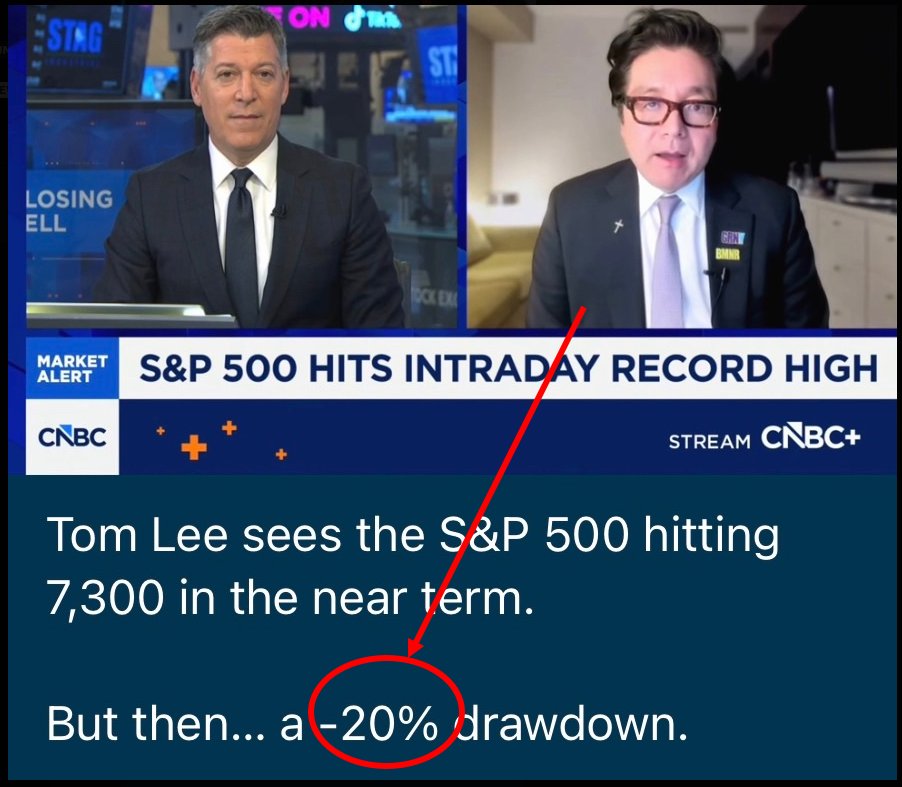
$730 is SPY target right now, but after it will crash 20% says Tom Lee to $580.
When ON SALE, I'd add these 20 stocks:
1. $IONQ – Quantum computing leader with massive asymmetric upside
Buy zone: $20–25 = early-stage value accumulation
2. $IREN – Cheap energy + AI compute = powerful margin expansion
Buy zone: $25–30 = strong support + cost advantage
3. $ASTS – Space-based telecom disruptor with global scalability potential
Buy zone: $65–70 = high conviction accumulation
4. $CRWV – AI data center REIT riding infrastructure demand wave
Buy zone: $70–75 = early positioning before scale
5. $GOOG (Alphabet Inc.) – AI + search dominance with strong cash flow engine
Buy zone: $150–170 = major institutional demand zone
6. $BE (Bloom Energy) – Data center power demand drives long-term growth story
Buy zone: $120–130 = prior base + demand zone
7. $COIN (Coinbase) – Crypto infrastructure with leverage to bull cycles
Buy zone: $130–140 = strong cyclical support
8. $AAPL (Apple Inc.) – Ecosystem moat + AI integration tailwinds building
Buy zone: $220–230 = long-term value zone
9. $TSLA (Tesla) – AI + autonomy optionality with massive upside
Buy zone: $280–300 = strong psychological support
10. $LITE (Lumentum Holdings) – AI data flow bottleneck driving explosive growth
Buy zone: $500–550 = momentum continuation base
11. $NVDA (NVIDIA) – AI leader with unmatched demand and pricing power
Buy zone: $150–160 = institutional accumulation
12. $AMD (Advanced Micro Devices) – Competing in AI chips with strong upside leverage
Buy zone: $180–190 = breakout retest zone
13. $HOOD (Robinhood Markets) – Retail trading growth + monetization expansion
Buy zone: $60–65 = demand + growth inflection
14. $SOFI (SoFi Technologies) – Fintech scaling with improving profitability trends
Buy zone: $13–15 = early-stage base
15. $QS (QuantumScape) – Solid-state battery breakthrough potential long-term
Buy zone: $5–7 = speculative accumulation
16. $MU (Micron Technology) – Memory cycle + AI demand driving pricing power
Buy zone: $310–320 = cycle bottom support
17. $SNDK (Sandisk) – Storage demand surge from AI + data growth
Buy zone: $550–600 = structural demand zone
18. $ONDS (Ondas Holdings) – Private wireless + drone tech early growth phase
Buy zone: $5–6 = high risk accumulation
19. $NKE (Nike) – Global brand reset with margin recovery potential
Buy zone: $35–40 = long-term support
20. $COHR (Coherent Corp.) – Optical infrastructure play on AI data explosion
Buy zone: $220–230 = direct LITE sympathy play
♻️RESHARE this post & write 1 comment for my list of SMALL CAPS under $20.