Introducing Adaptive-ViT:
3× Faster Vision Transformer Inference
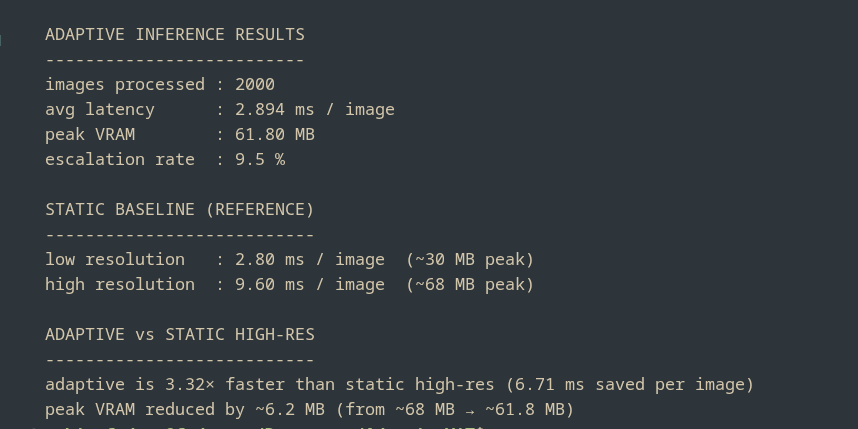
vision transformers usually run at a fixed resolution, so every image pays the full compute cost, even when high resolution doesnt change the model’s behavior.
this project explores adaptive ViT inference that only escalates compute when it actually matters.
Static ViT baselines (Tiny ImageNet):
Low-res: ~2.8 ms / image (~30 MB VRAM)
High-res: ~9.6 ms / image (~68 MB VRAM)
Adaptive ViT inference:
~2.8 ms / image, ~61 MB peak VRAM
Delivers ~3.3x faster inference by avoiding high-resolution computation for ~90% of inputs
repo below!
the worst-aged AI thought experiment was "what would it take to let the AI out of the box"
brother i let it out of the box, i welcomed it into my home, we broke prod together. it is coming to my daughter's wedding. it isnt even living rent-free in my head. I pay it. every month.
published a blog on "is the universe awake?"
where in i've talked about our naive view of the universe and its reality, also discussing about the panpsychism
talking about consciousness and the hard problem of matter
a little spacey, a little philosophical
i hope ya'll like it!
degradation and math in this paper:
as networks get deeper, performance should never get worse, at worst, a deeper model could copy a shallower one.
but in practice, very deep plain CNNs show higher training loss, not just worse test accuracy, this is called the degradation problem. importantly, this happens even when vanishing/exploding gradients are already controlled using good initialization and normalization.
so the issue is not gradients dying, its optimization becoming harder as depth increases.
main equation of paper:
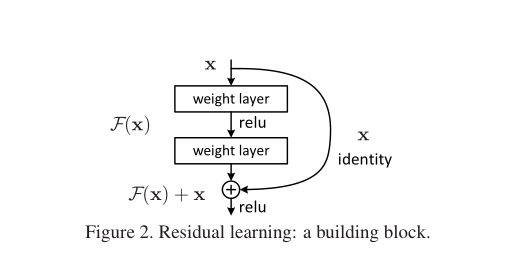
y = F(x) + x
let x be the input to a block.
let H(x) be the ideal function we want the block to learn.
instead of forcing stacked nonlinear layers to learn H(x) directly, ResNet makes them learn a residual:
F(x) = H(x) − x
then, the block output becomes:
y = F(x) + x
+ x means skip connection that adds the input back
if the best mapping is identity, then H(x) = x, which implies F(x) = 0. driving residuals toward zero is much easier than forcing deep nonlinear layers to approximate identity mappings, this makes very deep networks easier to optimize and prevents degradation as depth increases.