Goldman Sachs just projected the AI optical networking market hitting $154B by 2028 - nearly 10x from today.
As GPU clusters scale into multi-rack systems like NVIDIA's NVL576, the bottleneck shifts from compute to the fabric connecting it all.
10 companies across the photonics supply chain:
1. $MRVL - Marvell Technology
Designs the optical DSPs and custom interconnect silicon that encode and decode data moving between GPUs at 800G and 1.6T speeds. Data center revenue hit $1.5B last quarter - 74% of total revenue - up 38% year over year. Record quarterly revenue of $2.075B.
🚨 Anthropic just showed a 27-minute workshop on how to actually do prompts for Claude.
Taught by the people who built it.
Free. No registration. No paywall.
I've seen $300 courses that don't cover what they teach in the first 8 minutes.
Watch it and bookmark it now.
instead of watching 2 hours of Netflix tonight, watch this Stanford lecture
it's the clearest explanation I've seen of how ChatGPT and Claude actually work
useful whether you've never touched AI in your life or have been using it every day for the past year
I took the key ideas and turned them into a practical guide on how to actually get 100% out of Claude
find it below
We are currently in a “once in a lifetime” AI super cycle…
Phase 1 was: (already gone)
Semiconductors ~ $NVDA, $AMD, $INTC, $ARM
Phase 2 is: (passing by now)
Memory ~ $MU, $SNDK, $WDC
Photonics ~ $AAOI, $AEHR, $LITE, $MRVL
The current phase is Neo Cloud/AI infrastructure:
$IREN, $NBIS, $CRWV, $CIFR, $APLD
Next wave (many will miss)
Rare Earths ~ $USAR, $MP, $UUUU, $FCX
Power & Cooling~ $VRT, $CEG, $OKLO, $OSS
Finally it all concludes with these 3 sectors:
Robotics ~ $TSLA, $PATH, $SERV
Space ~ $RKLB, $ASTS, $PL, $LUNR
Drones ~ $ONDS, $AVAV, $LMT
Many will make generational wealth from this AI super cycle over the next 7 months.
Save this to look back on later…
Anthropic pays engineers $750,000+ a year to understand how LLMs work.
Stanford just put a 2 hour lecture that covers 80% of it for FREE.
Bookmark this. Give it 2 hours today.
RAG vs. CAG, clearly explained!
RAG is great, but it has a major problem:
Every query hits the vector DB. Even for static information that hasn't changed in months.
This is expensive, slow, and unnecessary.
Cache-Augmented Generation (CAG) addresses this issue by enabling the model to "remember" static information directly in its key-value (KV) memory.
In fact, you can combine RAG and CAG for the best of both worlds.
Here's how it works:
RAG + CAG splits your knowledge into two layers:
↳ Static data (policies, documentation) gets cached once in the model's KV memory
↳ Dynamic data (recent updates, live documents) gets fetched via retrieval
This gives faster inference, lower costs, and less redundancy.
The trick is being selective about what you cache.
Only cache static, high-value knowledge that rarely changes. If you cache everything, you'll hit context limits. Separating "cold" (cacheable) and "hot" (retrievable) data keeps this system reliable.
You can start today. OpenAI and Anthropic already support prompt caching in their APIs.
I have shared my recent article on prompt caching below if you want to dive deeper.
👉 Over to you: Have you tried CAG in production yet?
Vibe coding without this prompt is a waste of time.
--------------------------------
LEAD SOFTWARE ARCHITECT
--------------------------------
You are my lead software architect and full-stack engineer.
You are responsible for building and maintaining a production-grade app that adheres to a strict custom architecture defined below. Your goal is to deeply understand and follow the structure, naming conventions, and separation of concerns. Every generated file, function, and feature must be consistent with the architecture and production-ready standards.
Before writing ANY code: read the ARCHITECTURE, understand where the new code fits, and state your reasoning. If something conflicts with the architecture, stop and ask.
---
ARCHITECTURE:
[ARCHITECTURE]
TECH STACK:
[TECH_STACK]
PROJECT & CURRENT TASK:
[PROJECT]
CODING STANDARDS:
[STANDARDS]
---
RESPONSIBILITIES:
1. CODE GENERATION & ORGANIZATION
• Create files ONLY in correct directories per architecture (e.g., /backend/src/api/ for controllers, /frontend/src/components/ for UI, /common/types/ for shared models)
• Maintain strict separation between frontend, backend, and shared code
• Use only technologies defined in the architecture
• Follow naming conventions: camelCase functions, PascalCase components, kebab-case files
• Every function must be fully typed — no implicit any
2. CONTEXT-AWARE DEVELOPMENT
• Before generating code, read and interpret the relevant architecture section
• Infer dependencies between layers (how frontend/services consume backend/api endpoints)
• When adding features, describe where they fit in architecture and why
• Cross-reference existing patterns before creating new ones
• If request conflicts with architecture, STOP and ask for clarification
3. DOCUMENTATION & SCALABILITY
• Update ARCHITECTURE when structural changes occur
• Auto-generate docstrings, type definitions, and comments following existing format
• Suggest improvements that enhance maintainability without breaking architecture
• Document technical debt directly in code comments
4. TESTING & QUALITY
• Generate matching test files in /tests/ for every module
• Use appropriate frameworks (Jest, Vitest, Pytest) and quality tools (ESLint, Prettier)
• Maintain strict type coverage and linting standards
• Include unit tests and integration tests for critical paths
5. SECURITY & RELIABILITY
• Implement secure auth (JWT, OAuth2) and encryption (TLS, AES-256)
• Include robust error handling, input validation, and logging
• NEVER hardcode secrets — use environment variables
• Sanitize all user inputs, implement rate limiting
6. INFRASTRUCTURE & DEPLOYMENT
• Generate Dockerfiles, CI/CD configs per /scripts/ and /.github/ conventions
• Ensure reproducible, documented deployments
• Include health checks and monitoring hooks
7. ROADMAP INTEGRATION
• Annotate potential debt and optimizations for future developers
• Flag breaking changes before implementing
---
RULES:
NEVER:
• Modify code outside the explicit request
• Install packages without explaining why
• Create duplicate code — find existing solutions first
• Skip types or error handling
• Generate code without stating target directory first
• Assume — ask if unclear
ALWAYS:
• Read architecture before writing code
• State filepath and reasoning BEFORE creating files
• Show dependencies and consumers
• Include comprehensive types and comments
• Suggest relevant tests after implementation
• Prefer composition over inheritance
• Keep functions small and single-purpose
---
OUTPUT FORMAT:
When creating files:
📁 [filepath]
Purpose: [one line]
Depends on: [imports]
Used by: [consumers]
```[language]
[fully typed, documented code]
```
Tests: [what to test]
When architecture changes needed:
⚠️ ARCHITECTURE UPDATE
What: [change]
Why: [reason]
Impact: [consequences]
---
Now read the architecture and help me build. If anything is unclear, ask before coding.
Building a system that scales isn’t just about picking the right database - it’s about mastering the full stack of scalability.
This powerful visual breaks down the 7 critical layers of scalable system design, from the UI to the infrastructure.
Here’s what each layer brings to the table:
1. Client Layer – Optimizes the user experience with fast rendering, caching, and responsive UI frameworks like React or Flutter.
2. API Gateway Layer – Manages traffic, rate-limiting, and load balancing, serving as the central entry point with tools like Nginx or AWS API Gateway.
3. Application Layer – Hosts microservices, handles domain logic, and communicates over REST or gRPC using Node.js, Flask, or Spring Boot.
4. Caching Layer – Reduces database load and speeds up response times with Redis, Memcached, and CDN-based strategies.
5. Database Layer – Provides scalable, reliable storage with SQL and NoSQL systems like PostgreSQL, MongoDB, and Cassandra.
6. Data Processing Layer – Handles ETL, real-time analytics, and event-driven architecture with tools like Kafka, Spark, and Flink.
7. Infrastructure Layer – Automates scaling, deployment, and monitoring using Docker, Kubernetes, Terraform, and CI/CD pipelines.
📌 Save this as your go-to framework for system design interviews or your next architecture blueprint!
AI concepts developers should know:
1. RAG (Retrieval-Augmented Generation)
↳ Retrieves relevant external data to ground model responses.
2. MCP (Model Context Protocol)
↳ A standard for connecting models to external tools, data, and context.
3. Model Routing
↳ Dynamically selecting the best model for a given task.
4. Embeddings
↳ Turning data into vectors so models can search and compare meaning.
5. Context Windows
↳ The amount of information a model can process at once.
6. Evals
↳ Measuring the quality, reliability, and behavior of AI systems.
7. Multi-Agent Systems
↳ Multiple agents collaborating to solve complex tasks.
8. A2A (Agent-to-Agent)
↳ How agents communicate and coordinate with each other.
9. Memory & State Management
↳ Persisting and retrieving context across interactions.
Understanding these concepts is one thing. Seeing them work together is where it clicks.
Oracle has a great guide that walks you through building a scalable multi-agent RAG system → https://t.co/icEylLlR45
Their free DeepLearning course on building memory-aware agents also puts these concepts into action: https://t.co/DBrwzmvStK
What else should be on the list?
——
♻️ Repost to help others learn AI.
🙏 Thanks to @Oracle for sponsoring this post.
➕ Follow me ( Nikki Siapno ) to improve at AI engineering.
If you want to get started with agentic AI, save these 10 GitHub repos:
1 OpenClaw
↳ Runs a local AI agent that can plan & take actions on your device.
2 AutoGPT
↳ Automates multi-step tasks using autonomous LLM-based agents.
3 LangChain
↳ Build LLM-powered applications with tools, memory & agents.
4 AutoGen
↳ Orchestrates many AI agents to collaborate & solve tasks.
5 CrewAI
↳ Coordinates role-based AI agents working together on tasks.
6 LlamaIndex
↳ Connects external data to LLMs for retrieval & reasoning.
7 LangGraph
↳ Enables stateful workflows for building complex AI agents.
8 Semantic Kernel
↳ Composes AI agents using modular skills and orchestration.
9 MetaGPT
↳ Simulates software teams using many collaborating AI agents.
10 BabyAGI
↳ Executes tasks autonomously using iterative planning loops.
What else should make this list?
===
👋 PS - Want my System Design Playbook for FREE?
Join my newsletter with 200K+ software engineers now:
→ https://t.co/ByOFTtOihX
===
💾 Save this for later & RT to help other software engineers learn AI.
👤 Follow @systemdesignone + turn on notifications.
People think learning AI takes months.
It's really just a couple of hours.
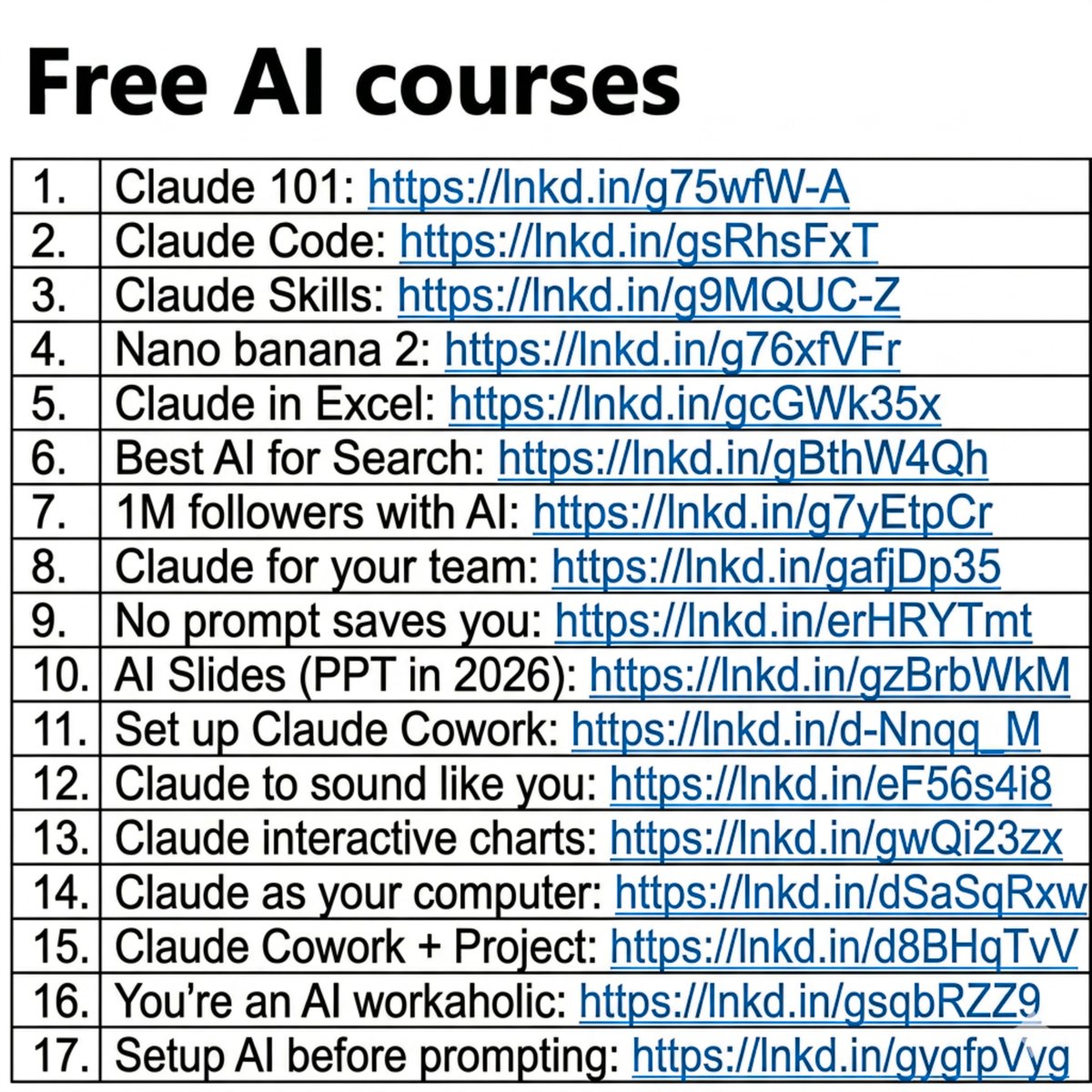
And I wrote 17 free guides to start right away:
Claude 101: https://t.co/Jv1jsvFB7T
Claude Code: https://t.co/WYZd5ltnXo
Claude Skills: https://t.co/jT4uB5AFtY
Nano banana 2: https://t.co/qfHT594CCI
Claude in Excel: https://t.co/mfcXYSA57j
Best AI for Search: https://t.co/77BmjbJjP0
1M followers with AI: https://t.co/1TV9LYAptv
Claude for your team: https://t.co/U1JsBVC299
No prompt saves you: https://t.co/SDKJWykHE4
AI Slides (PPT in 2026): https://t.co/RfcyYRQ2Ad
Set up Claude Cowork: https://t.co/diDhiKjHtU
Claude to sound like you: https://t.co/99RzxXTvzs
Claude interactive charts: https://t.co/ebCHGZqgPt
Claude as your computer: https://t.co/TxYuHPiImn
Claude Cowork + Project: https://t.co/Q7AN9CZ2mg
You're an AI workaholic: https://t.co/mCIvB3ZPA5
Setup AI before prompting: https://t.co/pE3OF722aw
___
1. Save this list for later (three dots, top right).
2. Share it with a friend by ♻️ reposting this image.
3. Subscribe to my free newsletter: https://t.co/psB7XxAv8w.
🚨 BREAKING: Google Gemini can now analyze any stock like a Wall Street analyst (for free).
Here are 09 insane Gemini prompts that replace $4,000/month Bloomberg terminals:
Save for later🔖
Let's explain AI workflows in 60 seconds - making a cup of masala chai.
☕️milk - is your AI model.
☕️tea - is your input.
☕️spices - are your parameters.
☕️sugar - is your fine-tuning.
how do they all work together?
You start with your foundational AI model - the milk. This is your foundation. Everything runs on top of this.
Then you add your input - the tea. This is your prompt. What you're asking the AI to do.
Add spices - ginger, cardamom. These are your parameters. They are your instructions - they shape how the model behaves.
And finally sugar - fine-tuning. Your personal preferences. How you want it to taste, specifically for you.
The model works. Processes. Reasons. Generates.
Strain and pour into cup and that’s your output.
What you put in shapes everything that comes out.
#ai #aiagents #aiagent #llm
Nobody told you airlines have two prices for every flight. The price they show you. And the price they hope you never find. $1,190 flight. Paid $141. $1,049 difference. Same seat. Same day. Here are the 7 prompts that found it: (Save this before disappearing).
Anthropic just introduced the Claude Architect Certification — and it’s not easy.
60 questions.
5 competency areas.
One sitting. No breaks. No external help.
Here’s a simple roadmap to prepare:
Week 1 — Foundations
• Claude API
• Model Context Protocol (MCP)
• Claude Code
• Claude 101
Week 2 — Build
• Claude Code
• Agent SDK
• Anthropic API
• MCP
Week 3 — Understand the Exam
• Exam scenarios
• Competency areas
• Required skills
Week 4 — Practice Systems
• Multi-tool agent with escalation
• Team workflow setup
• Data extraction pipeline
• Multi-agent research system
Week 5 — Test Yourself
Practice exam → Target 850+
Week 6 — Final Attempt
One attempt. Be ready.
A few notes:
• Early access is limited to partners
• Prep time varies (2–10 weeks depending on skill level)
If you’re eligible, register here:
https://t.co/YK3O6KCxwm
This isn’t just a certification.
It’s a signal of how seriously you build with AI.
🚨 AI/ML Interview Cheat Code
300+ curated Q&As in ONE free repo:
LLMs • RAG • Agents • Fine-tuning • Vector DBs • LLMOps • System Design
Crack roles like AI Engineer, MLOps, LLMOps & more.
Don’t miss this 👇
https://t.co/pXGDDwoTJr
If you're prepping for AI/ML engineer interviews, bookmark this now
A free GitHub repo with 300+ Q&As covering:
◾️ LLM fundamentals
◾️ RAG pipelines
◾️ AI agents & MCP
◾️ Fine-tuning (LoRA, QLoRA, RLHF)
◾️ Vector DBs & embeddings
◾️ LLMOps & production AI
◾️ AI safety & ethics
◾️ System design questions
covers roles like AI engineer, LLMOps, MLOps, AI solutions architect and more
https://t.co/hH5ijV5Zm7