And finally…
Q2FY27 Result Season comes to an end! 🙏
What a quarter! 🔥
What an incredible set of performances!
What an absolutely crazy few weeks!
One hell of a results season! 👏
Time to take a deep breath and reflect
Until next quarter! 😊
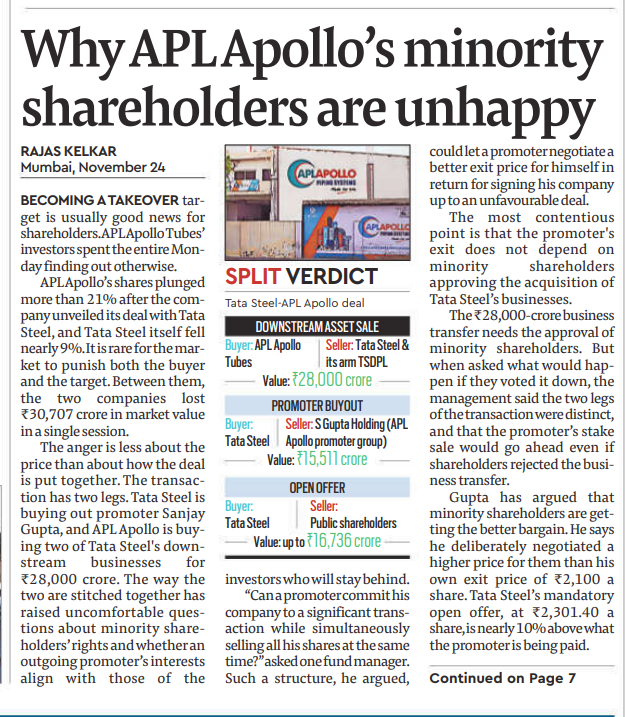
Why APL Apollo's Minority Shareholders Are Unhappy; Shares Plunge 21% and Tata Steel Falls Nearly 9% as ₹28,000 Crore Deal Structure Raises Governance Questions
Core Theme
The Tata Steel-APL Apollo deal has triggered a rare double sell-off because its three linked legs let the promoter exit regardless of minority approval of the ₹28,000 crore asset purchase, while public shareholders face a roughly one-in-three open-offer acceptance, EPS dilution and a more leveraged business, putting APL Apollo's independent directors under pressure to deliver a credible, reasoned recommendation.
The Market Reaction
APL Apollo Tubes' shares plunged more than 21% after the company unveiled its deal with Tata Steel, and Tata Steel itself fell nearly 9%
It is rare for the market to punish both the buyer and the target
Between them, the two companies lost ₹30,707 crore in market value in a single session
The anger is less about the price than about how the deal is put together
How the Deal Is Structured
Downstream asset sale: APL Apollo Tubes buys two of Tata Steel's downstream businesses (Tata Steel and its arm TSDPL) for ₹28,000 crore
Promoter buyout: Tata Steel buys promoter Sanjay Gupta's S Gupta Holding (APL Apollo promoter group) for ₹15,511 crore
Open offer: Tata Steel buys from public shareholders for up to ₹16,736 crore
The two legs are stitched together, raising uncomfortable questions about minority shareholders' rights and whether an outgoing promoter's interests align with those of investors who stay behind
One fund manager: can a promoter commit his company to a significant transaction while simultaneously selling all his shares at the same time?
Such a structure could let a promoter negotiate a better exit price for himself in return for signing his company up to an unfavourable deal
The Contentious Points
The promoter's exit does not depend on minority shareholders approving the acquisition of Tata Steel's businesses
The ₹28,000-crore business transfer needs minority shareholder approval
Asked what happens if they vote it down, management said the two legs were distinct and the promoter's stake sale would go ahead even if shareholders rejected the business transfer
Gupta argues minority shareholders are getting the better bargain: he negotiated a higher price for them than his own exit price of ₹2,100 a share
Tata Steel's mandatory open offer, at ₹2,301.40 a share, is nearly 10% above what the promoter is being paid
The Catch: Open Offer Acceptance
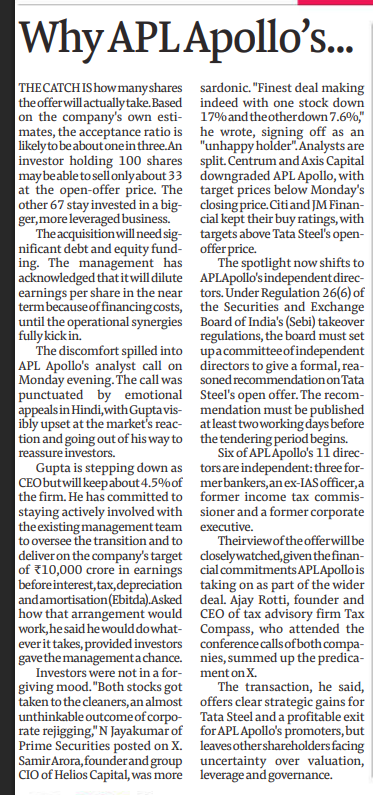
Based on the company's own estimates, the acceptance ratio is likely to be about one in three
An investor holding 100 shares may be able to sell only about 33 at the open-offer price; the other 67 shares stay invested in a bigger, more leveraged business
The acquisition will need significant debt and equity funding
Management acknowledged it will dilute earnings per share in the near term because of financing costs, until operational synergies kick in
Management Response and Investor Reaction
The discomfort spilled into APL Apollo's analyst call on Monday evening, punctuated by emotional appeals in Hindi, with Gupta visibly upset at the market's reaction
Gupta is stepping down as CEO but will keep about 4.5% of the firm
He committed to staying actively involved with the existing management team and to deliver on the company's target of ₹10,000 crore Ebitda
Investors were not forgiving: N Jayakumar (Prime Securities) called it "an almost unthinkable outcome of corporate rejigging"; Samir Arora (Helios Capital) sarcastically wrote, "Finest deal making indeed with one stock down 17% and the other down 7.6%," signing off as an "unhappy holder"
Analysts are split: Centrum and Axis Capital downgraded APL Apollo, with targets below Monday's closing price; Citi and JM Financial kept buy ratings, with targets above Tata Steel's open-offer price
Spotlight on Independent Directors
Under Regulation 26(6) of Sebi's takeover regulations, the board must set up a committee of independent directors to give a formal, reasoned recommendation on Tata Steel's open offer
The recommendation must be published at least two working days before the tendering period begins
Six of APL Apollo's 11 directors are independent: three former bankers, an ex-IAS officer, a former income tax commissioner and a former corporate executive
Their view will be closely watched given the financial commitments APL Apollo is taking on
Ajay Rotti (Tax Compass): the deal offers clear strategic gains for Tata Steel and a profitable exit for APL Apollo's promoters, but leaves other shareholders facing uncertainty over valuation, leverage and governance
Japan Draws Auto Suppliers into Major Arms Build-Up; Government Taps Existing Industrial Supply Chains to Speed Up Security Transformation as Carmakers Struggle
Core Theme
Facing weak margins and Chinese competition, Japan's auto suppliers are being steered by the Takaichi government into defence work, as with Aster's drone motors for Anduril, a shift that lets Tokyo rapidly scale its biggest military buildup since World War Two on existing industrial capacity while giving a declining auto sector a new growth avenue, with a broader security strategy and arms-industry road map due by year-end.
The Pivot: Aster's Story
Japanese manufacturer Aster spent years supplying parts for Toyota vehicles
As the auto industry struggles against fierce Chinese competition, Aster found a new niche in defence technology
Its electric motors power drones built by US military technology company Anduril
Defence work has grown to a tenth of revenue since it entered the sector last year
Takenobu Hongo (CEO): "Drones are a much better business"; at the moment, automotive motors aren't very profitable
Defence contracting has long been viewed warily by citizens of a country shaped by decades of pacifism
The Government Push
Aster's pivot is part of a move by Tokyo to encourage Japan's many auto suppliers to join the country's biggest military buildup since World War Two, per interviews with nine people, including officials, company executives and an advisor to Prime Minister Sanae Takaichi's cabinet
The government hopes tapping existing industrial supply chains will speed up Japan's security transformation
Aim: bolster defences against threats from nuclear-armed neighbours China, Russia and North Korea
Rearmament efforts are backed by Tokyo's chief security partner, the US, which is pressing allies to increase spending on armed forces
The buildup also offers an important diversification avenue for Japan's once world-leading auto industry
How the Support Works
Reuters is reporting for the first time details of the industry's nascent push into the defence sector
The Acquisition, Technology & Logistics Agency (ATLA), which oversees defence ministry procurement, has been evaluating suppliers like Aster, pairing them with arms firms and offering new funding streams, an agency official and four executives said
Koko Kato (adviser to Takaichi's cabinet): if there is a synergy between defence and autos, carmakers "should take the opportunity"
She oversaw changes in February to a separate trade ministry program aimed at helping auto suppliers diversify into defence and other industries
ATLA said it serves as a point of contact for companies seeking to enter defence and will work with other departments to encourage new entrants
Takaichi's office did not respond to questions
The government has pledged to lay out a new security strategy by year-end, including a road map for bolstering an arms industry initially dismantled after Japan's WWII defeat
Auto Industry Backdrop
Japan's factories built nearly 900,000 fewer vehicles in 2025 than a decade earlier, per the Japan Automobile Manufacturers Association
Despite the decline, Japan remains the world's third-largest vehicle-producing nation
The industry manufactures more than 8 million vehicles a year and supports one in 10 jobs, with some 70,000 companies making a vast array of components
The plan builds on Japan's legacy as a manufacturing powerhouse
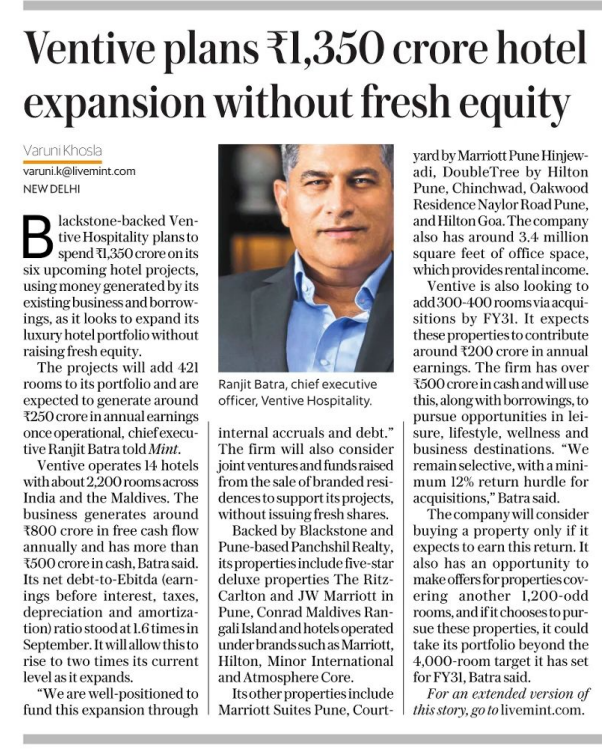
Ventive Plans ₹1,350 Crore Hotel Expansion Without Fresh Equity; Six Projects to Add 421 Rooms and ₹250 Crore in Annual Earnings, Funded by Internal Accruals and Debt
Core Theme
Ventive Hospitality is funding a ₹1,350 crore, 421-room expansion entirely through ₹800 crore of annual free cash flow, cash reserves and debt headroom rather than fresh equity, while staying selective with a 12% return hurdle on acquisitions that could push its portfolio past its 4,000-room FY31 target.
The Expansion Plan
Blackstone-backed Ventive Hospitality plans to spend ₹1,350 crore on its six upcoming hotel projects, using money generated by its existing business and borrowings
The aim is to expand its luxury hotel portfolio without raising fresh equity
The projects will add 421 rooms and are expected to generate around ₹250 crore in annual earnings once operational, said CEO Ranjit Batra to Mint
Batra: "We are well-positioned to fund this expansion through internal accruals and debt"
The firm will also consider joint ventures and funds raised from the sale of branded residences to support projects, without issuing fresh shares
Current Business and Financial Strength
Ventive operates 14 hotels with about 2,200 rooms across India and the Maldives
The business generates around ₹800 crore in free cash flow annually and has more than ₹500 crore in cash
Net debt-to-Ebitda ratio stood at 1.6 times in September
It will allow this to rise to two times its current level as it expands
Also holds around 3.4 million square feet of office space, which provides rental income
The Portfolio
Backed by Blackstone and Pune-based Panchshil Realty
Properties include five-star deluxe hotels The Ritz-Carlton and JW Marriott in Pune, Conrad Maldives Rangali Island, and hotels operated under Marriott, Hilton, Minor International and Atmosphere Core
Other properties include Marriott Suites Pune, Courtyard by Marriott Pune Hinjewadi, DoubleTree by Hilton Pune, Chinchwad, Oakwood Residence Naylor Road Pune and Hilton Goa
Acquisition Strategy
Looking to add 300-400 rooms via acquisitions by FY31, expected to contribute around ₹200 crore in annual earnings
Will use its ₹500 crore-plus cash along with borrowings to pursue opportunities in leisure, lifestyle, wellness and business destinations
Batra: "We remain selective, with a minimum 12% return hurdle for acquisitions"
The company will buy a property only if it expects to earn this return
It has an opportunity to make offers for properties covering another 1,200-1,300 rooms, and if it pursues these, the portfolio could go beyond the 4,000-room target set for FY31
Diamond Power Bets Big on Data Centres; New Cable Business Clocks ₹242 Crore in First Month, a Fourth of Jul-Sep Revenue, as Firm Seeks to Cut Reliance on Adani Group
Core Theme
Diamond Power's data centre cable line, funded by a ₹1,614 crore QIP, delivered ₹242 crore in its very first month and helped more than double quarterly revenue, giving the company a higher-margin growth engine and a route to diversify away from the Adani Group, though management cautions that the September run rate won't repeat every month and guides to about ₹750 crore for FY27.
The Data Centre Debut
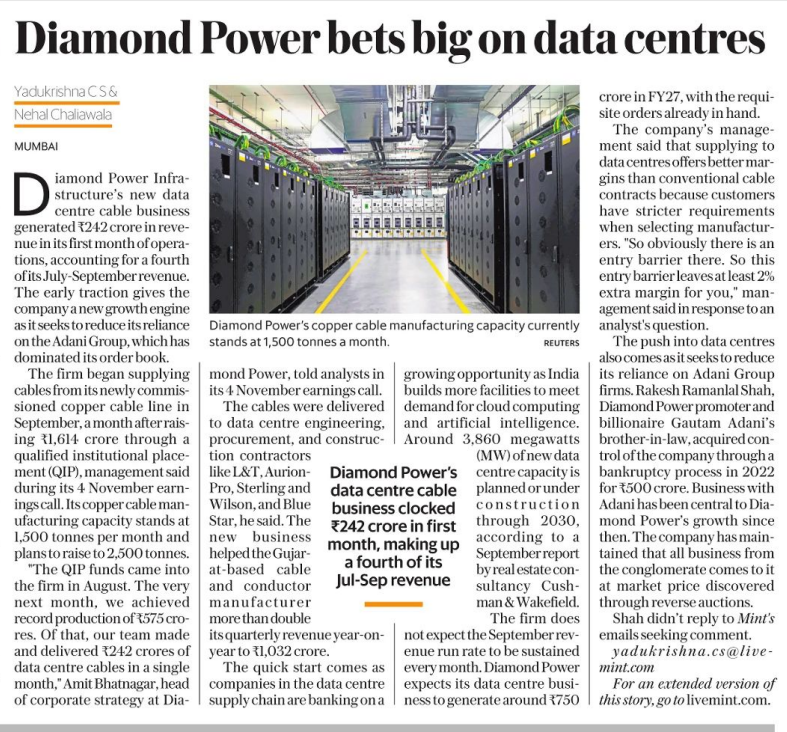
Diamond Power Infrastructure's new data centre cable business generated ₹242 crore in revenue in its first month of operations, accounting for a fourth of its July-September revenue
It began supplying cables from its newly commissioned copper cable line in September, a month after raising ₹1,614 crore through a qualified institutional placement (QIP)
Amit Bhatnagar (head of corporate strategy): QIP funds came in August, and in September the company achieved record production of ₹575 crore, of which ₹242 crore was data centre cables made and delivered in a single month
Cables were delivered to data centre engineering, procurement and construction contractors like L&T, AurionPro, Sterling and Wilson, and Blue Star
The new business helped the company more than double quarterly revenue year-on-year to ₹1,032 crore
Capacity and Outlook
Copper cable manufacturing capacity currently stands at 1,500 tonnes a month, with plans to raise it to 2,500 tonnes
The firm does not expect the September revenue run rate to be sustained every month
Expects the data centre business to generate around ₹750 crore in FY27, with the requisite orders already in hand
Margins and Market Opportunity
Management says supplying to data centres offers better margins than conventional cable contracts because customers have stricter requirements when selecting manufacturers
Management: the entry barrier leaves at least 2% extra margin
Companies in the data centre supply chain are banking on a growing opportunity as India builds more facilities for cloud computing and AI
Around 3,860 MW of new data centre capacity is planned or under construction through 2030, per a September report by Cushman & Wakefield
Reducing Reliance on Adani Group
The push comes as Diamond Power seeks to reduce its reliance on Adani Group firms, which have dominated its order book
Rakesh Ramanlal Shah, promoter and billionaire Gautam Adani's brother-in-law, acquired control of the company through a bankruptcy process in 2022 for ₹500 crore
Business with Adani has been central to the company's growth since then
The company maintains that all business from the conglomerate comes at market price discovered through reverse auctions
Shah did not reply to Mint's emails seeking comment
Why India's AI Flagship Sarvam Is Now Renting Out Global Models; Token Factory Offers DeepSeek, Kimi and Others Alongside Sarvam's Own Models, but Thin Economics Raise Questions
Core Theme
Sarvam's Token Factory is a pragmatic bid to monetise scarce GPU capacity and meet Indian demand for locally hosted AI by renting out mostly Chinese open-weight models alongside its own, but with introductory pricing barely covering rented chip costs and no live data centres yet, the move tests whether India's sovereign AI flagship can build a viable business without drifting from its model-building mission.
What Token Factory Is
Sarvam AI recently launched Token Factory, a platform that lets businesses run its AI models alongside global alternatives such as DeepSeek and Kimi
The move has drawn scrutiny over why a sovereign AI startup, seen as India's answer to global labs, is now offering inference and access to rival models
Running advanced open-weight AI models needs costly hardware that many Indian startups cannot afford, forcing them to settle for weaker models or rely on overseas cloud providers
Government procurement rules increasingly mandating local hosting add to the challenge
Token Factory aims to bridge both gaps while testing the economics of running AI inference
Training is the process of building a model; inference is the model answering a user's request
It sells inference by the token, roughly three-quarters of a word (100 tokens is about 75 words), and charges separately for input, output and cached input, which is far cheaper
Pricing and Model Lineup
At introductory rates (valid until December), Sarvam's 105B model costs ₹10 per million input tokens and ₹25 per million output tokens
DeepSeek V4.1 Flash costs ₹14 and ₹55, with cached input at ₹0.25
Sarvam says it serves over 450 billion DeepSeek tokens a day, with 95.7% of prompt tokens from cache
It has not said how much of this traffic is paid; counting input tokens alone at list prices, Mint calculates revenue of about ₹3.8 lakh a day
Half of Token Factory's 12 models are Chinese, from DeepSeek, Z. ai, Moonshot AI and Alibaba; the rest are Sarvam models, two from Google and Cloudflare's Clef
Experts say the lineup is deliberate, pairing Sarvam's Indian-language focus with global models for other tasks
Ajay Modi (Piper Serica): DeepSeek is a broad application, Kimi is long-context tasks and Qwen a general-purpose engine, each with complementary uses
Whose GPUs Run It
Under the IndiaAI Mission, Sarvam received six months' access to 4,096 Nvidia H100 GPUs to train its models, with a compute bill of ₹246.7 crore, of which the government subsidised ₹98.68 crore
That access ended in March; Token Factory runs on privately procured Nvidia Blackwell GPUs
Sarvam has no live data centres; facilities in Odisha, with HCLTech, and Tamil Nadu are being built
It relies on partners such as Yotta Data Services, on whose Shakti Cloud it trained its Sarvam 1 model in 2024
Selling inference to outside customers helps Sarvam get more out of expensive hardware, as model training happens in bursts and chips bought or leased for research would otherwise sit unused
The Economics
In India, an eight-chip Nvidia B200 server costs ₹3.7 crore to ₹4.9 crore, or at least ₹46 lakh a chip (ZenoCloud)
Renting one chip costs ₹473 an hour on Yotta and ₹759 on demand at E2E Networks, or ₹11,350 to ₹18,200 a day
Sarvam said in a 22 November blogpost that one B200 generates about 6,000 output tokens a second on its 105B model; running all day, that is roughly 518 million tokens, or about ₹12,950 at introductory rates
At those rates, a rented chip earning at most ₹12,950 a day needs to run nearly round the clock to cover its ₹11,350-18,200 rental
Investors say that leaves little room for prolonged discounting
Anil Joshi (Unicorn India Ventures): if they are subsidising the offering, sooner or later you have to start charging more to recover GPU costs, otherwise it will be totally unviable
Who Is Sarvam Targeting?
Token Factory is pitched to Indian startups, smaller enterprises and state-linked buyers who want to build with top open-weight AI models without investing in expensive servers or routing sensitive data via overseas clouds
Experts flag two risks: commercial traffic could crowd out the compute Sarvam's researchers need, and customers coming for global models may never adopt Sarvam's, leaving it a pure inference host rather than a sovereign model builder
India Plans New Gas Exchange to Deepen Futures Trading; PNGRB Seeks Proposals to Build It This Fiscal, as Only 3% of India's Natural Gas Is Traded on Exchanges
Core Theme
With only 3% of India's gas traded on exchanges despite record IGX volumes, PNGRB is moving to set up a second exchange that would also list products like ATF and naphtha, aiming to improve price discovery and strengthen energy security after the West Asia conflict, and to shift the market away from oil-indexed and volatile spot-linked pricing.
The Plan
India's downstream gas and petroleum product regulator, the Petroleum and Natural Gas Regulatory Board (PNGRB), plans to facilitate a new gas exchange to deepen futures trading of critical petroleum products
Energy security is taking centre stage in the wake of the West Asia conflict, said two people with knowledge of the developments
PNGRB will soon seek proposals from companies interested in establishing the exchange and intends to make it a reality this fiscal year
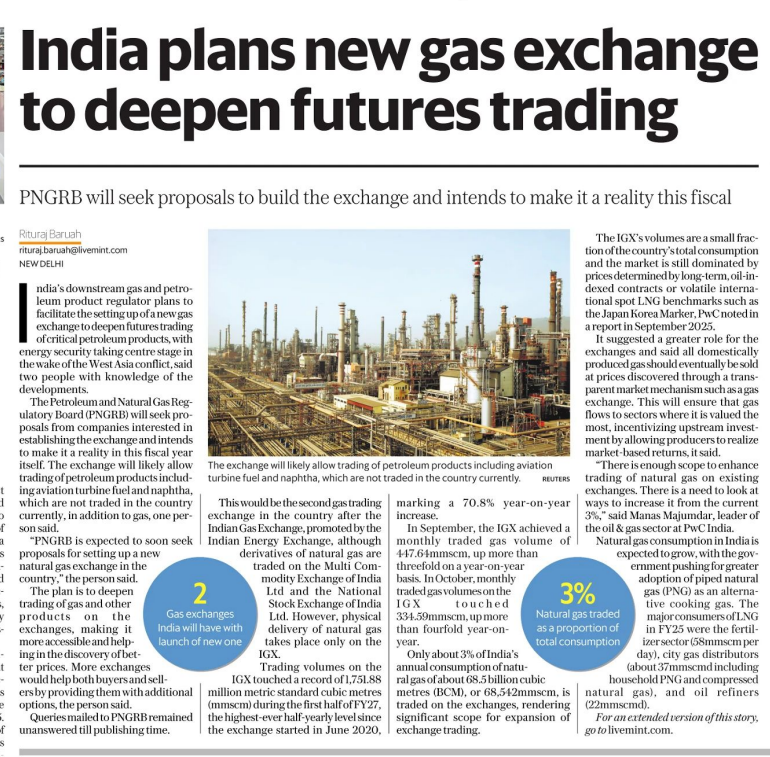
The exchange will likely allow trading of petroleum products not currently traded in India, including aviation turbine fuel and naphtha, in addition to gas
Aim: make trading more accessible and help in discovery of better prices; more exchanges would help buyers and sellers by providing additional options
Queries mailed to PNGRB remained unanswered
India would have 2 gas exchanges with the launch of a new one
Existing Gas Trading: The IGX
This would be the second gas trading exchange after the Indian Gas Exchange (IGX), promoted by the Indian Energy Exchange
Derivatives of natural gas are traded on the Multi Commodity Exchange of India Ltd and the National Stock Exchange of India Ltd, but physical delivery takes place only on the IGX
Trading volumes on the IGX touched a record 1,751.88 mmscm in the first half of FY27, the highest-ever half-yearly level since the exchange started in June 2020
That was up 70.8% year-on-year
In September, the IGX's monthly traded gas volume was 447.64 mmscm, up more than threefold year-on-year
In October, monthly volumes reached 334.59 mmscm, more than fourfold year-on-year
Room to Grow
Only about 3% of India's annual natural gas consumption (about 68.5 BCM, or 68,542 mmscmd) is traded on exchanges
IGX volumes are a small fraction of total consumption, and the market is still dominated by prices set by long-term, oil-indexed contracts or volatile international spot LNG benchmarks such as the Japan Korea Marker, PwC noted in a September 2025 report
PwC suggested a greater role for exchanges, saying all domestically produced gas should eventually be sold at prices discovered through a transparent market mechanism
This would ensure gas flows to where it is valued most and incentivise upstream investment by letting producers realise market-based returns
Manas Majumdar (PwC India): there is enough scope to enhance trading on existing exchanges, with a need to look at ways to increase it from the current 3%
Demand Backdrop
Natural gas consumption is expected to grow, with the government pushing for greater adoption of piped natural gas (PNG) as an alternative cooking fuel
Major consumers in FY25: fertilizer sector (58 mmscm per day), city gas distributors (about 37 mmscmd, including household PNG and CNG) and oil refiners (22 mmscmd)
Tata Electronics Taps Global EPC Firms for Assam OSAT Phase 2; Talks Widen Beyond Phase-1 Partner TCE as ₹27,000 Crore Jagiroad Chip Plant Begins Trial Runs
Core Theme
Tata Electronics is widening its partner base beyond TCE as it plans Phase 2 of the ₹27,000 crore Jagiroad OSAT plant, India's first indigenous semiconductor assembly and test facility, signalling that the project is moving from first-phase trial runs toward a larger, more globally supported build-out.
Phase 2 Talks
Tata Electronics is in exploratory discussions with global engineering, procurement and construction (EPC) contractors and project management firms for Phase 2 of its Outsourced Semiconductor Assembly and Test (OSAT) facility in Jagiroad, Assam
Per a person aware of the developments, it has begun talks with some global players to chalk out the plan for the second phase of the facility
Tata Consulting Engineers (TCE) was its partner on the first phase, but Tata is talking to other players for the second phase
Queries sent to Tata Electronics remained unanswered as of press time Tuesday
The Project
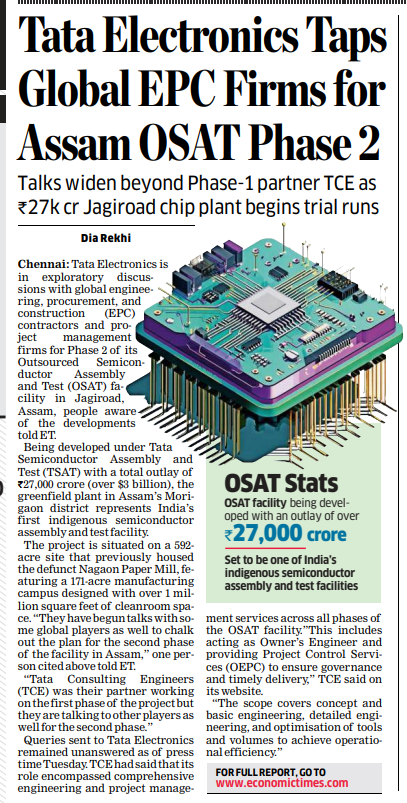
Being developed under Tata Semiconductor Assembly and Test (TSAT) with a total outlay of over ₹27,000 crore (over $3 billion)
The greenfield plant in Assam's Morigaon district represents India's first indigenous semiconductor assembly and test facility
Located on a 592-acre site that previously housed the defunct Nagaon Paper Mill
Features a 171-acre manufacturing campus designed with over 1 million square feet of cleanroom space
Completion period: 36 months
TCE's Role
TCE had said its role encompassed comprehensive engineering and project management services across all phases of the OSAT facility
This includes acting as Owner's Engineer and providing Engineering Project Control Services (OEPC) to ensure governance and timely delivery
Scope covers concept and basic engineering, detailed engineering, and optimisation of tools and volumes to achieve operational efficiency
VCs Lock onto DefTech Amid Homegrown Push; Elev8, Peak XV, Nexus and Premji Invest Lead as Govt Reserves ₹1.39 Lakh Crore for Local Buys
Core Theme
Venture capital is flowing into India's defence tech startups on the back of a ₹1.39 lakh crore domestic procurement budget and a global rearmament cycle, with a wave of deals in drones, engines and electronic systems, but the long-term durability of this funding will hinge on whether government backing converts into large, timely commercial orders.
The Investor Shift
Mainstream risk capital investors are increasingly entering India's defence and aerospace technology sector
They are betting that rising demand for indigenous military systems and the government's push to reduce import dependence will create significant growth opportunities for domestic startups
The investor base, traditionally dominated by specialist funds and strategic investors, is widening due to rising military expenditure, changing warfare requirements and greater government procurement of locally developed systems
Deals in the Pipeline
Constelli (Hyderabad): Elev8 Venture Partners in talks to invest ₹150 crore in its first defence tech bet; TVS Capital also in talks to join the ₹300-400 crore round at a pre-money valuation of ₹1,850 crore
Apollyon Dynamics (Hyderabad): develops high-speed combat drones and unmanned aerial systems; discussing a $5 million round with Sameer Brij Verma's Northpoint and Peak XV Partners
Green Aero: develops propulsion systems for defence drones and aircraft; looking to raise $12 million from Crane Venture Partners (which expanded its Asia-Pacific fund to $150 million in September) and 3one4 Capital
Parsec Aerospace (Bengaluru): developing next-generation aerospace engines; in talks to raise $8 million from Nexus Venture Partners
Hical Technologies: $35 million raised, with Premji Invest as investor
Sanlayan Technologies: $30-40 million round, with Premji Invest and Singularity AMC
The companies and investors did not respond to queries sent by ET
Why Investors Are Interested
Pranav Pai (founding partner, 3one4 Capital): the most important change is demand; even pre-Covid there was not much demand for deeptech in India
A big rearming is underway globally, including in Europe and Japan
Instead of buying platforms and more bullets and guns, new types of weapons, advanced communication, embedded intelligence, autonomous drones, intelligence surveillance and space-based surveillance are now needed
This creates opportunities for companies building specialised components, software and electronic systems deployable across multiple military platforms, reducing the need for startups to build complete defence systems
Government Push and Risks
India is accelerating efforts to build domestic military capabilities amid geopolitical tensions, supply-chain disruptions and concerns over dependence on foreign suppliers
The government has earmarked ₹1.39 lakh crore, or 75% of its capital acquisition budget, for procurement from domestic defence manufacturers in FY27
Investors cautioned that sustainability of funding interest depends on whether government support translates into large commercial orders, given the long development cycles and capital-intensive nature of defence technology
An investor, on condition of anonymity: if revenue doesn't come in seven or eight years, it's a very long time to give a company, and the company is going to fail
Luxury Carmakers Charged Up for Electric Push; EVs Are About 15% of India's 52,000 Luxury Sales, Flagship Models Win Strong Bookings, Segment Seen Reaching 35,000 EVs by 2033
Core Theme
India's luxury carmakers are betting that affluent buyers will move quickly to electric, with flagship EVs like the BMW i7 and Mercedes GLC already seeing waiting lists and sell-outs, new entrants such as BYD's Denza, MG SELECT and Hyundai's Genesis widening choice, and lower GST, trade deals and new models setting up a fivefold rise in luxury EV sales to about 35,000 units by 2033.
The Electric Push
Luxury carmakers are accelerating their EV push in India, encouraged by growing demand from affluent buyers, which has also spurred new brands to enter the market
Manufacturers are expanding beyond conventional luxury sedans and SUVs into high-end limousines, performance cars and technology-led vehicles, with models priced up to ₹1.5 crore
Nearly 52,000 luxury vehicles were sold in India in 2025, with EVs comprising about 15% of the total
The share is expected to rise as automakers widen electric portfolios and introduce models across price points
Flagship Models Leading Demand
BMW Group India: the all-electric i7 accounts for half the sales of its 7 Series range, while EVs contribute about a fourth of overall volumes
BMW's i7, priced at ₹1.95 crore, has a waiting period of two to three months, said Hardeep Singh Brar (president and CEO); buyers weigh luxury, performance and rear-seat comfort alongside lower total cost of ownership
Mercedes-Benz India: electric GLC SUV fetched more than 1,000 bookings and is sold out through March 2027, prompting the company to seek additional supplies
Mercedes-Benz India MD and CEO Santosh Iyer indicated EVs could contribute 25-30% of sales if adequate supplies meet demand
Mercedes plans to introduce 40 new vehicles over three years, spanning electric and combustion-engine models, including the electric CLA and GLC
New Entrants and Other Players
BYD: rolled out its luxury Denza brand with two models, the D9 electric MPV at ₹90 lakh and the Z9 GT at ₹1.5 crore
BYD sold close to 6,200 vehicles last year, surpassed by August-September this year
The company is aiming to grow sales by 30-40% in 2026, said Rajeev Chauhan (senior VP and head of electric passenger vehicles, BYD India)
The premium MPV segment has expanded from around 1,000 units annually two years ago to nearly 5,000 currently
JSW MG Motor: built a separate channel for premium new energy vehicles through MG SELECT; the Cyberster electric sports car and M9 luxury limousine have together sold close to 4,000 units since launch in 2025, with the network expanded to 15 centres across 14 cities
Hyundai India: preparing to introduce luxury marque Genesis, with the GV90 electric SUV expected to lead its entry; it would likely be priced above ₹2 crore and compete with the Mercedes-Maybach EQS SUV and Range Rover Electric
Growth Outlook
Puneet Gupta (director, Mobility Global): luxury EVs priced above ₹45 lakh are expected to grow fivefold to 35,000 units by 2033 from around 7,000 currently
Greater model availability, free trade agreements and the 5% GST rate on EVs could support this growth
Mercedes-Benz chairman Ola Källenius, on a recent India visit, said demand for EVs would gain momentum with a new generation of products
REC Targets ₹1.2 Lakh Crore Loan Disbursal in H2; Aims to Keep Net Interest Margin at 3-3.25% and Build a ₹15,000-20,000 Crore Commercial Paper Portfolio
Core Theme
REC is targeting a stronger second half with ₹1.2 lakh crore of disbursements after a year when heavy prepayments muted growth, while protecting its 3-3.25% net interest margin through new borrowers, diversified funding and a growing commercial paper portfolio that taps cheaper short-term rates.
Disbursement Plans
REC Ltd aims to disburse about ₹1.2 lakh crore in loans in the second half of this fiscal year, adding to the about ₹1 lakh crore disbursed in the first half, said Rajesh Kumar Gupta, director finance
REC disbursed about ₹2.4 lakh crore in FY26, but loan growth was muted due to prepayments
Gupta: "This year, we are ensuring that prepayment should be less"
Prepayments were about ₹10,000 crore in the first half of FY27, from ₹50,000 crore in the whole of FY26
Sanctioned loans worth around ₹1.5 lakh crore so far this fiscal year, including to second-generation businesses, new clients and promoters
Competition and Margins
Gupta does not expect significant competition from banks in financing long-term power sector projects, given REC's expertise and the availability of capital for long-term investments
Large-scale funding needed for green energy and the broader power sector means there is room for all lending institutions to grow
REC expects to maintain net interest margin at 3-3.25% going forward despite pressure on lending yields
Net interest margin is currently about 3.22%
The company is looking to add new borrowers to boost yields
Borrowing and Funding Strategy
REC is working on diversifying its borrowing portfolio and optimising the cost of funds through diverse funding sources and a mix of currencies to access cheaper capital
Building a short-term borrowing portfolio of ₹15,000-20,000 crore through commercial papers
Has recently prepared a commercial paper calendar and created a portfolio of around ₹10,000 crore
Plan is to finance and redeem commercial papers through fresh commercial paper issuances
Normally there is about one percentage point difference between commercial paper rates and regular borrowing rates
Construction Equipment Cos Seek Fiscal Sop; ICEMA Wants Support for Domestic Manufacturing of High-Value Equipment Amid China's Export Curbs, While MNCs Warn Against Strict Local Sourcing
Core Theme
China's export curbs on TBMs and other heavy equipment have exposed India's dependence on Chinese machines, components and servicing, prompting ICEMA to seek fiscal support and R&D funding for domestic manufacturing of critical parts, even as domestic firms and MNCs disagree on how strict local sourcing mandates should be, and the promised 2026-27 manufacturing scheme remains unrolled.
The Ask
The Indian Construction Equipment Manufacturers' Association (ICEMA) has sought fiscal support to promote domestic manufacturing of high-value construction equipment and critical components
Concerns cited: procurement delays, higher costs and availability of spares and servicing for infrastructure projects amid China's export restrictions
ICEMA said in a draft note that there is a need to promote greater domestic content in TBMs deployed in government-funded infrastructure projects, wherever technically and commercially feasible
The note stresses the need to ensure supply-chain resilience and access to alternative sources
ET has seen the draft note
China's Export Curbs
China imposed curbs on export of certain equipment, including tunnel boring machines (TBMs), walking excavators, plateau-type wet shotcrete machines and certain dredging components used in projects in hilly, high-altitude and border areas, effective November 18
India largely depends on China for these machines
The curbs could delay procurement of machines and components and could also affect services and spares for already imported machines
What the Industry Wants
Government support to encourage domestic manufacturing of critical TBM components, including main bearings, cutterheads, disc cutters, hydraulic systems, main drives and automation systems
Higher capex support for setting up investment in R&D, technology development and manufacturing capabilities for high-value construction equipment
Targeted interventions to help India become self-reliant
Industry Divided on Local Sourcing
Some domestic manufacturers are seeking strict local sourcing requirements and duties on imports of finished equipment
Multinational companies with manufacturing operations in India favour a more calibrated approach, warning that rigid import curbs could disrupt supply chains
A domestic manufacturer's representative said some parts used in construction and infrastructure equipment are not made in India, and a very strict local sourcing mandate can be counterproductive
A second representative said the focus should be on getting end-products made in India instead of getting caught up with individual components
TBM Demand and Policy Backdrop
Tunnelling is a key part of India's infrastructure, spanning metro rail, high-speed and semi-high-speed rail, hydropower projects and road projects in border and hilly areas
Demand for TBMs in India is growing at around 20% annually, with more than 150 machines expected to be required over the next four years, per industry estimates
China accounts for a significant share of the global TBM supply chain, and executives fear the restrictions could affect new machine procurement and the availability of components, spares, maintenance and technical support for deployed equipment
ET reported in October that deliberations will soon be held with stakeholders on measures to mitigate the impact of China's curbs
The Union budget for 2026-27 announced a scheme to strengthen domestic manufacturing of construction and infrastructure equipment, including critical machinery and components; the scheme is yet to be rolled out
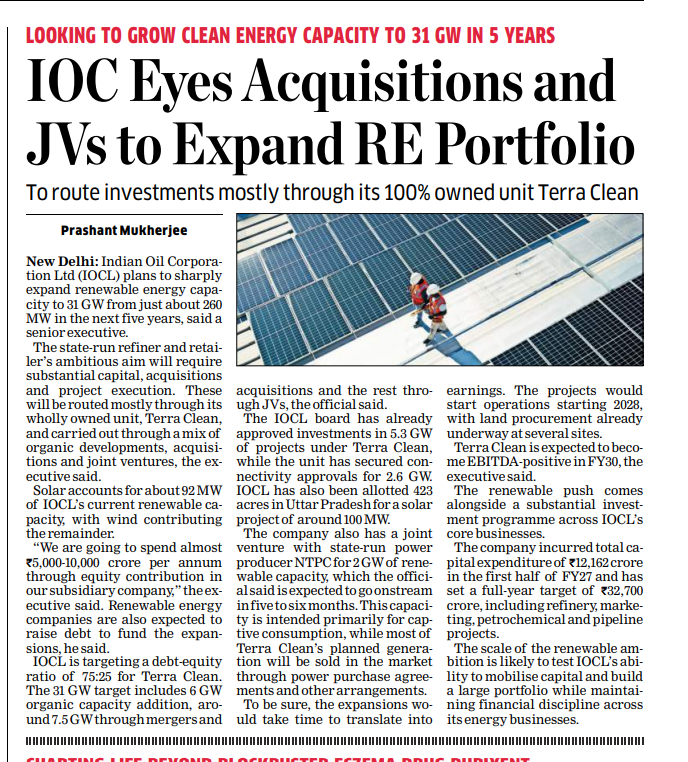
IOC Eyes Acquisitions and JVs to Expand RE Portfolio; Targets 31 GW Clean Energy Capacity in 5 Years from Just 260 MW, Routed Mostly Through Terra Clean
Core Theme
IOCL is betting on a more than 100-fold jump in renewable capacity, from about 260 MW to 31 GW in five years, through Terra Clean via organic builds, M&A and JVs such as the NTPC partnership, funded by ₹5,000-10,000 crore of annual equity and 75:25 debt-equity leverage, but with earnings not expected until after 2028 and Terra Clean EBITDA-positive only in FY30, the plan will stretch the company's capital and financial discipline alongside its ₹32,700 crore core capex.
The Expansion Target
Indian Oil Corporation Ltd (IOCL) plans to sharply expand renewable energy capacity to 31 GW from just about 260 MW in the next five years, said a senior executive
The aim will require substantial capital, acquisitions and project execution
Investments will be routed mostly through its wholly owned unit, Terra Clean, via a mix of organic developments, acquisitions and joint ventures
Solar accounts for about 92 MW of current renewable capacity, with wind contributing the remainder
How the 31 GW Will Be Built
Target includes 6 GW organic capacity addition, around 7.5 GW through mergers and acquisitions and the rest through JVs
The IOCL board has already approved investments in 5.3 GW of projects under Terra Clean, while the unit has secured connectivity approvals for 2.6 GW
IOCL has been allotted 423 acres in Uttar Pradesh for a solar project of around 100 MW
A JV with state-run power producer NTPC for 2 GW of renewable capacity is expected to onstream in five to six months
That capacity is intended primarily for captive consumption, while most of Terra Clean's planned generation will be sold in the market through power purchase agreements and other arrangements
Funding Plan
IOCL will spend almost ₹5,000-10,000 crore per annum through equity contribution in its subsidiary
Renewable energy companies are also expected to raise debt to fund the expansions
IOCL is targeting a debt-equity ratio of 75:25 for Terra Clean
Timeline and Profitability
Expansions will take time to translate into earnings
Projects would start operations from 2028, with land procurement already underway at several sites
Terra Clean is expected to become EBITDA-positive in FY30
Core Investment Programme
The renewable push comes alongside a substantial investment programme across IOCL's core businesses
Total capital expenditure in the first half of FY27: ₹12,162 crore
Full-year target: ₹32,700 crore, including refinery, marketing, petrochemical and pipeline projects
The scale of the renewable ambition is likely to test IOCL's ability to mobilise capital and build a large portfolio while maintaining financial discipline across its energy businesses
Tile Makers Outperform Peers; Pull Ahead on Growth and Margins as Cost Control and Operating Leverage Help; Cera Remains Preferred Pick
Core Theme
Tile makers delivered their strongest growth in 15 quarters on market-share gains, 12-24% price hikes and operating leverage, outpacing plastic pipes and wood panels on both revenue and margins; with a strong housing backdrop and sector valuations well below historical averages, brokerages stay constructive, preferring Cera, though easing gas costs and a high base could temper growth from FY28.
Sector Performance in Q2 FY27
Building materials were among the top-performing sectors in the quarter (July-September), with revenue growth hitting its highest level in the past four years
Profits were driven by market-share gains and improved realisations
The tile sector outperformed plastic pipes and wood panels on both revenue and operating performance
Pipe and wood panel segments reported revenue growth of 18-22%, while leading tile companies saw top lines expand by 25% in aggregate
Better cost control and operating leverage helped tile companies expand operating profit margins, while plastic pipes and wood panels saw a decline or slight growth in margins
Company-Wise Performance
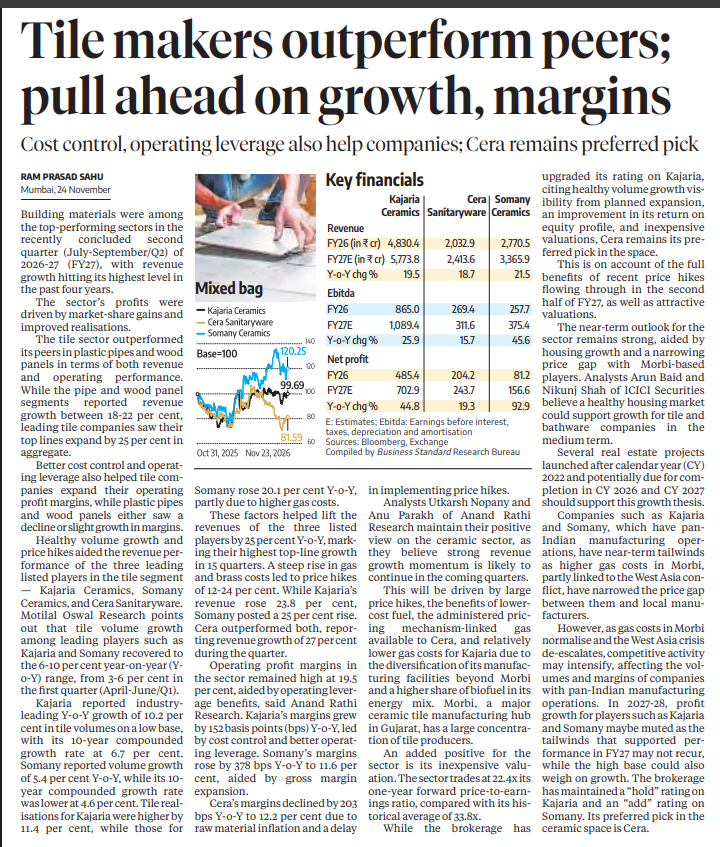
Revenue of the three listed tile players rose 20.1% Y-o-Y, their highest top-line growth in 15 quarters
A steep rise in gas and brass costs led to price hikes of 12-24%
Kajaria Ceramics: revenue up 23.8%; volumes up 10.2% (industry-leading) on a low base; margins grew by 152 bps Y-o-Y, led by cost control and better operating leverage
Somany Ceramics: revenue up 25%; volume growth 5.4%; margins rose 378 bps Y-o-Y to 11.6%, aided by gross margin expansion
Cera Sanitaryware: revenue growth of 27%; margins declined 203 bps Y-o-Y to 12.2% due to raw material inflation and a delay in implementing price hikes
Tile realisations for Kajaria were higher by 11.4%, while those for Somany rose 20.1% Y-o-Y, partly due to higher gas costs
Key Financials
Kajaria: FY26 revenue ₹4,830.4 cr, FY27E ₹5,773.8 cr (+19.5%); Ebitda ₹865 cr to ₹1,089.4 cr (+25.9%); net profit ₹485.4 cr to ₹702.9 cr (+44.8%)
Cera: FY26 revenue ₹2,032.9 cr, FY27E ₹2,413.6 cr (+18.7%); Ebitda ₹269.4 cr to ₹311.6 cr (+15.7%); net profit ₹204.2 cr to ₹243.7 cr (+19.3%)
Somany: FY26 revenue ₹2,770.5 cr, FY27E ₹3,365.9 cr (+21.5%); Ebitda ₹257.7 cr to ₹375.4 cr (+45.6%); net profit ₹81.2 cr to ₹156.6 cr (+92.9%)
Outlook and Brokerage Views
Anand Rathi Research (Utkarsh Nopany, Anu Parakh) expects strong revenue momentum to continue, driven by large price hikes, lower-cost fuel, the administered pricing mechanism and diversification of manufacturing facilities beyond Morbi
Kajaria benefits from a higher share of biofuel in its energy mix; Morbi, a major hub in Gujarat, has a large concentration of tile producers
Sector trades at 22.4x one-year forward P/E, versus a historical average of 33.8x
ICICI Securities (Arun Baid, Nikunj Shah): upgraded Kajaria on healthy volume visibility, improved ROE and inexpensive valuations; Cera remains preferred pick on full benefits of price hikes in H2 FY27 and attractive valuations
Near-term outlook is strong, aided by housing growth and a narrowing price gap with Morbi-based players
Several real estate projects launched after CY2022 are due for completion in CY2026 and CY2027, supporting the growth thesis
Kajaria and Somany have near-term tailwinds as higher gas costs in Morbi, partly linked to the West Asia conflict, narrowed the price gap with local manufacturers
Risks: as gas costs normalise and the West Asia crisis de-escalates, competitive activity may intensify; in FY28, profit growth may moderate given the high base
Ratings: "hold" on Kajaria, "add" on Somany, with Cera the preferred pick
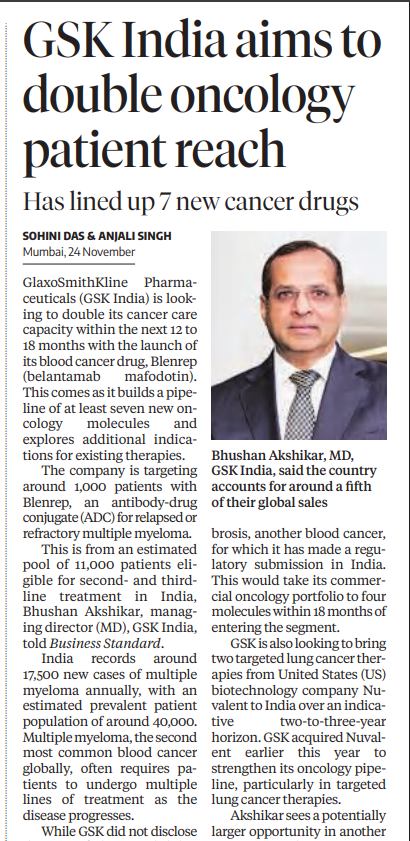
GSK India Aims to Double Oncology Patient Reach Within 12-18 Months; Targets 1,000 Myeloma Patients with Blenrep, Has 7+ New Cancer Drugs in Pipeline
Core Theme
GSK India is making oncology a central growth engine, using the Blenrep launch, a pipeline of at least seven cancer molecules and acquired Nuvalent lung cancer assets to double its cancer patient reach within 12-18 months, while pushing innovative therapies from 8% to 15% of turnover and expanding into hepatitis B, RSV and liver disease to double its ₹4,000 crore business by the end of the decade.
The Blenrep Launch
GSK India (GlaxoSmithKline Pharmaceuticals) aims to double its cancer care capacity within 12 to 18 months with the launch of its blood cancer drug Blenrep (belantamab mafodotin)
Blenrep is an antibody-drug conjugate (ADC) for relapsed or refractory multiple myeloma
Targeting around 1,000 patients out of an estimated pool of 11,000 patients eligible for second- and third-line treatment in India, said Bhushan Akshikar (MD, GSK India), to Business Standard
India records around 17,500 new cases of multiple myeloma annually, with an estimated prevalent population of around 40,000
Multiple myeloma is the second most common blood cancer globally and often requires multiple lines of treatment
GSK did not disclose Blenrep's price, but Akshikar said its per-visit pricing would be comparable to the existing standard of care, Darzalex (daratumumab), which costs around ₹2.3 lakh per vial
Overall cost of treatment could be lower owing to potential requirement for fewer treatment cycles
GSK will also offer patient assistance programmes
Oncology Business Today
GSK entered oncology in India in August 2025 with Jemperli (dostarlimab) for endometrial cancer and Zejula (niraparib) for ovarian cancer
The two drugs together reached around 1,000 patients, per Akshikar
GSK India currently has an annual turnover of around ₹4,000 crore and aims to double it by the end of the decade
Innovative therapies are expected to drive a significant part of the incremental business
New molecules currently account for about 8% of turnover, with the company targeting an increase to 15% over the next three years
India accounts for around a fifth of GSK's global sales volumes and is among its two largest markets by volume
New Launch Plans
Momelotinib is the next oncology launch, a treatment for myelofibrosis (another blood cancer), for which GSK has made a regulatory submission in India
This would take its commercial oncology portfolio to four molecules within 18 months of entering the segment
GSK is also looking to bring two targeted lung cancer therapies from US biotech Nuvalent to India over an indicative two-to-three-year horizon; GSK acquired Nuvalent earlier this year to strengthen its oncology pipeline
Akshikar sees a potentially larger opportunity in another investigational ADC targeting the B7-H3 protein, which is being explored across 17 potential cancer indications
Small-cell lung cancer alone represents a patient pool of around 8,000 in India
The broader oncology pipeline includes a B7-H4-targeting ADC (for gastrointestinal stromal tumours) and a drug targeting HER2-altered lung cancer
GSK is exploring additional indications for Jemperli, including head and neck cancer and colorectal cancer, which could expand the addressable market
Growth Beyond Oncology
GSK has submitted regulatory dossiers in India for bepirovirsen, an investigational treatment aimed at achieving a functional cure for chronic hepatitis B
Also has its adult respiratory syncytial virus (RSV) vaccine, Arexvy
Clinical trials are underway for efimosfermin, an investigational treatment for metabolic dysfunction-associated steatohepatitis, a form of fatty liver disease
GSK has 33 clinical trials in India, with more than half in oncology
It is including India in its global drug development programmes to narrow the gap between international and domestic launches
Olectra to Enter Electric Truck Market with 6 Models in Q1FY28; Targets Medium and Heavy Commercial Vehicles Across Ports, Steel, Cement and Mining
Core Theme
Olectra Greentech is diversifying beyond electric buses into electric trucks, planning a staggered rollout of six medium and heavy commercial vehicle models from Q1FY28, backed by 10-12 prototypes under testing, and aimed at industrial and logistics-heavy sectors such as ports, steel, cement and mining.
The Launch Plan
Olectra Greentech is preparing to enter the electric truck market with the launch of six models
Launches are planned from the first quarter of FY28 (April-June 2027)
The company expects to launch one truck every quarter starting from that period
Said Mahesh Babu, Managing Director, Olectra Greentech, in an interview with PTI
Strategy and Focus
The move comes as the electric bus maker looks to expand its presence in the commercial vehicles segment
Focus will be on medium and heavy commercial vehicle segments
Currently working on 10-12 prototypes for testing across different locations
Target Applications
The Hyderabad-based company is targeting applications across ports, steel, cement, e-commerce, road construction and mining
These are sectors where commercial vehicles are used for transporting goods and materials
Aluminium Body Seeks Import Duty Hike, Says ₹4 Trillion Pipeline at Risk; AAI Wants 10% Duty on Primary Aluminium and 15% on Downstream Products in Pre-Budget Proposals
Core Theme
India's aluminium industry is lobbying for higher import duties, a 91% aluminium purity floor on scrap and plug-and-play downstream parks in the 2027-28 Budget, arguing that these steps are essential to secure a ₹4 trillion capacity expansion (from 4.3 to 11 mtpa by FY33) and cut a ₹88,434 crore import bill as domestic demand nearly doubles.
The Pre-Budget Asks
The Aluminium Association of India (AAI) wants higher import duties on aluminium products and mandatory quality standards for imported scrap, as part of its pre-Budget 2027-28 proposals
It has also asked the government to support downstream aluminium parks
The measures are needed to protect the proposed investment of ₹4 trillion
Recommendations were submitted to the Ministries of Finance; Commerce and Industry; and Mines, and the Department for Promotion of Industry and Internal Trade
Key Demands
Primary aluminium: raise basic Customs duty (BCD) to 10%
Downstream products: raise duty to 15%
Scrap duties: maintain or increase import duties, in line with those for primary aluminium, until mandatory quality controls are introduced
Scrap quality: permit imported scrap only if it contains more than 91% aluminium, in line with the government's "Aluminium Vision Document" and standards followed by other countries
Expected Benefits (per AAI)
Help reduce foreign-exchange outflow
Strengthen the domestic scrap market
Encourage responsible recycling and promote a circular economy
Ensure a larger share of India's demand is met through domestic production
Demand and Investment Outlook
India's aluminium demand is projected to rise from around 6 million tonnes in FY26 to 11.5 million tonnes by FY33
Adding 1 million tonnes of capacity requires approximately ₹60,000 crore of investment, making a stable and predictable policy framework important for long-term decisions
Industry's proposed investment will enhance capacity from 4.3 mtpa to 11 mtpa by FY33, with opportunities for doubling employment, growth in MSMEs and greater value addition
AAI said aluminium imports in FY26 resulted in a foreign-exchange outgo of ₹88,434 crore
Downstream Aluminium Parks
AAI wants government support for parks in a plug-and-play model
Parks would give downstream manufacturers access to common infrastructure and hot metal, reducing remelting and logistics costs
Intended to strengthen domestic manufacturing, encourage value addition, and support employment and exports
Adani Signs $1 Billion Copper Supply Deal with Attero for 3 Years; Kutch Copper to Get 2,000 Tonnes of Copper Anode Monthly, Cutting Import Reliance by About 5%
Core Theme
Adani's $1 billion, three-year copper anode deal with Attero, alongside its Chile exploration tie-up with Codelco, shows the group securing both recycled and mined feedstock to support Kutch Copper's planned doubling to 1 million tonnes, even though the Attero volumes trim import dependence by only about 5%, leaving India's smelters still heavily reliant on imported supply.
The Deal
Adani Enterprises has signed a three-year deal worth about $1 billion to source copper anode for its smelting operation from recycler Attero, two sources said
Deal is worth around $1 billion at current market prices
Signed about three months ago and not previously disclosed
Adani did not respond to a request for comment
It will ease India's dependence on imports of the scarce feedstock
What Adani Gets
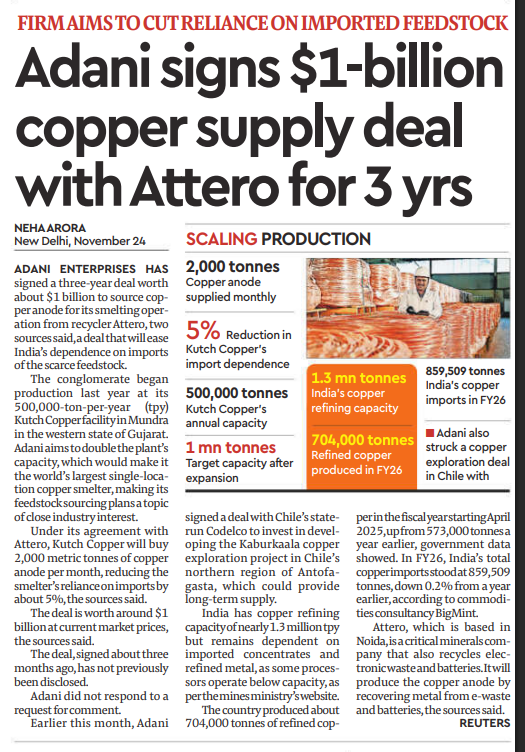
Under the arrangement, Kutch Copper will buy 2,000 metric tonnes of copper anode per month
This reduces the smelter's reliance on imports by about 5%
Attero, based in Noida, is a critical minerals company that also recycles electronic waste and batteries
It will produce the copper anode by recovering metal from e-waste and batteries
Kutch Copper and Expansion Plans
Adani began production last year at its 500,000-tonne-per-year (tpy) Kutch Copper facility in Mundra, Gujarat
Aims to double the plant's capacity to 1 million tonnes, which would make it the world's largest single-location copper smelter
Expansion has made its feedstock sourcing plans a topic of close industry interest
Adani also struck a copper exploration deal in Chile with state-run Codelco to develop the Kaburkaala copper exploration project in Antofagasta, which could provide long-term supply
The Chile deal was signed earlier this month
India's Copper Landscape
India has copper refining capacity of nearly 1.3 million tpy, but remains dependent on imported concentrates and refined metal, as some processors operate below capacity, per the mines ministry's website
The country produced about 704,000 tonnes of refined copper in the fiscal year starting April 2025, up from 573,000 tonnes a year earlier
India's total copper imports in FY26 stood at 859,509 tonnes, down 0.2% from a year earlier, according to commodities consultancy BigMint