Surprise! It’s possible to generate revenue via advertising without tracking users
@guardian launches contextual advertising service for those users who reject tracking via the dozens of cookies that websites use nowadays.
A different web is possible.
https://t.co/n0c8hqthUy
How is this article really about "The EU prepares for war"?
Seriously, @POLITICOEurope, words really matter, especially in times like these. Media shouldn't go around contributing to a warmongering narrative.
The Tonnerre, France’s powerful amphibious helicopter carrier, is a self-sufficient mini-town.
Aboard, there is a 69-bed hospital, a dentist, gyms — and even a boulangerie.
https://t.co/CZS2INlLBk
Very thought provoking @EUScream episode on Eurowhiteness and the civilisationalism that is alive and kicking at the heart of today’s European project. An essential reflection for European citizens about the Europe we want to build.
“Pro-Europeans” can also be nativists, says @MehreenKhn in this @euscreams podcast with @HelenaMalikova and me - and the onus is on other “pro-Europeans” who are not nativists to challenge nativist (or civilisational) narratives. https://t.co/9tDLxASRHN
SO good -- the best follow the money reporting on who's behind the global attack on digital privacy yet.
TLDR: it's law enforcement x AI companies posing as NGOs w a commercial interest in selling scammy mass scanning tech. Deeply cynical, deeply shady.
https://t.co/RTXYvUwArK
We've failed to build transparency, accountability and respect for human rights in the ad ecosystem that fuels the internet economy.
Now it's a matter of security too. No time to waste.
Time to act - @EU_EDPS@vestager@ThierryBreton
Thanks @omerbenj!
We live in a digital ecosystem that is invasive-by-design and poorly regulated...
Naturally, intel agencies and the firms that service them have found ways to exploit surveillance capitalism for targeted espionage.
Nice deep dive into "AdInt" by @omerbenj 👇
Testing out @HeyGen_Official translation on French and German. I don’t speak either language so let me know if it sounds natural if you do.
I hope if you pay you can turn off the color correction.
It didn’t work on my phone so I had to upload on my pc.
https://t.co/FMJp9sJEBI
🚨🚨WE URGE EVERYONE TO UPDATE THEIR APPLE DEVICES AS SOON AS POSSIBLE.
We have found an actively exploited #zero#click vulnerability that was used to deliver #NSO group’s #Pegasus#spyware.
https://t.co/BS0ZI4QuIz
🚨An extremely wide range of experts have warned against the misguided & dangerous measures in the @EU_Commission's Child Sexual Abuse Material Regulation #CSAR. See the summary below. ↩️
Like this thread and pass it on!🧵
#StopScanningMe
Video & audio calls coming to X:
- Works on iOS, Android, Mac & PC
- No phone number needed
- X is the effective global address book
That set of factors is unique.
12 Reasons Why Cities Need More Trees:
1. Temperature Control
One large tree is equivalent to 10 air conditioning units, and the shade they provide can reduce street temperature by more than 30%.
2. Noise Reduction
Trees can reduce loudness by up to 50%. In urban areas filled with the sound of cars, construction, sirens, aeroplanes, and music, trees are essentially the best way to block noise and keep cities — along with the homes and workplaces in them — quieter.
3. Air Purity
Trees remove an astonishing amount of harmful pollutants and toxins from the air. In urban areas air quality is often disastrously bad — with severe consequences for our health. Trees make the air we breathe much cleaner.
4. Oxygen
And, while absorbing all those pollutants, trees also put more oxygen back into the urban environment. Oxygen levels are significantly lower in cities compared to the countryside; trees help to solve that problem.
5. Water Management
Trees do more than just shelter us and our buildings from rain — which is, in fact, extremely important. They also absorb huge quantities of water, reduce run-off, neutralise the severity of flooding, and make flooding more unlikely altogether. Not to forget that their roots absorb pollutants and prevent them from feeding back into a city's water supply.
6. Psychological Health
Studies have proven what we instinctively know to be true: that human beings are significantly happier when surrounded by nature rather than sterile urban environments. Our emotions, behaviour, and thoughts are shaped by the places we spend time — and trees have a profoundly positive effect on our psychology. The consequential benefits of being happier and more peaceful — as individuals and as a society — are immense.
7. Physical Health
Beyond all the other ways in which trees improve air quality and the urban environment, much to the benefit of our health, they also encourage people to go outside. Cycling, running, and walking are all more common in urban areas with plenty of trees. A knock-on effect of people spending more time outdoors is also social integration and stronger communities.
8. Privacy
A simple point, but not inconsequential, is that trees provide privacy.
9. Economics
The total economic benefit of urban trees is hard to calculate. There are costs, of course, including the repair of infrastructure damaged by roots and maintaining the trees themselves. But the total economic benefit — a consequence of everything else in this list and more — far outweighs the expenditure. Trees make cities wealthier.
10. Wildlife
Trees are miniature cities all of their own, serving as a habitat for hundreds of different species, including birds and mammals and insects.
11. Light Pollution
Trees don't only block the light shining down, therefore keeping us and our cities cooler — they also disrupt light shining up, from street lighting, cars, houses, and billboards. Skies are clearer in cities with more trees.
12. Aesthetics
And, finally, trees are beautiful. They break up the potential monotony of urban environments — the sharp geometry, the greyscale roads and buildings, the endless rows of cars — with their trunks, boughs, canopies, and flowers.
Just think: the gold and red of falling leaves in autumn, the white and pink blossom of spring, the vast green canopies of summer, and the branches lined with hoar-frost in winter. Every single tree is a myriad of intricacy and texture, of colour and scent, of dappled light on the pavement, mottled bark, knotted roots, of clustered leaves and delicate petals and stern boughs.
Few streets would not be improved by the kaleidoscopic aesthetic delights of a tree, not to mention the many different species of tree, all over the world, whether willow, oak, lime, cherry, aspen, maple, birch, horse chestnut, dogwood, hornbeam, ash, sycamore... the list goes on.
There are some drawbacks to urban trees, most of them context-specific, and they are not — of course — universally appropriate. But it seems fair to say that many cities would benefit from at least a few more trees here and there.
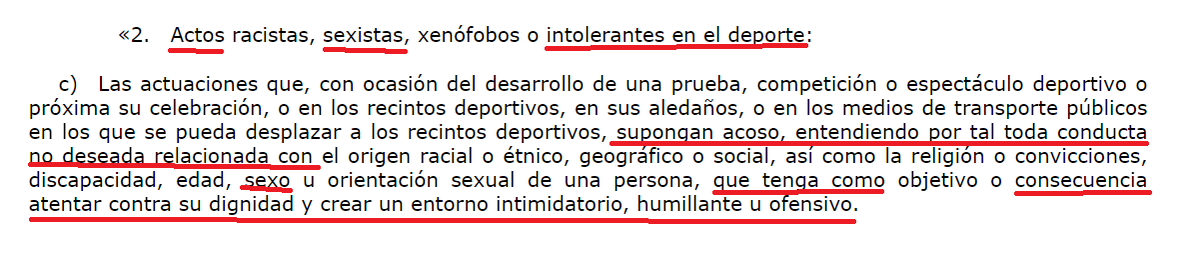
¿Qué dice la Ley 39/2022 del Deporte del acto de #RubialesDimision hacia la jugadora de fútbol de la #SeleccionFemenina en la entrega del trofeo de #MundialFemenino2023?
Para empezar, según la Disp. Final 1ª, "Se trata de un acto sexista intolerable en el deporte"
Abro hilo👉
🛟Hoy llegó cayuco a La Gomera, algo poco habitual. A bordo, 36 personas. Hubo un traslado al hospital. Había 3 menores a bordo. Salieron desde Saint Louis, Senegal.
En los últimos días ha habido varios niños pequeños y bebés desde Senegal. También alguna familia completa 📝
Tienes a 23 mujeres que mañana harán historia, y que han luchado por romper barreras sociales que llevaban siglos establecidas.
Ellas, y sus antecesoras, han cambiado el cuento, y ahora las niñas pueden ser futbolistas.
¿A quién ponen los dos grandes medios en portada? A Vilda.