🚨🚨Comunicado de todas las asociaciones de jueces y fiscales profesionales e independientes , ante los gravísimos hechos de acoso, denigración y hostigamiento a la magistrada Beatriz Biedma, que se están publicando en los medios de comunicación, que contrastan con la vergonzosa y tibia nota del CGPJ y con el
impresionante silencio de algunos.
Creo que este duro comunicado debe ir acompañado de otras actuaciones que se intuyen en su párrafo final, y que deberían pasar por la inmediata comunicación a las instituciones europeas de lo que aquí está ocurriendo e incluso, cuando la investigación avance y se concreten las imputaciones, por el ejercicio de las oportunas acciones legales.
A ti que lees esto y te indignas, te pido que retuitees y difundas 👇👇
Richard Feynman ganó el Nobel de Física y dijo algo que dejó huella:
"La mayoría de personas saben muchas cosas. Pero no saben pensar."
Feynman dio una clase magistral de 1 hora sobre física e imaginación.
Sus 12 lecciones de vida:
1. La imaginación le gana al conocimiento
✨ Mejora la imagen de tu marca sin ser diseñador/a
Curso gratuito “Marketing visual y diseño con herramientas digitales”
• Diseños profesionales #Canva
• Vídeos impactantes #CapCut
• Contenido visual
📅 20– 30/abril
🕓 16:00–19:30
📍 @PalmaActiva
🔗 https://t.co/hzgetgi3OT
Mallorca recupera una peça clau de la seva història.
Formalitzam a Londres l’adquisició de la carta portolana de Pere Rossell, una de les joies més valuoses de la cartografia medieval mallorquina.
Després de més de cinc segles, aquesta obra excepcional torna a casa i passa a formar part del patrimoni públic de tots els mallorquins.
Una fita històrica que reforça el paper de Mallorca com a referent en la cartografia medieval i garanteix la conservació i difusió d’un llegat únic per a les generacions futures.
A partir del mes de juny, la ciutadania la podrà visitar al @MuseudeMallorca.
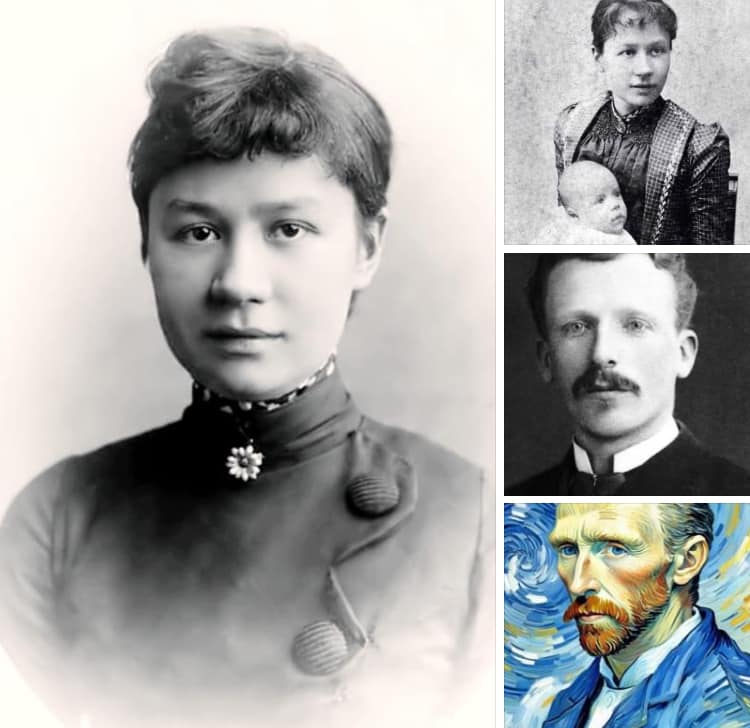
29 de julio de 1890, Vincent van Gogh muere en una pequeña habitación en Francia con apenas 37 años, sin reconocimiento, sin éxito y habiendo vendido prácticamente una sola pintura en toda su vida, mientras su hermano Theo, la única persona que creyó realmente en él, muere apenas seis meses después, dejando tras de sí no solo el dolor, sino también un legado que, en ese momento, parecía no tener ningún valor: cientos de cuadros que nadie quería y cartas que pocos habrían considerado importantes.
Todo terminó en manos de una mujer de 28 años, Jo van Gogh-Bonger, viuda, con un hijo pequeño, sin recursos y con un apartamento lleno de obras que el mundo había rechazado, una situación en la que la mayoría habría vendido todo por lo que fuera posible para sobrevivir y seguir adelante, pero ella decidió hacer exactamente lo contrario, porque donde otros veían fracaso, ella vio algo distinto, algo que merecía ser entendido antes de ser juzgado.
Jo empezó por las cartas, por ese diálogo íntimo entre Vincent y Theo que revelaba no a un hombre roto sin sentido, sino a un artista profundo, consciente, obsesivo con su obra y con su forma de ver el mundo, así que las tradujo, las organizó y las compartió, permitiendo que la gente empezara a ver más allá de la imagen simplificada de “genio loco” y entendiera la dimensión real de su pensamiento, mientras al mismo tiempo organizaba exposiciones, contactaba con críticos y defendía una idea que nadie estaba dispuesto a aceptar: que Vincent van Gogh era un gran artista.
Durante décadas sostuvo esa convicción incluso cuando necesitaba dinero, negándose a vender las pinturas a cualquier precio porque entendía que su valor no estaba en el mercado del momento, sino en el tiempo, y gracias a esa decisión, a esa resistencia silenciosa pero firme, el nombre de Van Gogh empezó poco a poco a ocupar el lugar que hoy consideramos evidente, hasta convertirse en una figura central de la historia del arte, con obras en museos y un legado que millones reconocen.
Jo nunca pintó un cuadro, pero sin ella, probablemente nadie conocería a Vincent como lo conocemos hoy, porque no solo conservó su obra, sino que construyó el puente necesario para que el mundo pudiera entenderla, demostrando que a veces el talento necesita algo más que existir: necesita a alguien que crea en él cuando nadie más lo hace.
@PabloIglesias@DiazCanelB Si regresas a España te darán de tu jarabe democrático. Escraches dónde vayas por parte de los cubanos residentes en este, su país de acogida, huidos de la dictadura que apoyas !
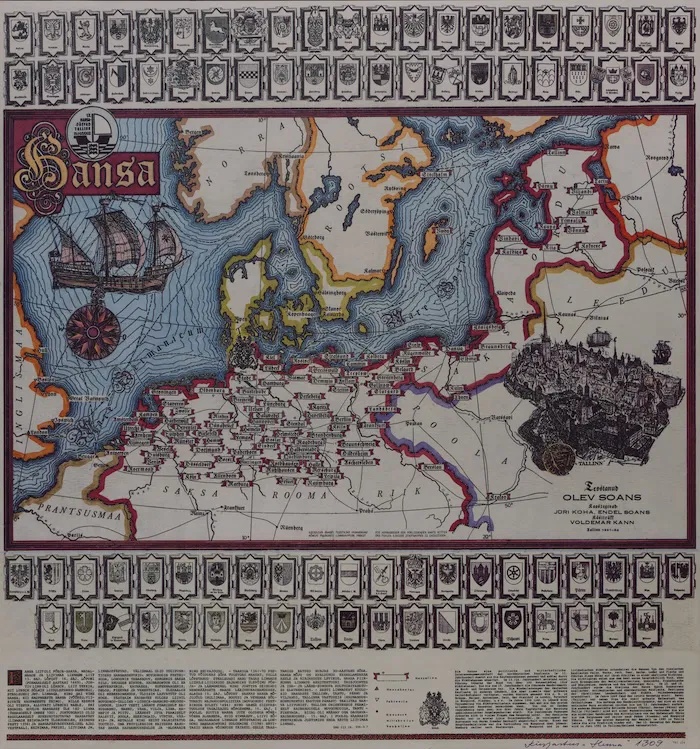
The Hanseatic League solved commercial disputes for 400 years without a single government court, police force, or regulatory agency—and they did it better than any modern state system.
From 1159 to 1669, German merchants spanning from London to Novgorod created the most sophisticated private arbitration network in history. When a Hamburg trader accused a Lübeck merchant of breach of contract, they didn't petition some distant king or wait months for bureaucratic tribunals. They brought their dispute before merchant courts staffed by actual businessmen who understood trade, contracts, and reputation. These arbitrators rendered decisions within days, not years.
The enforcement mechanism? Pure market discipline. The League maintained detailed records of every merchant's behavior and shared this information across all member cities. Cross a Hanseatic trader in Bergen, and you'd find yourself blacklisted from Riga to Bruges within weeks. No bailiffs, no jackbooted enforcers, no violence—just the inexorable power of reputation and voluntary association. And it worked spectacularly. The League dominated Northern European commerce for half a millennium precisely because merchants trusted their dispute resolution more than royal courts.
But here's what modern lawyers and judges will never tell you: the Hanseatic system resolved disputes faster, cheaper, and more accurately than contemporary government courts. Why? Because the arbitrators actually understood commerce and faced real consequences for bad decisions. Screw up a ruling as a Hanseatic arbitrator, and merchants would stop using your services. Screw up as a federal judge today, and you get lifetime tenure.
The League died when centralized nation-states crushed private governance with military force, not because their system failed. Every blockchain arbitration platform and private dispute resolution service today merely rediscovers what German merchants perfected 800 years ago.
"Entras. Seleccionas tu comunidad autónoma. Dices si eres asalariado, autónomo, o ambos. Marcas tu situación: si tienes hijos, si alquilas, si inviertes, si cuidas a alguien. Y te dice cuáles de las 375 deducciones te corresponden. Con una estimación de cuánto puedes ahorrarte. Sin pedirte el NIF. Sin registro. Sin datos personales. La información es de la AEAT. Yo solo he hecho legible para ti y para mí."
https://t.co/Y8VmoaJmVM
Productazo que acaba de lanzar @paumrch
@codepink That’s miserable. A real safari !! Do you know you are visiting a narco state ? Check the luggage of your boss there so the deal is done behind your eyes. The 99,9% of the people in Cuba is against Diaz-Canel.
Se confirma lo que sospechábamos:
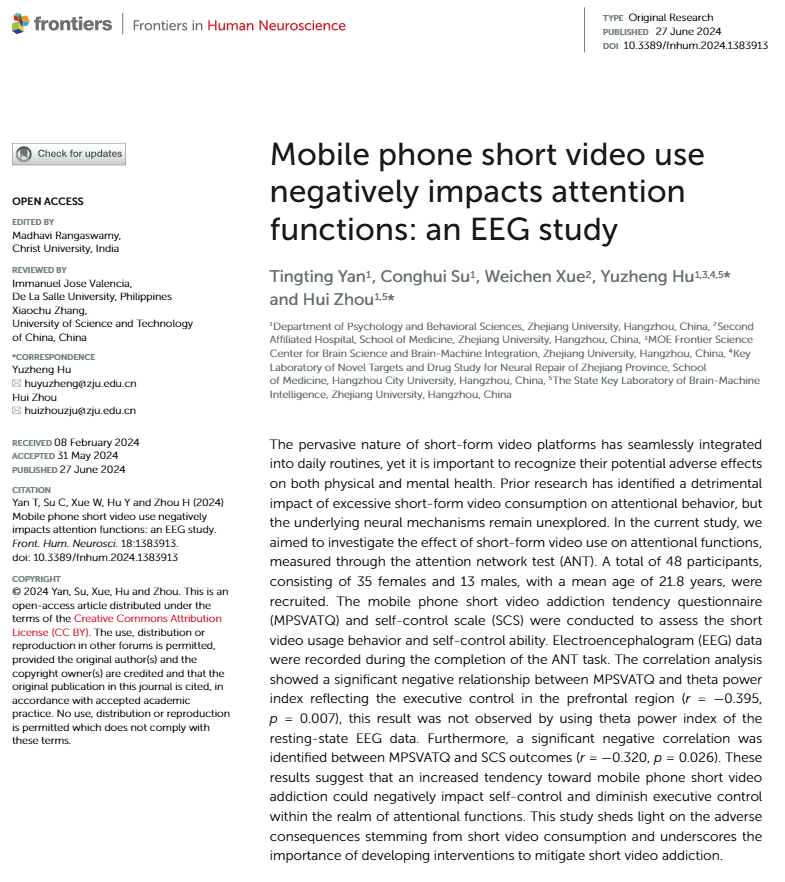
La adicción a los vídeos de corta duración reduce la actividad cerebral en el lóbulo frontal, debilitando la capacidad de concentración.
Hoy hace 6 años que Pedro Sánchez se comprometió públicamente conmigo: que él y su gobierno darían ayudas para vivir a los enfermos de ELA.
Hoy seguimos sin ninguna ayuda pública en funcionamiento que contempla la #LeyELA para no vernos obligados a morir —los que desean vivir— por una cuestión económica.
¿Cuántas leyes están funcionando perfectamente en estos 6 años que no salvan vidas?
Lo que hicieron realmente es borrar el rastro de todos los millones de euros robados durante años por estos corruptos.
Así es cómo lo descubrió el trabajador de Resilis y cómo desde Esquerra Republicana lo están intentando callar.👇
The richest people in the world are quietly switching to flip phones. Not because they’re old. Not because they hate technology.
But because smartphones are destroying something far more valuable than money. Most people won’t realize it until it’s too late.
At a private dinner, a banker friend of mine noticed something strange.
Every billionaire at the table pulled out a button phone.
No apps. No notifications. No glowing screens.
It felt less like coincidence and more like a silent agreement.
He finally asked:
“Why don’t any of you use smartphones?”
The room went quiet.
Then someone said:
“Because every notification is someone else controlling my mind.”
To them, smartphones aren’t tools anymore.
They’re attention leaks.
Every buzz pulls focus.
Every scroll fragments thinking.
Every algorithm trains reaction instead of intention.
And attention is the rarest currency on Earth.
One billionaire said something chilling:
“Money is easy to make again. Focus is not.”
He explained that once attention breaks, decision quality collapses.
And bad decisions destroy fortunes faster than bad markets.
So they simplified.
Old phones. One function. Call. Message. Off.
No feeds competing for dopamine.
No endless mental noise.
No invisible manipulation.
Just silence, on command.
Ironically, the wealthier they became, the less technology they personally touched.
Their assistants manage screens.
They manage thinking.
Because power isn’t access to information—it’s control over your inner world.
One investor admitted:
“Quitting my smartphone lowered my anxiety more than therapy.”
Not because life became easier, but because his mind finally stopped being pulled in 100 directions.
He could hear his own thoughts again.
Meanwhile…
Most people wake up and touch their phone before touching their own awareness.
News. Fear. Comparison. Noise.
The mind gets hijacked before the day even begins.
The elite understand something most never learn:
If you don’t decide how your attention is used, someone else will decide for you.
And they will profit from it.
This is why flip phones became a status symbol.
Not because they’re cheaper, but because they signal independence.
“I choose when I connect.”
“I choose when I consume.”
“I choose when I disappear.”
Real luxury isn’t faster internet.
It isn’t the newest device.
It isn’t constant access.
Real luxury is mental silence.
Undisturbed thinking.
And time with yourself.
That’s the upgrade money can’t buy—unless you protect it.
That’s why 2 Rules of Michael Saylor’s (@saylor) 10 Rules for Life hit so hard:
Focus your energy
Guard your time
[see the full 10 + 2 pinned to my profile]
Assuming you’re not ready to ditch the smartphone yet, here’s how to reclaim focus and turn X into your superpower:
• No more doom scrolling or rage bait—mute, block, curate Lists for signal only.
• Use search intentionally: Dive into inflation, taxes, Bitcoin strategies instead of reactive feeds.
• Set strict notification rules and time blocks.
Reading the right things catapults you toward financial independence.
Grab “The Millionaire Next Door” and “The Bitcoin Standard” (free audiobook on YouTube).
Want to dig deeper on why digital minimalism is the real power move? Ever heard of Cal Newport’s 2019 book Digital Minimalism: Choosing a Focused Life in a Noisy World?
This builds on his earlier ideas from Deep Work (focused, high-value effort) and tackles how constant digital noise—smartphones, apps, notifications, social media—fragments attention, spikes anxiety, and erodes meaningful living.
Core Definition of Digital Minimalism
Newport defines it as:
A philosophy of technology use in which you focus your online time on a small number of carefully selected and optimized activities that strongly support things you value, and then happily miss out on everything else.
Thread 🧵
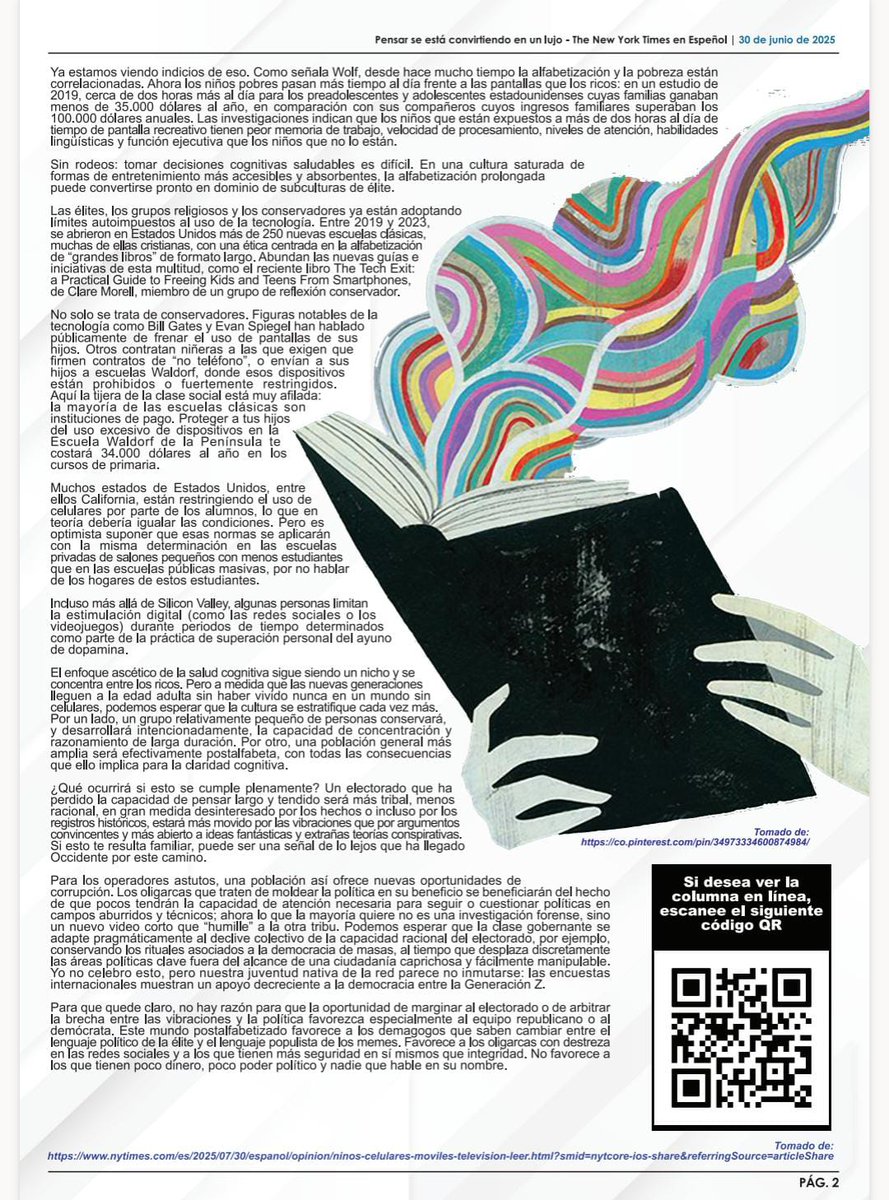
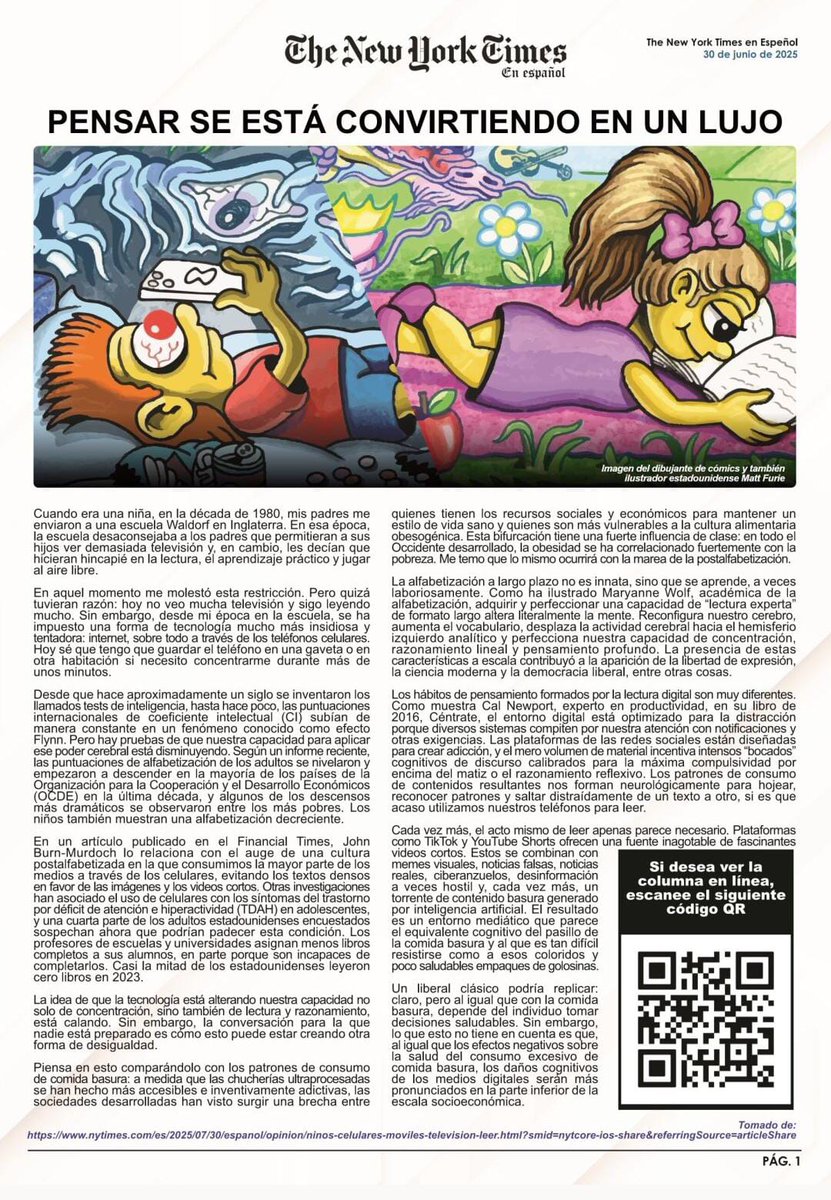
Recomiendo este excelente artículo del NYT. Harrington sostiene que están formando a una generación para vea videos cortos y piense poco. Con el tiempo, aumentará la desigualdad social. Los hijos de ricos leerán textos profundos y complejos, y los de pobres leerán poco y muy mal: