Beautifully said 🌷👌 A lyrical reflection on writing, truth, and the way social media and bots distort genuine criticism. The core idea is simple: writing can still invite real debate, but today it is increasingly tangled with noise, ideology, and artificial reactions
Wednesday morning in Thinking Zone, in my small Black Sea village, where I am drinking coffee and observing the world through a wide-open window, while the world, as usual, remains full of people who are entirely convinced that truth is a wonderful thing, provided it is spoken to someone else.
I have always found this amusing.
Everyone loves truth in principle, in much the same way that they love justice, reason, virtue, and vegetables, yet enthusiasm tends to diminish rather dramatically when any of these things appear in close proximity to their own lives.
Which is probably why this morning I find myself thinking about Voltaire and his brief observation: “He who has a pen has a war.”
Not because writers are particularly warlike people, but because the simple act of describing the world contains an unfortunate characteristic, namely that the moment you say what you see, it immediately turns out that someone else has invested a considerable portion of their life in not seeing it.
And that is when the entire performance begins.
One person defends a conviction, another defends a vanity, a third defends an ideology, a fourth defends a career, a fifth defends some illusion particularly dear to their heart, and the person holding the pen suddenly finds themselves accused of creating the conflict, despite the fact that their only offense was opening the window and pointing at what was outside.
The more I observe people, the more I begin to suspect that the true price of writing has never been censorship, criticism, or disapproval.
The true price is considerably higher.
It is the willingness to remain on good terms with truth even when doing so places you on less favorable terms with certain people.
And the Black Sea this morning appears to be in complete agreement with him.
☕️📖🪻
Good morning.
@Pergament_F Beautifully said 🌷👌 A lyrical reflection on writing, truth, and the way social media and bots distort genuine criticism. The core idea is simple: writing can still invite real debate, but today it is increasingly tangled with noise, ideology, and artificial reactions
23 June 1912. Alan Turing was born in London. He was a key influence on theoretical computer science with the Turing machine which is considered a model of a general-purpose computer. His contribution was not recognised during his lifetime, but he’s now the face of the £50 note.
“We have come as far as we have because we are the cleverest creatures to have ever lived on Earth. But if we are to continue to exist, we will require more than intelligence. We will require wisdom.”
— Sir David Attenborough
Amazon's new book delivery service
Cologny, Fondation Martin Bodmer, Cod. Bodmer 49; Christine of Pisan, Epitre d'Othea; c. 1460 CE; France; f.7r (https://t.co/b20lEWwBKE)
"It's not enough to read a book to your kid and then sit there looking at your phone. Your kid is going to want to look at a phone if that's what you're doing... children have to see you reading books." Acclaimed novelist Ann Patchett tells me why she's "evangelical" about the importance of reading and protecting books. "Book banning is a terrible thing. And it's an extraordinary waste of time... it takes up the energy that we need to make children safe from guns."
One of the intriguing and exciting areas of research and probably exquisite imagination is the use of the initials in the beginning of a folio or a text in the mediaeval manuscript. It's really worth a lot of research and careful attention
Struggling with a dragon in an initial 'h'(ebreos)
BnF MS Latin 8959; Flavius Josephus, Antiquitates Judaicae, and Bellum Judaicum; 12th century (1160 CE); Troyes; f.173r @GallicaBnF
Interesting quote, but it is not originally by Einstein. It was likely paraphrased from his ideas on 'holy curiosity” and “the search for truth.' And " I have never fully identified with a country, a state, a circle of friends, or even my own family."
@Pergament_F What a wonderful morning to read this contemplation, with a cup of coffee in hand, awakening the soul. Good morning. ......It feels as though Greek islands stir your mind, just as they have for thousands of years, igniting flames of thought and memory. ☕️🌷
“Being wrong is part of being a scientist. We’re wrong all the time. One of the jokes that I use all the time, but it’s not a joke, it’s really true, is when we got to the point of trying to identify this gene, we had 20 possible genes it could be. I prioritised those genes. The gene that was responsible was the last gene, which means I could not have been more wrong in my prioritisation. It’s absolutely the most wrong thing I could have done. We got it eventually, so it was still there, but it was because there was nothing left. It’s not because I was smart or had any foresight.”
In our official interview with medicine laureate Fred Ramsdell, he told us about the importance of handling failures and being persistent.
Watch the full interview: https://t.co/F0U2k5CXSI
17 June 1950. Dr Richard Lawler performed the kidney transplant in a 45-minute operation in the Little Company of Mary Hospital in Evergreen Park, Chicago, Illinois, USA. The patient was 44 year old Ruth Tucker.
King John of England signed the Magna Carta at Runnymede today in 1215, which established the principle that the king and his government were not above the law.
Erwin Schrödinger once said, "Quantum physics thus reveals a basic oneness of the universe."
He believed quantum theory points to something profound: the separateness we perceive may not be as fundamental as we think.
Do you agree?
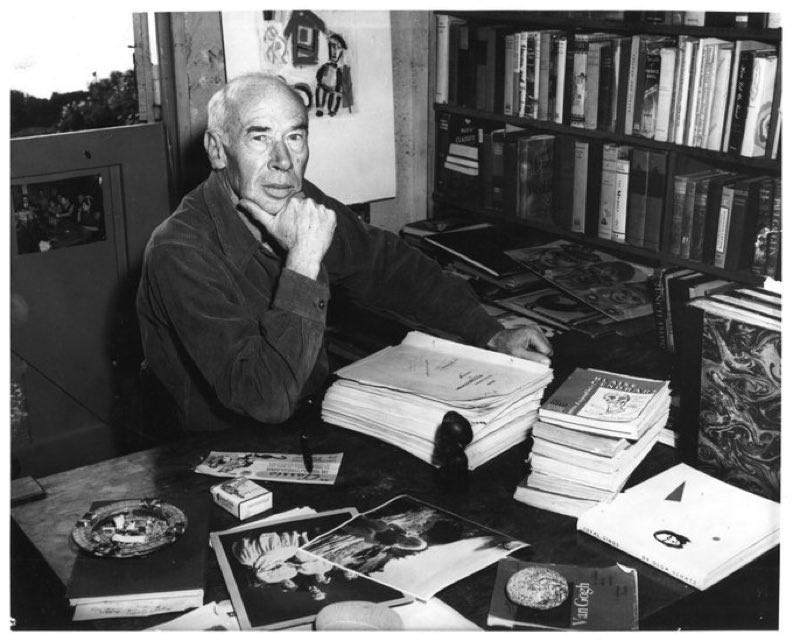
A book is not only a friend, it makes friends for you. When you have possessed a book with mind and spirit, you are enriched. But when you pass it on you are enriched threefold.
— Henry Miller