Si tuviera un fin de semana para dominar Claude, empezaría aquí: https://t.co/nepfUQW21c
Deja de guardar 50 guías que nunca vas a leer. Estas son las únicas que importan:
(algunas guías son del jefe Ruben Hassid)
→ Nivel 1 - 17 min: Lo básico.
Claude For Dummies: https://t.co/jlB6IzTaHs
Claude Setup: https://t.co/f1oUvNtNAP
→ Nivel 2 - 1 hora: Flujos de trabajo reales.
Claude Cowork: https://t.co/7jjWe01ZWl
Claude para equipos: https://t.co/z7LEpf9xjr
Claude Design: https://t.co/GCAe64H6AG
Cowork + Projects: https://t.co/O218wA4Sb7
Claude para presentaciones: https://t.co/4M4gX7XCZY
Claude Skills: https://t.co/JsPA2rybvA
→ Nivel 3 - 3,5 horas: Nivel pro.
Evitar la adulación: https://t.co/iRp6XiQtdR
Claude Code: https://t.co/8KRFXLfJ2f
Claude 101: https://t.co/nMFE3CkP55
Deja de alcanzar los límites de Claude: https://t.co/EUtqndF4Y7
Deja de hacer prompting: https://t.co/hXgc6s1sFi
→ Nivel 6 - 8 horas: Modo experto.
Claude Computer: https://t.co/NrFSyiRC3d
Construir con la API de Claude: https://t.co/S4D13vdRJG
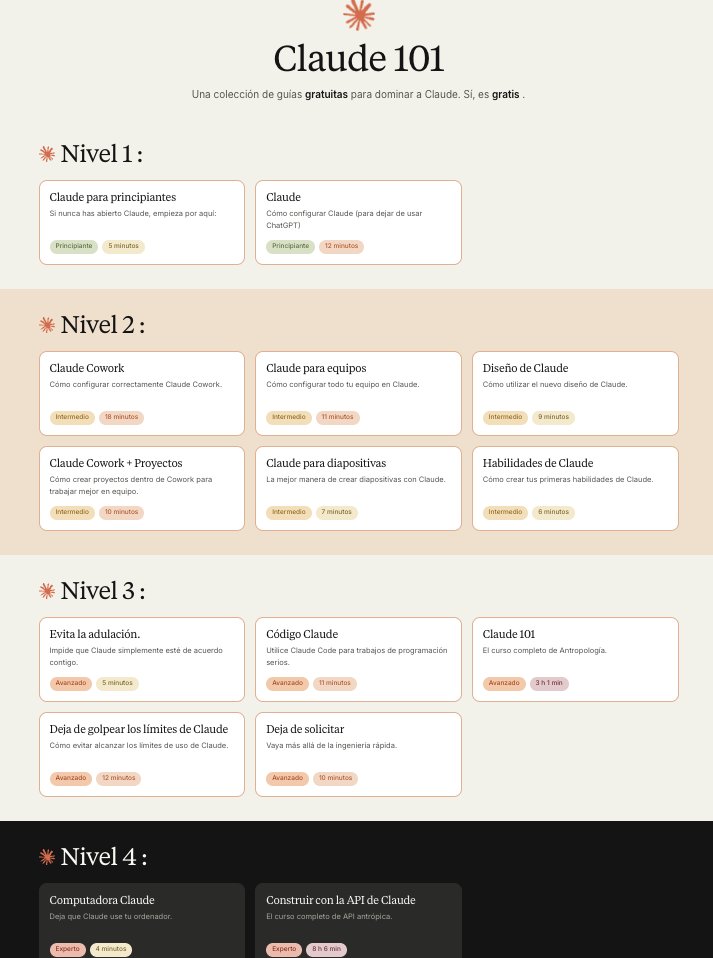
If I travel back to my Interview Days, I will study these 40 Articles to learn system design Fundamentals. These articles and videos will save you 50+ hours of hopping to resources and wasting time.
Btw, if you’re preparing for system design interviews, check out our AI Tutor: https://t.co/D3IATtNW7T
You can:
- voice chat about your questions in real-time
- get feedback in real time and improve with these sessions.
- learn concepts, practice HLD questions even if you're a complete beginner
All of these topics covered in the image are mentioned here in great detail:
[1] HLD Basics: https://t.co/I6E3xWnnPV
[2] Core Concepts & Trade-offs: https://t.co/guimX30aqb
[3] Networking & DNS: https://t.co/mEQN53UdRK
[4] Load Balancing & Scaling: https://t.co/kKWa0cgDfU
[5] Application Architecture: https://t.co/pBzsfCiUVC
[6] Databases: https://t.co/Aq4AJBSTWy
[7] Caching: https://t.co/SjJ4m8qhhP
[8] Asynchronous Processing:https://t.co/1S25lPgiEC
[9] Communication Protocols: https://t.co/v5Lse3k0wP
[10] Performance & Monitoring: https://t.co/eQOXMGYVqj
[11] Cloud Design Patterns: https://t.co/20nRBjreAn
[12] Reliability Patterns: https://t.co/bWuWBbzqEZ
🔍 What is Observability?
Most people think it’s just monitoring.
It’s not.
Observability = knowing what’s happening inside your system without guessing.
It answers 3 simple questions:
1. What is happening?
2. Why is it happening?
3. How is it happening?
1. Metrics:
→ What’s happening
(CPU, memory, latency, traffic)
2. Logs
→ Why it happened
(Errors, events, debug info)
3. Traces
→ How it happened
(Request flow across services)
Metrics = What
Logs = Why
Traces = How
If you don’t have observability,
you’re just guessing in production.
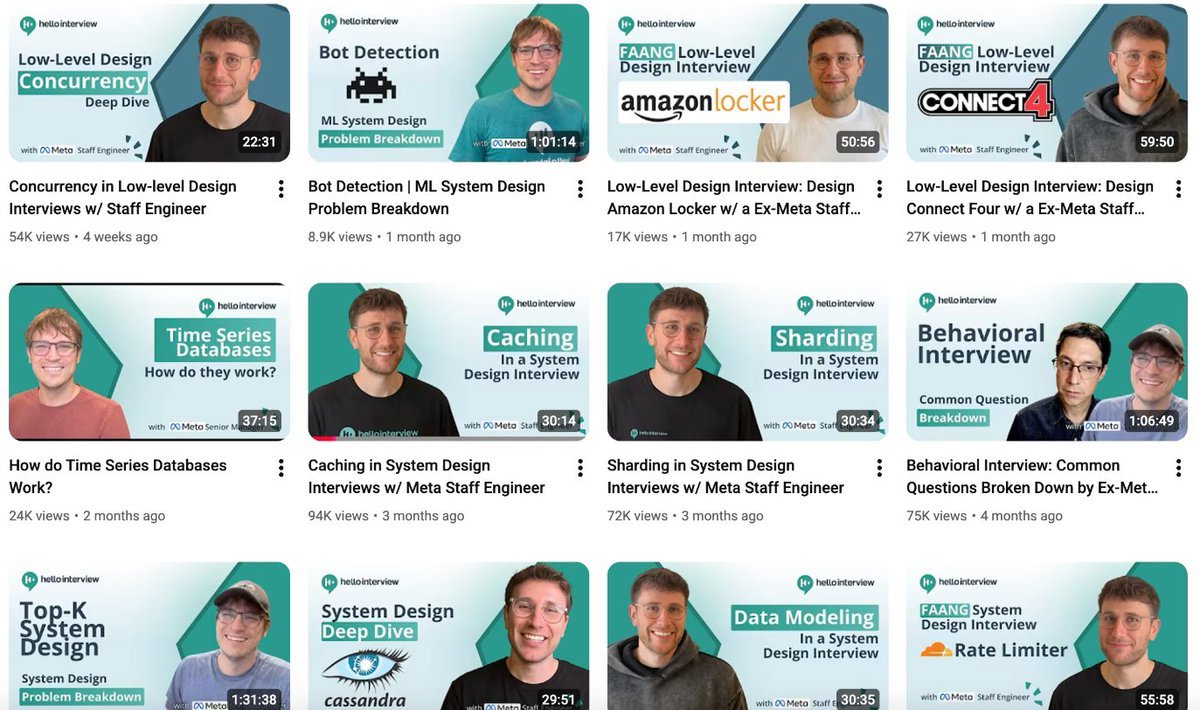
Certainly one of the BEST channels for System Design:
https://t.co/6LJuJnIu3m
1. API Design
https://t.co/AUx3IzQkir
2. Sharding
https://t.co/sKObv3NN9H
3. Caching
https://t.co/zQr7bzsZm2
4. Concurrency
https://t.co/WcxW2fAyCZ
5. Data Modeling
https://t.co/zX2R66k7NK
6. Rate Limitter
https://t.co/zX2R66k7NK
7. DB Indexing
https://t.co/q35bD2BMiw
8. CAP Theorem
https://t.co/qAzsSi7Ej7
9. Kafka
https://t.co/PoAMbsnFOF
10. Redis
https://t.co/vbQqwgpZTw
11. System Design of Uber, WhatsApp, Bitly, etc.
https://t.co/mmUw8tamPk
Una pregunta clásica en entrevistas:
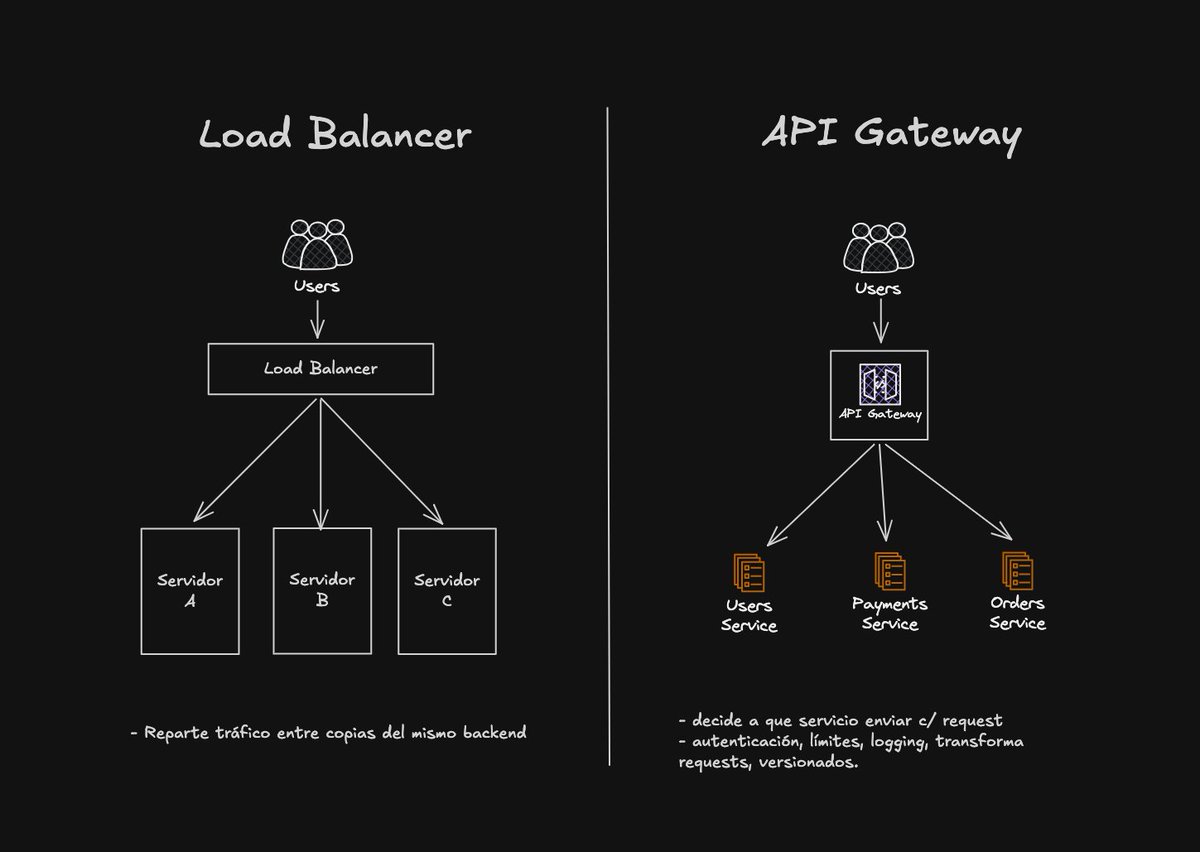
¿Cuál es la diferencia entre Load Balancer y API Gateway?
Primero, el problema de escala.
Tenés 3 servidores iguales corriendo tu backend: A, B y C. Si todas las requests caen en A, se satura.
Ponés un load balancer adelante:
- Cada request nueva la envía a A, B o C.
- Si uno se cae, deja de usarlo.
- Evita que una sola máquina reciba todo el tráfico.
Ahora imaginá que tu sistema crece.
Lo dividís en servicios: users, payments y orders. Cada uno corre en un lugar distinto y tiene su propia URL.
Definís un API Gateway como único punto de entrada.
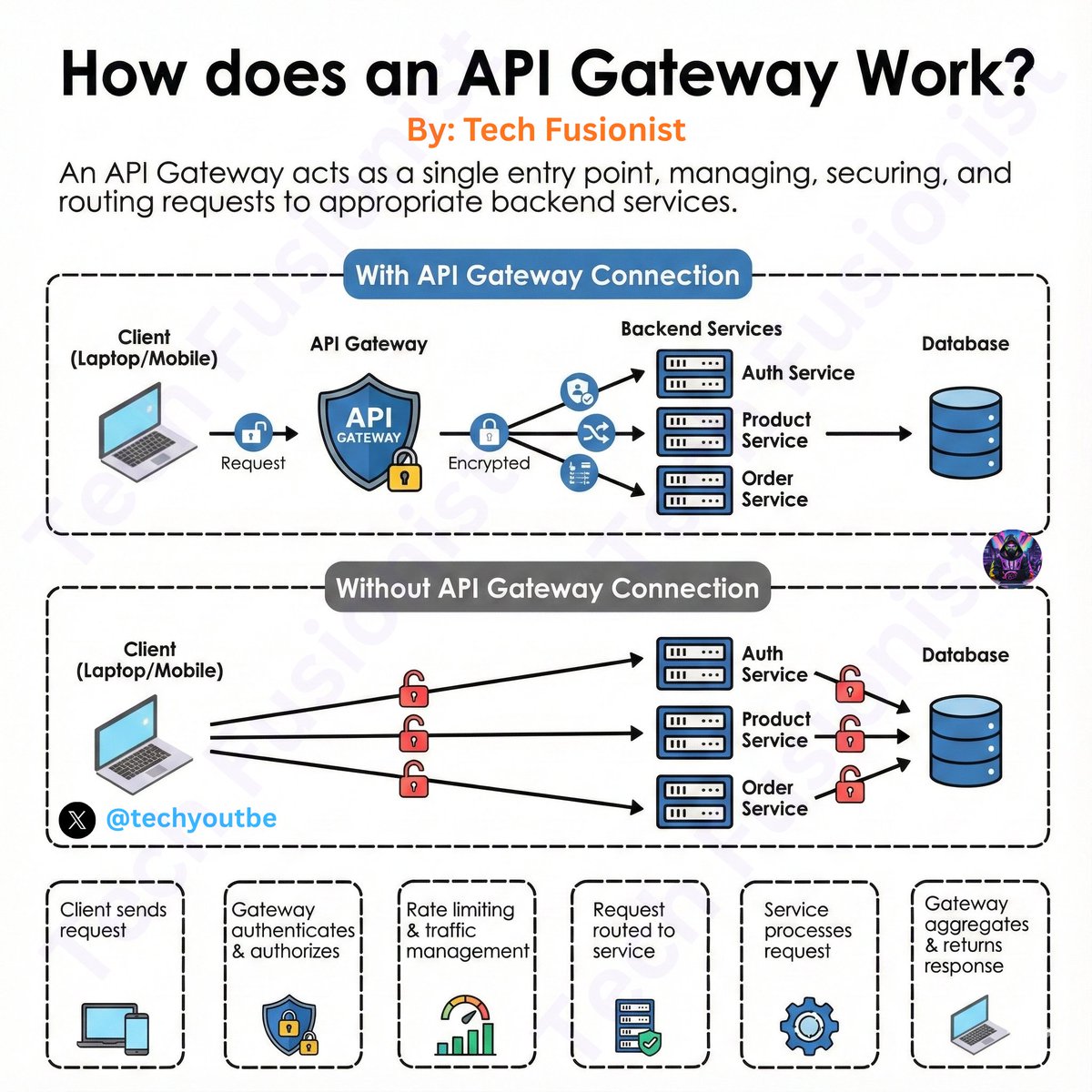
El frontend siempre llama a una sola URL y el gateway decide a qué servicio enviar la request. Además puede validar autenticación, aplicar límites, centralizar logging, transformar requests y manejar versiones.
La diferencia clave:
-> El load balancer reparte tráfico entre varias copias del mismo backend.
-> Un API Gateway centraliza el acceso a servicios distintos.
Y en sistemas grandes suelen convivir. El tráfico puede entrar por un API Gateway y detrás cada servicio tener su propio load balancer para escalar.
Uno distribuye tráfico.
El otro organiza la entrada al sistema.
🦀Los chinos lo han vuelto a hacer😳
Ingenieros chinos reconstruyen #OpenClaw y el resultado es una locura:
🚀 Corre en una Raspberry Pi de $10
⚡ 400× más rápido al iniciar
🕒 Arranca en solo 1 seg
🧠 Usa menos de 10MB de RAM
🐹 Escrito en Go.
¡Gratis y 100% Open-Source! 💻🔥
Concurrency vs Parallelism - They are NOT the same.
🔹 𝐂𝐨𝐧𝐜𝐮𝐫𝐫𝐞𝐧𝐜𝐲
Concurrency means an application is making progress on multiple tasks at the same time.
While a single CPU core can handle only one task at a time, it achieves concurrency by rapidly switching between tasks.
Example: Listening to music while writing code. The CPU quickly switches between these tasks so efficiently that it feels like both are happening at once.
The primary goal of concurrency is to maximize CPU utilization by minimizing idle time.
🔹 𝐏𝐚𝐫𝐚𝐥𝐥𝐞𝐥𝐢𝐬𝐦
Parallelism means executing multiple tasks at the same time.
To achieve parallelism, tasks are broken down into smaller independent subtasks and processed at the same time across multiple CPUs, cores, or GPUs.
Example: Training a deep learning model by splitting the dataset into batches and processing each batch simultaneously across multiple GPUs.
The goal of parallelism is to boost processing speed by executing multiple tasks in parallel.
𝐓𝐡𝐞𝐲'𝐫𝐞 𝐧𝐨𝐭 𝐦𝐮𝐭𝐮𝐚𝐥𝐥𝐲 𝐞𝐱𝐜𝐥𝐮𝐬𝐢𝐯𝐞:
- You can have concurrency without parallelism.
- You can have parallelism without concurrency.
- Or you can have both together for high-performance systems.
♻️ Repost to help others in your network.
AntiGravity just got 200+ new agent skills for free.
This turns vibe coding into a repeatable system.
Here is the simple install flow.
→ Open the GitHub hub clone page.
→ Copy everything.
→ Paste it inside Anti-Gravity chat.
→ Prompt: set this up in my current skills directory.
→ It installs and merges the full skill library automatically.
Save this video, you’ll install 200 agents in minutes.
Want the SOP? DM me. 💬
¡Mega colección de Agent Skills para mejorar tu IA!
Son paquetes de conocimiento en formato Markdown que le enseñan a hacer mejor tareas específicas
✓ +60.000 skills disponibles
✓ Claude Code, Visual Studio Code, Antigravity...
→ https://t.co/40k8HPFZRL
Siempre que diseñen sus aplicaciones, hagan triple validación.
¿Qué significa esto?
No confiar en un solo punto de tu app para validar algo crítico.
Para eso, necesitas hacerlo en 3 capas distintas.
1) Frontend: Más que nada para guiar al usuario y evitar errores obvios.
Ejemplos:
- campos obligatorios
- formatos (email, números, fechas)
- límites básicos (longitud, rangos)
Mejoras la UX y reducís requests innecesarias.
Pero no te da seguridad.
El frontend se puede modificar.
2) Backend: decide qué está permitido y qué no.
Generalmente:
- permisos del usuario
- reglas de negocio
- estados válidos
- consistencia entre datos
Nunca confiás en los datos que vienen del cliente.
SIEMPRE se validan, incluso si el frontend ya lo hizo.
3) Base de datos: Es la última línea de defensa.
Ejemplos:
- constraints (NOT NULL, UNIQUE, FK)
- transacciones
- reglas de integridad
Si algo llega mal hasta acá, la base lo frena y mantenés la consistencia del sistema.
Un ejemplo completo sería:
Un usuario quiere reservar un turno.
(1) Frontend: no deja elegir horarios pasados
(2) Backend: valida que el turno siga libre y que el usuario tenga permisos (pago, plan activo, etc.)
(3) Base de datos: un constraint evita que existan dos reservas para el mismo horario
Los sistemas se rompen cuando confiamos demasiado.
La triple validación es asumir eso desde el diseño.
The Claude Code plugin that gives you 7 AI agents (code reviewer, debugger, security auditor, etc.), 6 skills, and 8 automation hooks.
Here's how to use it:
1. Open your terminal
2. Clone the repo: git clone https://t.co/8Def5pIk1s
3. Run Claude with the plugin: claude --plugin-dir ./claude-workflow
That's it! Claude will now automatically use the right agent based on what you ask it to do.
https://t.co/gMPrvCbkcF
@omarleal25@5eniorDeveloper Pero si prácticamente la música actual es autotune es casi un bot solo q está alguien a la moda de fachada más una agencia masiva de marketing





![Ai_Vaidehi's tweet photo. If I travel back to my Interview Days, I will study these 40 Articles to learn system design Fundamentals. These articles and videos will save you 50+ hours of hopping to resources and wasting time.
Btw, if you’re preparing for system design interviews, check out our AI Tutor: https://t.co/D3IATtNW7T
You can:
- voice chat about your questions in real-time
- get feedback in real time and improve with these sessions.
- learn concepts, practice HLD questions even if you're a complete beginner
All of these topics covered in the image are mentioned here in great detail:
[1] HLD Basics: https://t.co/I6E3xWnnPV
[2] Core Concepts & Trade-offs: https://t.co/guimX30aqb
[3] Networking & DNS: https://t.co/mEQN53UdRK
[4] Load Balancing & Scaling: https://t.co/kKWa0cgDfU
[5] Application Architecture: https://t.co/pBzsfCiUVC
[6] Databases: https://t.co/Aq4AJBSTWy
[7] Caching: https://t.co/SjJ4m8qhhP
[8] Asynchronous Processing:https://t.co/1S25lPgiEC
[9] Communication Protocols: https://t.co/v5Lse3k0wP
[10] Performance & Monitoring: https://t.co/eQOXMGYVqj
[11] Cloud Design Patterns: https://t.co/20nRBjreAn
[12] Reliability Patterns: https://t.co/bWuWBbzqEZ](https://pbs.twimg.com/media/HHcwqtFbYAAsoZI.jpg)