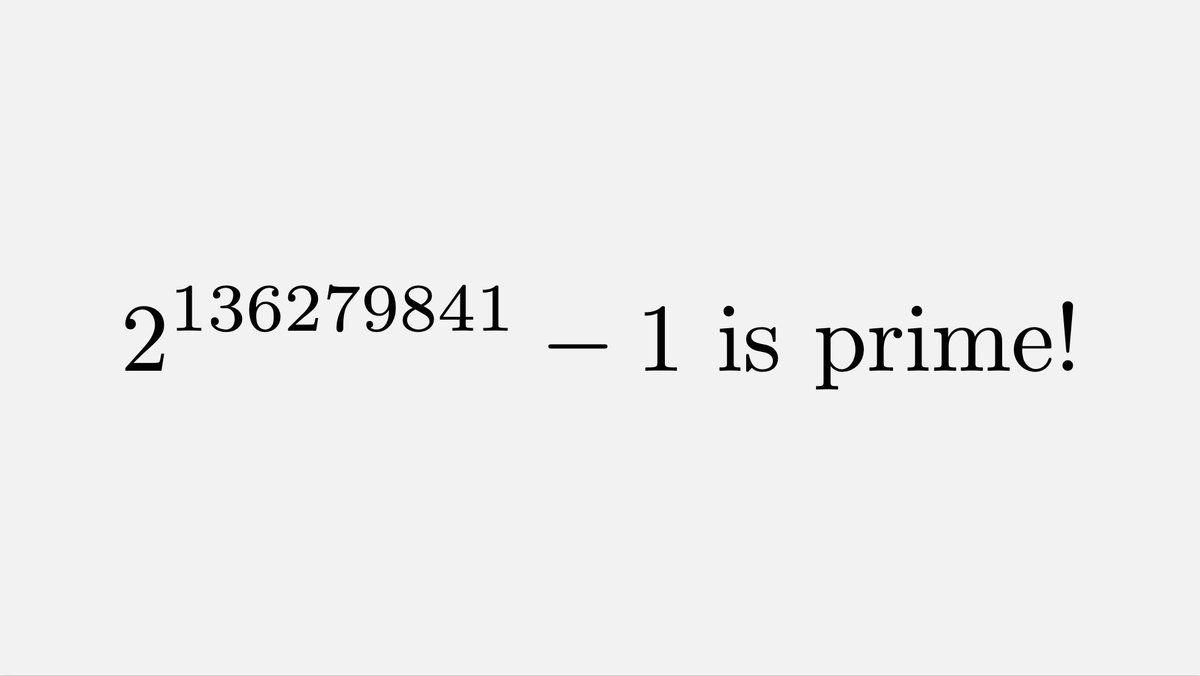
2¹³⁶²⁷⁹⁸⁴¹−1, discovered today, is the largest known prime. It's a Mersenne prime (2ᵖ-1), which are easier to find.
It took nearly 6 years for the GIMPS software to find it after the previous largest known prime. It was also the first Mersenne prime found using GPUs.
@kleinquentin@mathladyhazel rectangles d'hypoténuse 0"
- d'autre part, ça illustre le fait que "la formule habituelle" n'est pas bonne pour mesurer des distances en général dans les complexes et que la bonne généralisation du théorème de Pythagore aux complexes est plutôt
|a|^2 + |b|^2 = |c|^2
2/n, n=2
@kleinquentin@mathladyhazel J'aurais pas dit "blague" mais plutôt source de réflexion :
- d'une part il est vrai que sur les complexes x^2 + y^2 se factorise en (x + i y)(x - i y), donc il est vrai que toys les couples (et que ceux-là) de la forme (a, i a) ou (a, - i a) nous donneraient des "triangles
1/n
Tomorrow is the birthday of Ernő Rubik. This year, his birthday marks the 50th anniversary of the creation of the iconic Rubik's Cube. Read about speedcubers and the intersection of puzzles and mathematics: https://t.co/HHcaBnpNcW
#RubiksDay#RubiksCube#50YearsOfRubiksCube
📣Official statement: the new EU chat controls proposal for mass scanning is the same old surveillance with new branding.
Whether you call it a backdoor, a front door, or “upload moderation” it undermines encryption & creates significant vulnerabilities
https://t.co/g0xNNKqquA
@itsannamargaret@Malkaveer I think most people have just internalized that this his how steering wheels work. A more universal way to describe orientations for us humans would using the left-hand rule for clockwise and right-hand for counterclockwise (aka trigonometric)
@itsannamargaret@Malkaveer As a mathematician who has spent a lot of time complaining about improper terminology to describe orientation of rotations, I would like to point out that "left" and "right" by themselves are inadequate (the bottom part of the circle moves left when the upper moves right !).
I recently found an exploitable timing leak in the reference implementation of Kyber (ML-KEM), the soon-to-be NIST standard for post-quantum key encapsulation.
Let’s see if you can spot it in the source code - msg is secret:
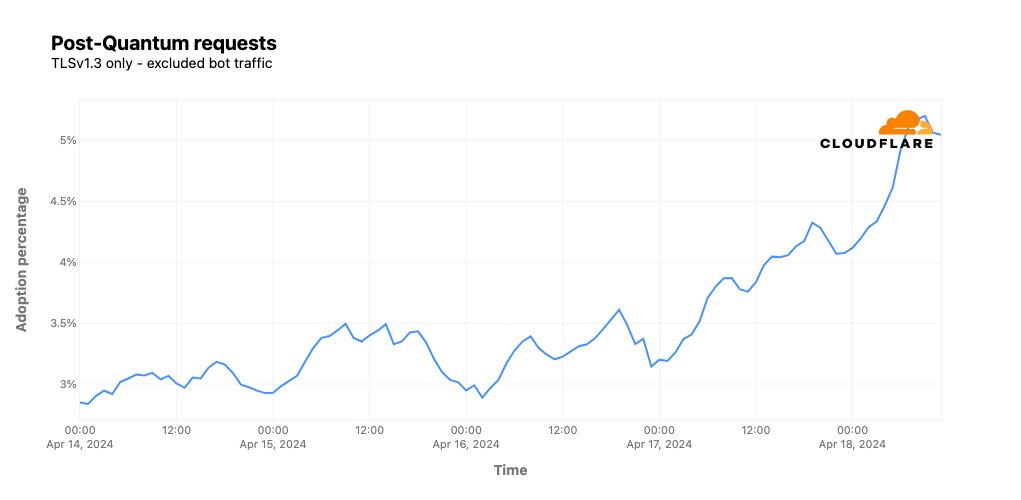
The rollout of @googlechrome 124 started yesterday, April 17, and it includes post-quantum key exchange enabled by default on desktop platforms.
With that rollout, post-quantum encrypted requests have grown to over 5% of @Cloudflare global TLS 1.3 request traffic.
Here is a 72-byte alphanum MD5 collision with 1-byte difference for fun:
md5("TEXTCOLLBYfGiJUETHQ4hAcKSMd5zYpgqf1YRDhkmxHkhPWptrkoyz28wnI9V0aHeAuaKnak")
=
md5("TEXTCOLLBYfGiJUETHQ4hEcKSMd5zYpgqf1YRDhkmxHkhPWptrkoyz28wnI9V0aHeAuaKnak")
Les sujets sur lesquels nous avons été interpellés sont techniques, sensibles, sujets à controverse, et malheureusement commentés de façon approximative (en moins de 280 caractères).
Nous y répondons ici 👉 https://t.co/xi9N0hNl69