I’ve tried a bunch of agent memory frameworks, and honestly, Hindsight just works better. mem0 and memobase don’t even come close.
It’s super easy to get started. Just a few lines of code, and self-hosting is straightforward. No messy configs, no need to deal with a vector database.
Everything is built on PostgreSQL. Memory, entities, relationships, and vectors all live in the same database.
Compared to that, self-hosting mem0 and memobase is a pain. Feels like it’s designed that way to push people toward their cloud services.
https://t.co/FJiBokdNWK
If you’re currently using Cursor’s legacy plan, the $20 monthly subscription includes 500 uses of Opus 4.6.
Be careful not to switch to the annual plan. Doing so will force your account onto the new pricing model (the new Pro plan), and there’s no way to revert back afterward.
A very long memory isn’t necessarily a good thing.
LLMs are fundamentally stateless. Most so-called “memory” is just past conversations being stuffed back into the context window. It burns tokens and makes long-context degradation more likely.
In many agents, “memory” is basically just a summary of past behavior. Compression is irreversible, so details will inevitably get lost.
Expecting OpenClaw to somehow evolve intelligence on its own is probably wishful thinking.
The new models are increasingly evolving toward agents.
Earlier, Grok 4.2 Beta pushed the multi-agent approach pretty aggressively.
Surprisingly, the results were actually quite good.
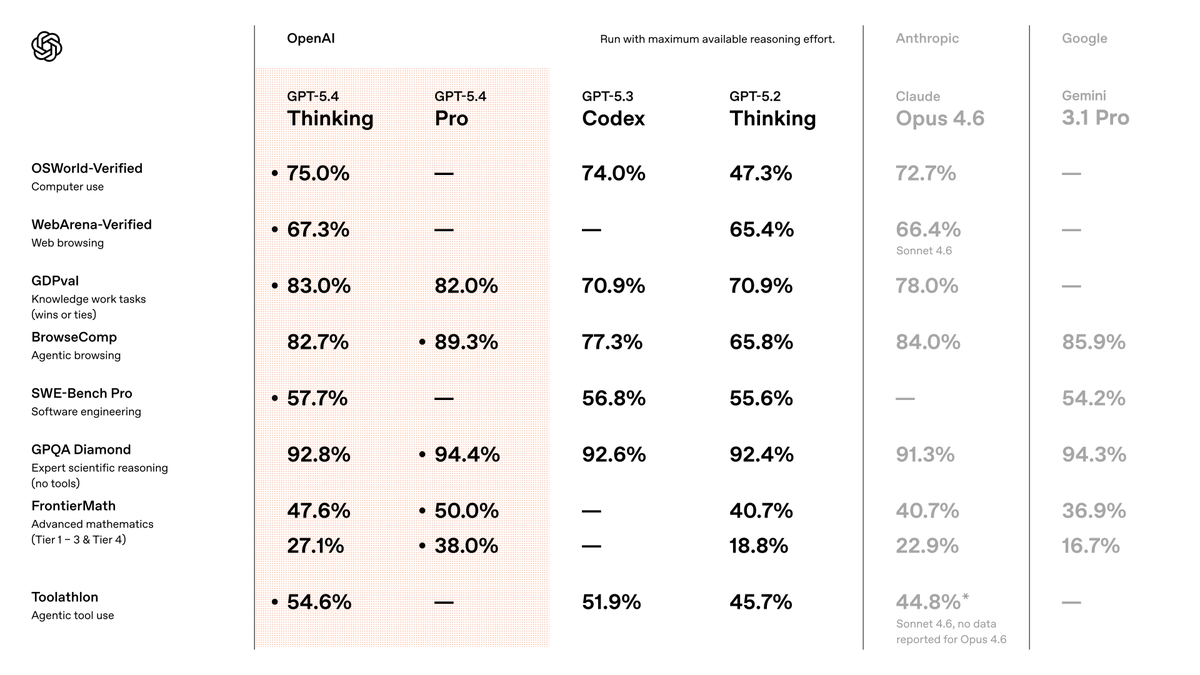
GPT-5.4 Thinking and GPT-5.4 Pro are rolling out now in ChatGPT.
GPT-5.4 is also now available in the API and Codex.
GPT-5.4 brings our advances in reasoning, coding, and agentic workflows into one frontier model.
No one’s using the product? Add more features. Still no users? Add even more features. And in the end, it’s still ignored.
It’s easy for developers to get trapped in their own self-created illusion. Time to wake up.
I’m honestly impressed by how real the Reddit community feels. One of my posts even made it to the top of the community.
The comments weren’t just a handful of replies either. People took the time to share genuine advice and thoughtful feedback.
Embedding models aren’t as plug-and-play as LLMs. If you upgrade to a new embedding model, you usually have to re-embed all your existing documents. Once you’re dealing with a large corpus, the cost can be brutal.
Rerank models are different. When a new version comes out, you can typically switch over immediately. Much more plug-and-play.