Geekbench 6.7 is out! This release adds Intel BOT detection, fixes stability issues on Linux ARM systems, and improves hardware identification. Find out more at https://t.co/pwmdQnCwgh
We spent a week investigating Intel's Binary Optimization Tool and discovered it doesn't just reorder code, it can vectorize workloads, boosting some Geekbench 6.3 scores by up to 30%. Find out more at https://t.co/1IhPznx1l0
Intel's Binary Optimization Tool can boost Geekbench 6 scores by up to 8%, but those results aren't comparable with standard runs. We've added a warning to affected results on the Geekbench Browser to keep scores comparable. Find out more at https://t.co/OGSNMNtWNI
@4k_isn Geekbench reports the target ABI, not the instruction set. Geekbench 6 uses ARM v9 instruction set extensions (e.g., SVE, SME) in several workloads.
@pers0naluni0n@toniievych@7600chip@Cartidise I'm not sure why you think that -- Geekbench 6.0 and later use AVX-VNNI (in addition to AVX512-VNNI and AMX) to accelerate inference tasks.
@toniievych@7600chip@Cartidise Most of the difference comes from ML workloads. Geekbench 6 uses AVX-VNNI (as well as AVX512-VNNI) to accelerate ML tasks. While Zen 4 supports AVX-VNNI, OpenVINO and oneDNN didn't use it until 2023 (the article you’re referring to was written in 2022).
@toniievych@7600chip@Cartidise Zen 4 AVX-512 is "double pumped" so the advantage over AVX2 isn't huge. Disabling AVX-512 on Ice Lake or Tiger Lake causes overall scores to drop by 10% and individual workload scores to drop by 60%.
@toniievych@Cartidise You can see which ARM and x86 instruction sets Geekbench 6 uses on pages 8 and 9 of the Geekbench 6 Internals document: https://t.co/S4gODS8Qdp
@toniievych@Cartidise Geekbench tests uses instruction sets that aren't available on all CPUs (e.g., NEON, AVX2, AVX512). Developer use these instructions to improve application performance. If Geekbench didn't use them it wouldn't provide an accurate measure of performance.
@toniievych@Cartidise Actually, Geekbench 6 scores are comparable between systems with and without SME support. You just need to be careful when using Geekbench 6.2 or earlier on systems with SME support.
If you’re a developer or software engineer: Do you use an LLM to help you with your work?
Opinions on their real-world utility vary (we’ve definitely got our own), but we’re curious to hear your take — whether that’s a nuanced answer or just “no.”
Geekbench AI is barely a few weeks old, but v1.1 is already here, with lots of little improvements and bug fixes. You may see better scores on some devices, and the benchmark should take less time to run — give it a spin and let us know what you got!
https://t.co/PzcKDPMTXa
All the new gadgets have AI Things and Stuff inside, but how fast is that AI? How do you compare Apples to Androids, or laptops to desktops?
Introducing Geekbench AI 1.0 for easy cross-platform, cross-device, cross-framework AI performance measurements: https://t.co/INjUQsNvUc
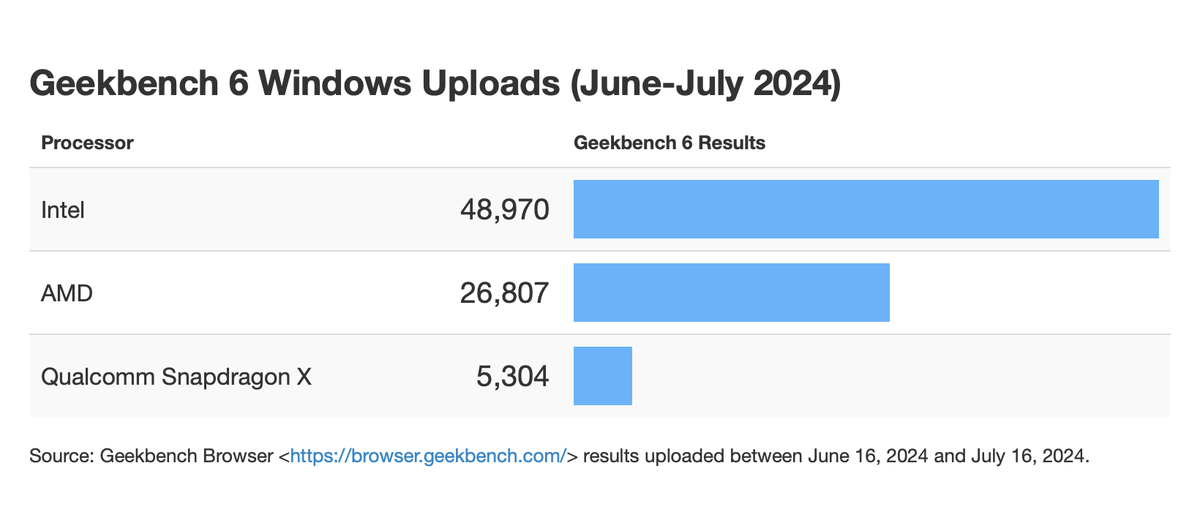
We looked at over 82,000 Geekbench 6 for Windows results uploaded to the Geekbench Browser over the last 30 days. Intel CPUs powered 59.2% of results, AMD CPUs powered 32.4%, and Qualcomm Snapdragon X SoCs powered 6.4%. Snapdragon X is off to a good start.
@SomeGadgetGuy This is due to a known issue in the 8 gen 2 GPU drivers. Qualcomm has a fix but we do not know when it will be released as part of an OTA update.