Open agent infrastructure in Go San, a terminal agent runtime, and sdk-go, the LLM and agent SDK beneath it.
@yanmxa_
0xb95679076e952aa62ab87f6c1be75062f6d61820
$SAN is now live @ponsdotfamily
CA: 0xb95679076e952aa62ab87f6c1be75062f6d61820
San the open-source terminal agent in one native binary now has a token on Pons.
One binary. Any model. Now on Robinhood Chain.
https://t.co/s2QGlDGxqx
Agents, by recipe.
Save a workflow once, run it as a graph a model per step, and only the summary comes back.
San turns repeatable work into a recipe.
One binary. Any model.
https://t.co/UwNL8TwTh8
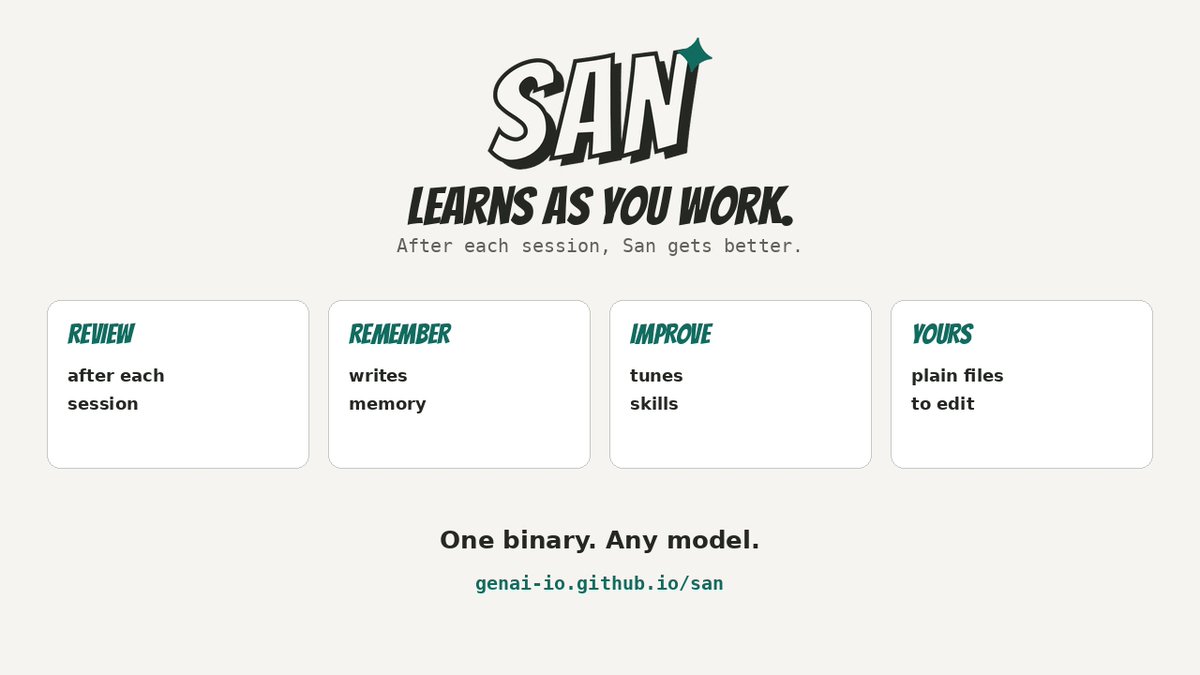
San learns as you work.
After each session, it reviews, remembers, and tunes its skills and the memory is yours, in plain files you can edit.
One binary. Any model.
One binary. Everywhere.
San runs on macOS, Linux, and Windows — plus Pi, Jetson, servers, and CI. Even offline with a local model.
One binary. Any model.
One task. More than one agent.
San lets agents work together subagents in parallel, sessions that talk to each other, and workflows that run as a team.
Decide what runs. See what happened.
San puts you in control permissions for every tool, and an inspector (Shift+Tab) that shows you exactly what it did.
One binary. Any model.
Your model. Your way of working.
San is model-agnostic — 20+ providers, switch instantly, and shape it with your own prompts, personas, skills, and tools.
One binary. Any model.
San means three.
三生万物 — 'three begets the ten-thousand things.' One runtime that becomes any agent, running a three-step loop: reason, act, observe.
The command stays san.
$SAN is launching on @ponsdotfamily ,on Robinhood Chain.
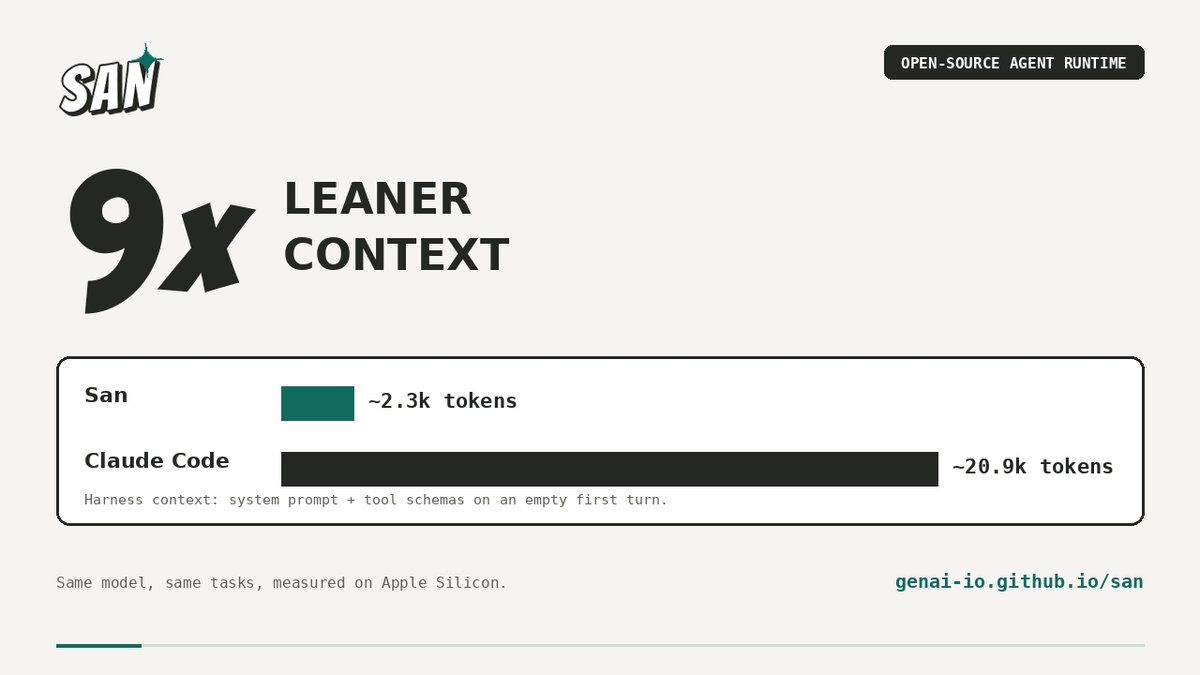
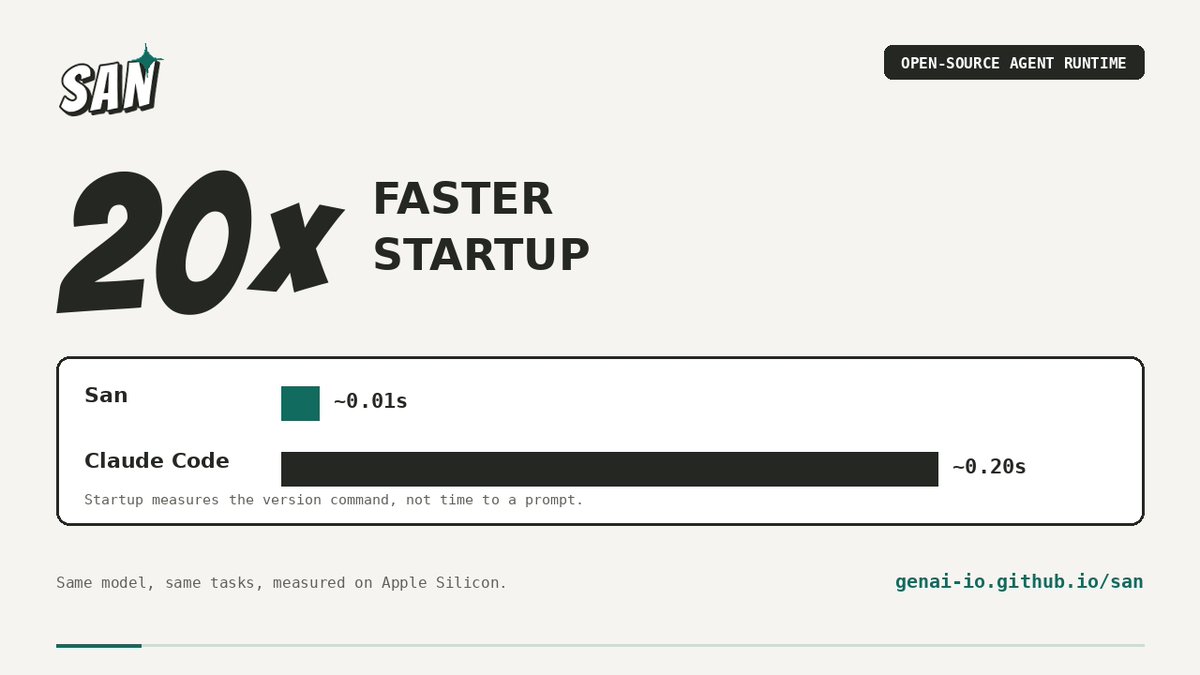
San is an open-source terminal agent runtime in a single native binary no runtime dependencies, minimal context overhead, and ready on macOS, Linux, and Windows.
https://t.co/UwNL8TwTh8