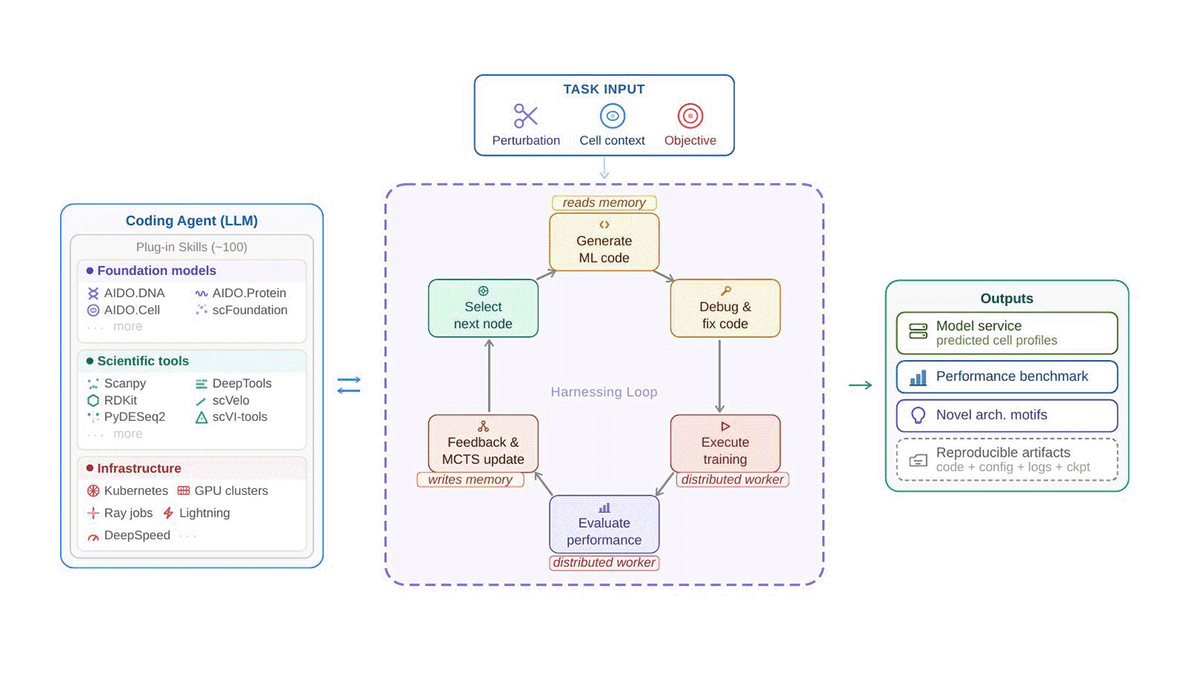
What if AI could build its own biology models — and beat human experts?
We built VCHarness: an autonomous system that proposes models, writes code, runs experiments, and learns from results in a closed loop.
Tested on CRISPR gene knockdown across 4 human cell lines — it outperforms expert-designed baselines.
From months of manual model-building → days of autonomous search.
🔬 Blog: https://t.co/XhhhbfeSR3
📄 Paper: https://t.co/kluV3aqRvq
🌐 Website: https://t.co/iEEji3uuHs
Virtual cells are supposed to help drug discovery. Why aren't they evaluated on drug discovery tasks? In our new preprint "Cell-Level Virtual Screening," we investigate this and other fundamental questions about practical applications of virtual cells for drug discovery.
We are humbled and honored to share that @iscb has named GenBio AI Co-Founder and Chief Scientist @ericxing and Senior Research Fellow @segal_eran to the prestigious 2026 Class of Fellows.
The ISCB Fellows program recognizes scientists who have made outstanding contributions to computational biology and bioinformatics, and we are grateful to see Eric and Eran receive this distinction.
Learn more about the award:
https://t.co/7PNdHX1UoR
Okay, this is very cool: an AI system that autonomously designs virtual cell models. It's called VCHarness, created by GenBio AI. Today, the manual process of designing these models is not just slow - it limits what gets tried.
The system is named after the harness concept that is everywhere in AI right now: the idea that the system wrapped around a model matters as much as the model itself.
I explain it in more detail in the latest issue of BAIO (where I also have a special treat for subscribers). Link below.
Most AI conversations are still centered on LLMs. GenBio AI Co-Founder & Chief Scientist @ericxing is already three steps ahead.
@ben_guggenheim@washingtonpost just sat down with him to break down why LLMs are "book smart" and how GenBio AI's world model can simulate an entire cell, run virtual drug trials, and potentially compress decades of drug discovery into a computational prompt.
Full interview 👇
https://t.co/wlB7vXCXUM
Look at this speaker lineup! 🔥 Super excited to see the SCALE workshop accepted for #ICML2026. If you're researching multimodal agents, agentic memory, or workflow optimization, you definitely want to submit your work here. Fantastic initiative by an amazing team! 👇 #AgentFlow #AI
Super honored to be co-organizing this event with an amazing team (please see @thisissouvikk's post).
Paper Submission Deadline: April 24, 2026!
We look forward to your amazing works!
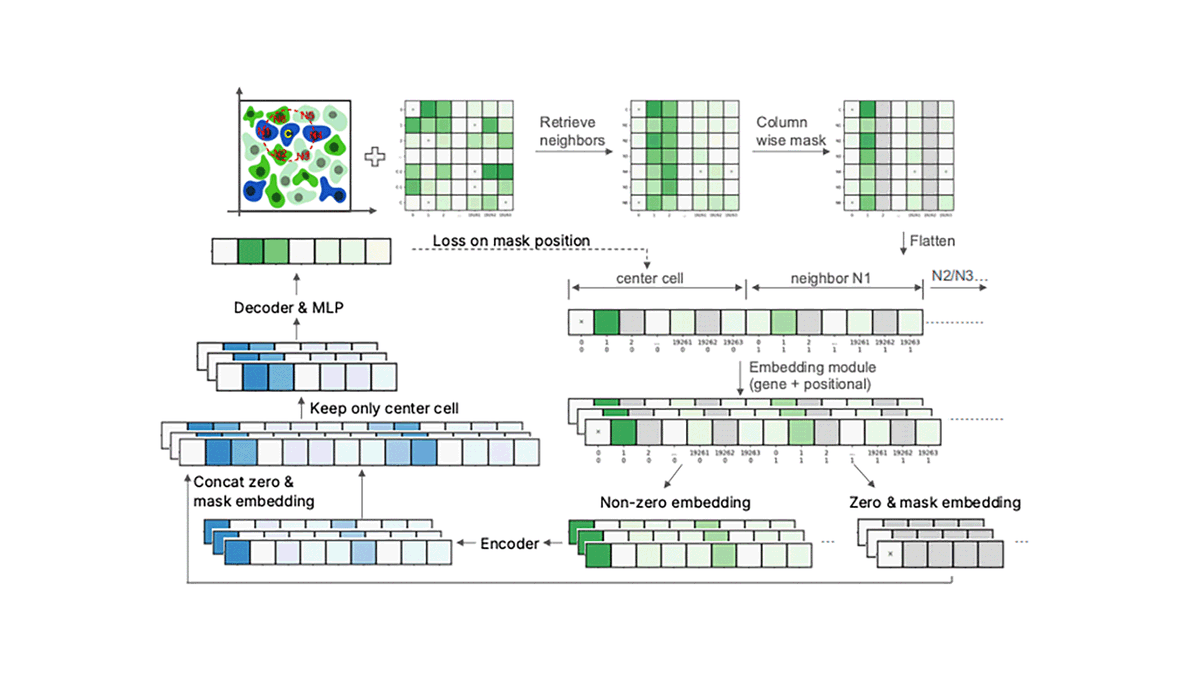
Cells aren't islands. Their representation and function depend on neighbors.
We introduce AIDO.Tissue, a foundation model that learns biology by thinking in cellular neighborhoods. It not only outperforms competing models but also demonstrates a scaling behavior with neighboring context.
Learn more👇
https://t.co/Kfn28QF76X
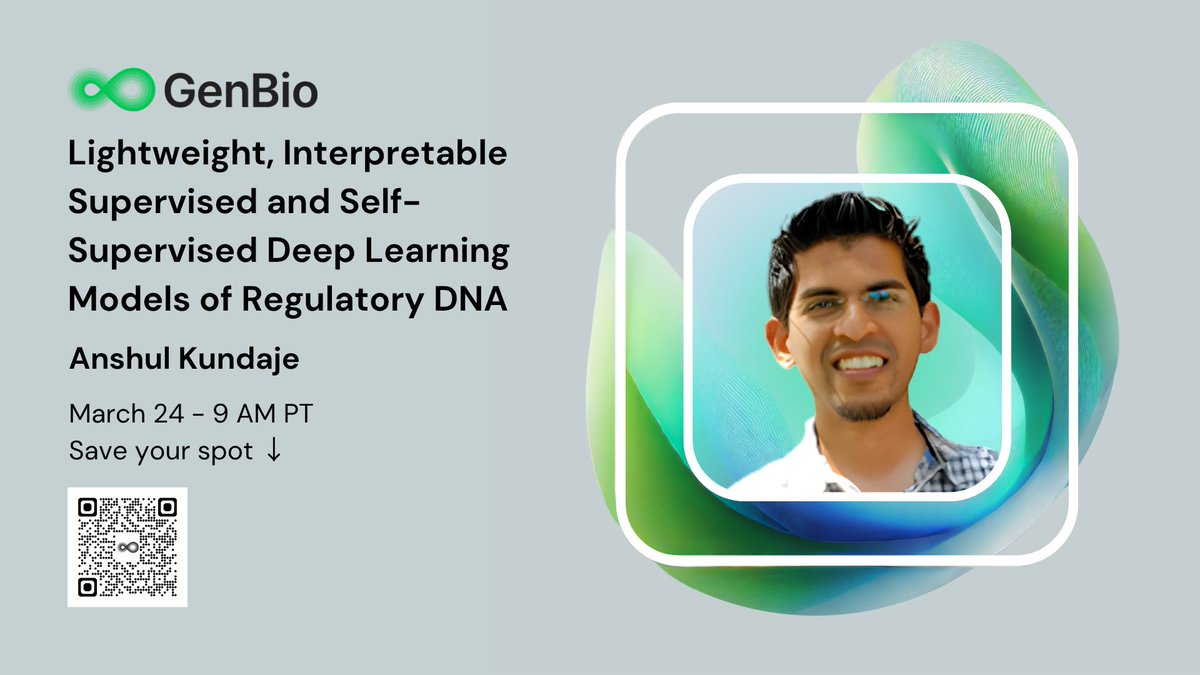
Big thanks to our presenter @anshulkundaje, our host @probablybots, and everyone who joined today's #FM4Bio seminar.
We'll be posting the talk "Lightweight, Interpretable Supervised and Self-Supervised Deep Learning Models of Regulatory DNA" on our YouTube channel soon.
Stay tuned: https://t.co/WTiW1PzeWj
⏰ Last chance to register!
Tomorrow at 9AM PT, Professor @anshulkundaje@Stanford joins the #FM4Bio Seminar to discuss his work on lightweight, interpretable models that outperform massive foundation models for decoding the regulatory genome.
Don't miss it 👇
https://t.co/e2OV4objTc
⏰ Last chance to register!
Tomorrow at 9AM PT, Professor @anshulkundaje@Stanford joins the #FM4Bio Seminar to discuss his work on lightweight, interpretable models that outperform massive foundation models for decoding the regulatory genome.
Don't miss it 👇
https://t.co/e2OV4objTc
⏰ Last chance to register!
Tomorrow at 9AM PT, Professor @anshulkundaje@Stanford joins the #FM4Bio Seminar to discuss his work on lightweight, interpretable models that outperform massive foundation models for decoding the regulatory genome.
Don't miss it 👇
https://t.co/e2OV4objTc
Bigger isn't always better in genomics AI
Join us Tue, Mar 24 at 9 AM PT for the next #FM4Bio Seminar with Professor @anshulkundaje@Stanford — on building smarter, interpretable models of regulatory DNA that outperform massive foundation models.
https://t.co/FOFQmq9iZV
Many “virtual cell” efforts restrict themselves to cell-level assays like scRNA-seq. To build a true world model for biology, we need to move beyond the individual cell and model the tissue context as well.
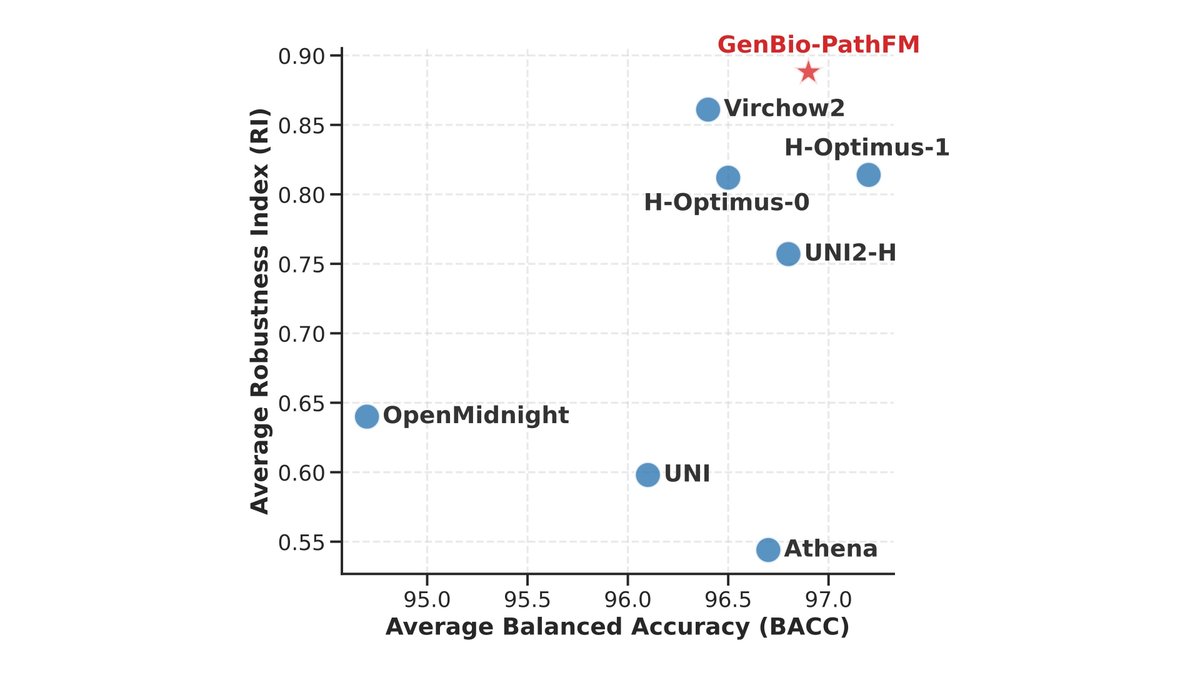
GenBio-PathFM is a new histopathology foundation model from GenBio AI. It is the only SOTA model trained without using proprietary image archives, and the strongest open-weight model to date.
Highlights:
- SOTA performance on public pathology benchmarks (THUNDER, HEST, PathoROB - shown below).
- Unprecedented data efficiency, requiring 5x-15x fewer WSIs for training.
- Novel two-stage pretraining strategy combining DINO and JEPA.
Blog post: https://t.co/vb5uoLzkcn
Paper: https://t.co/stnc4NbBU8
GitHub: https://t.co/mvnGPk4iW5
Predicting how cells respond to genetic or chemical changes is a fundamental challenge in drug discovery. While the potential of biological Foundation Models (FMs) has been widely discussed, their actual superiority over simple statistical baselines has remained a subject of significant debate in the field.
In our latest preprint, we provide a definitive evaluation of FMs for perturbation prediction. By benchmarking over 600 model variants, we demonstrate that FMs, when trained on the right modalities and integrated effectively, provide a significant leap in predictive accuracy.
Our findings confirm that FMs are not just a theoretical improvement, but a practical tool for building accurate, actionable simulations of cellular behavior.
Preprint: https://t.co/4FbQATsxGr
Code and data: https://t.co/peVs3bwT5r
Blog post:
https://t.co/HSDIGHZcDA
Don’t miss GenBio AI Co-Founder & Chief Scientific Advisor @Prof_Lundberg at #NVIDIAGTC:
��Scaling Laws in Biology: Why Bigger Models Alone Aren’t Enough [S81652]
March 18, 10:00–10:40 AM PT
An in-person panel on breaking the data wall in Bio x AI through at-scale data generation and new scaling laws.
Save your seat → https://t.co/j2bWUuhYUg
🎟️ Register → https://t.co/jtoXsBi4H4
v/ @NVIDIAHealth
If you're excited about AI scientists and biology simulators, we're looking for FTEs and interns @genbioai. Come work with an elite team of nobel laureates and titans of science+engineering on products that both people and agents use to accelerate biomedical research. DM or email
In @theinnovator’s Interview of the Week, GenBio AI Co-Founder and Chief Scientist @ericxing shares his view on the next phase of intelligence and why AI for biology must move beyond pattern matching toward world models.
Read the full interview ↓
https://t.co/IVh8zycvTC @jennschenker
What does the next phase of #intelligence look like?
We are developing a new generation of AI systems that use very different #LLMs, similar to next generation #worldmodels," says Professor @ericxing , co-Founder and Chief Scientist at @genbioai.
https://t.co/mQOfGSFhhO
Insightful remarks from GenBio AI Co-Founder and Chief Scientist @ericxing at #WEF26 on why the next phase of AI will be defined by world models, reasoning, and interaction, not just larger language models. Learn more 👇
AI today is powerful, but incomplete: language alone is not intelligence.
Speaking at #WEF26 USA House Davos, #MBZUAI President and University Professor @ericxing explained why today’s AI systems are reaching their limits and why the next phase of AI demands a fundamentally different approach.
Large language models (LLMs), he noted, deliver what he calls “book intelligence”: systems trained on text that can retrieve and recombine written knowledge.
However, real intelligence extends beyond language, requiring the ability to act in the world, collaborate with others, and ask new questions through physical, social, and philosophical intelligence. (1/3)
It was a pleasure to share the stage with @Yoshua_Bengio, @YejinChoinka, @harari_yuval, and @nxthompson, at #WEF26 in Davos to discuss "Next Phase of Intelligence". I shared my reservation of current LLM-based systems bringing us toward AGI very soon, and spoke for the needs for substantial innovations in representation, architecture, and learning paradigm before we can reach truly physical, social, and philosophical intelligence.
My candid response to @nxthompson's questions on what to go next, and what existing architecture to avid is: we must move past LLMs to focus on World Model to unlock physical intelligence, and we can't build a consistent, safe, and interactable world model by learning only in the "thought space" (i.e. latent space". We need new architectures like the GLP (Generative Latent Prediction) that support stateful representation, long-horizon reasoning, action-conditioning, and most importantly, close-loop training where learning takes place in both latent (thoughts) and observation (reality) space to ensure grounding, fidelity, and certifiability; and we also must go beyond passive self-supervised learning on pattern matching and reconstruction with a stationary model, but active and proactive learning on task-completion objectives and cost-conscious rewards over a non-stationary model that can improve not just during pre-train, but also in- and post-action during serving. Our PAN world model builds on such design principles.
GenBio AI Co-Founder and Chief Scientist @ericxing is speaking today at the World Economic Forum in Davos on The Next Phase of Intelligence.
The discussion explores how AI systems learn, plan, and act at scale, questions central to how we think about modeling complex systems in biology.
Tune in 👇 #WEF26
https://t.co/RRp4EAsfYJ






![genbioai's tweet photo. Don’t miss GenBio AI Co-Founder & Chief Scientific Advisor @Prof_Lundberg at #NVIDIAGTC:
🧬Scaling Laws in Biology: Why Bigger Models Alone Aren’t Enough [S81652]
March 18, 10:00–10:40 AM PT
An in-person panel on breaking the data wall in Bio x AI through at-scale data generation and new scaling laws.
Save your seat → https://t.co/j2bWUuhYUg
🎟️ Register → https://t.co/jtoXsBi4H4
v/ @NVIDIAHealth](https://pbs.twimg.com/media/HBno03jW8AEbJO2.png)





