Introducing The Genesis Block ($0).
CA: 7Hh9sc3RexGWPjLbf41P8ppwmkdXpfqYoviwtNCSpump
a proof-of-work experiment on Solana, applying Satoshi's original rules of mining, block rewards, and halvings to Pumpfun tokens.
- each token begins at block zero, with its own genesis.
- holders become miners, earning SOL based on holdings and time held.
- trading generates fees that fund the next block.
the longer you hold, the more mining weight you accumulate.
mining is holding.
https://t.co/WxNwljxlFB
spent a lot of time building this, not going to give up on it just because of negative price action.
i know what i've built, and i know there's a lot more to this than what people see.
give the manifesto a read and understand what i'm actually trying to build here.
this is a lot bigger than you all think.
the first block hasn't even been mined yet.
over 40 SOL is currently accumulating in creator fees, waiting for the block 0 mining threshold to be reached.
once that threshold is met, the first block is produced and the collected fees are allocated to miners based on their holdings and uninterrupted holding time.
block 0 is still in progress.
for those unfamiliar with Satoshi's original design, Bitcoin began with a single block mined on January 3, 2009.
block 0. the genesis block.
every block that followed obeyed a predetermined set of mathematical rules, with mining rewards, difficulty adjustments, and halvings governing how Bitcoin operates.
The Genesis Block applies this concept to tokens on Solana, introducing an entirely different way for a token to function beyond simply being an SPL asset.
each token has its own genesis, block height, mining schedule, and reward distribution, all powered by the creator fees it generates.
instead of computational power, mining weight is calculated through holdings and uninterrupted holding time:
W = B × Δt × (1 + log₂(1 + d))
where B is your eligible token balance, Δt is the mining interval, and d is your uninterrupted holding streak in days.
selling resets your streak. holding longer increases your weight.
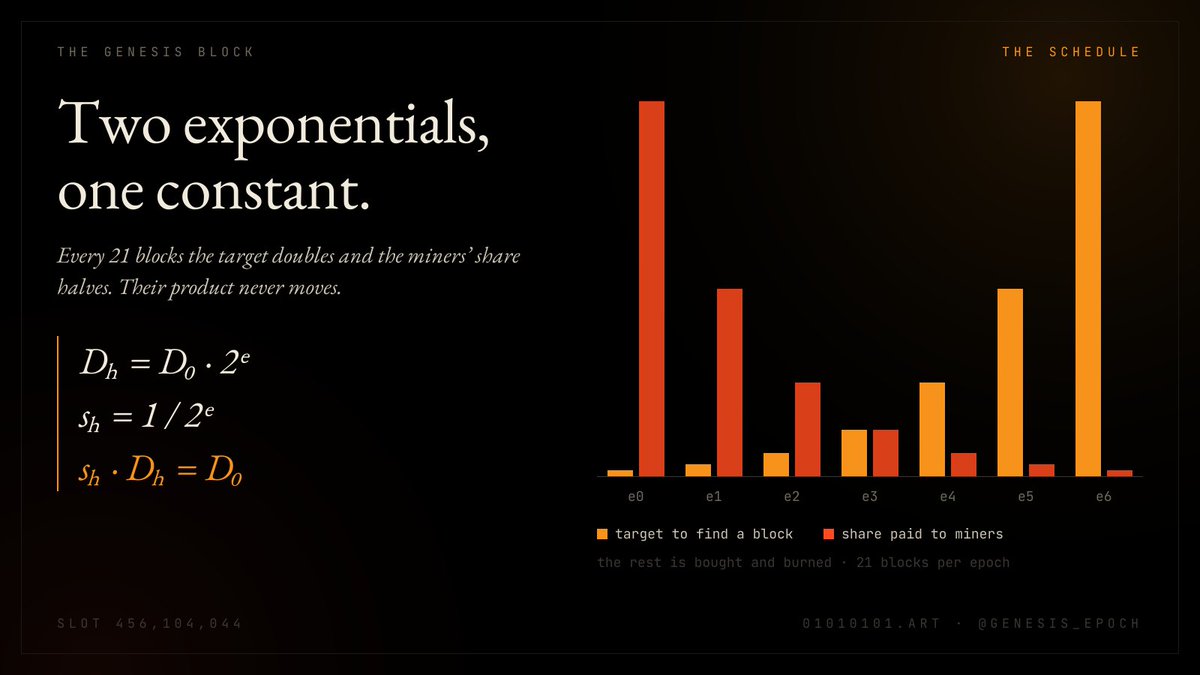
every 21 blocks, the fee threshold doubles while the miners' share halves, preserving a constant minimum SOL allocation per block.
the token itself is still an SPL token, but its behavior extends beyond transfers and trading. it now has a measurable mining history, a block height, and a fixed reward schedule.
Satoshi made computational work the basis of mining.
here, mining is holding.
block 0 is currently being mined.
as creator fees accumulate toward the first block threshold, every holder is building mining weight based on their balance and uninterrupted holding time.
once the threshold is reached, block 0 completes and 100% of collected creator fees are allocated to miners in SOL.
every distribution is recorded on Solana, so you can independently track the rewards directly onchain.
follow the vault and its transactions here:
https://t.co/qiPQziA2fC
every 21 blocks, the fee threshold doubles while the miners' allocation halves.
Dₕ = D₀ × 2ⁿ
Rₕ = 1 / 2ⁿ
Dₕ × Rₕ = D₀
the result is a constant minimum SOL reward allocated to miners per block, while an increasing share of fees buys back and burns tokens.
Satoshi used computational work to determine who earns a block reward.
here, mining weight comes from holding.
different mechanism. fixed mathematics.
block 0 is currently in progress.
the first mining cycle of The Genesis Block has begun, with trading fees accumulating toward the threshold required to produce the first block.
at block 0, 100% of collected creator fees are allocated to miners, distributed in SOL according to their mining weight.
your balance determines how much you mine. your holding time determines how much weight you accumulate.
two exponentials, one constant.
The Genesis Block follows a fixed mathematical schedule where every 21 blocks, the fee threshold doubles while the miners' share halves.
the relationship is simple:
Dₕ = D₀ × 2ᵉ
sₕ = 1 / 2ᵉ
Dₕ × sₕ = D₀
the minimum SOL allocated to miners per block stays constant, while an increasing percentage of fees is used to buy back and permanently burn tokens.
as block height increases, the rules never change. only the distribution does.
a miner follows a fixed set of rules, at all times.
each token starts at block zero and follows its own mining schedule, with SOL rewards funded by trading fees rather than newly minted supply.
holding replaces computational power. the longer you hold without selling, the more weight you accumulate toward the next block reward.
every 21 blocks, the reward allocation halves and more fees are directed toward buybacks and burns.
the rules stay the same. only the block height changes.