An increasing number of papers is emerging from the Human Phenotype Project.
👉It is a very rich dataset with serial deep phenotyping assessments for 10,000 participants
👉Latest paper explores associatons of 448 sleep traits from apnea test monitoring with other phenotypes.
@PeterPrinsley Thank you for raising this, Peter. We will be training more clinicians than ever over the next decade within our faculties and will be proud to do so but can't afford to lose expertise, skills and mentors for our next generation. This is no time for redundancies @UEA_UCU
Have you viewed our Genomics in Medical Specialties playlist? Listen to #genomics champions from a range of disciplines explain the importance of genomics in their practice and how it makes a difference for patients: https://t.co/squJbfvZlH
Why is a genetic family history an important tool to help identify an inherited condition? Find out the answer and learn how to draw a family history yourself, in this short, flexible online course.
https://t.co/NxWdbxRF2P
#Genomics101
Exactly how many protein-coding genes are there in the human genome? The truth is no one knows. The numbers change based on what database you use as reference.
"More than 2,500 coding genes in the human reference gene set still have unsettled status"
Maquedano et al. bioRxiv
https://t.co/HD0pcMQGpI
Epi-what now? Get to grips with the basics of #epigenetics, from what it is and how it works to its impact in #healthcare, with our handy bitesize resource: https://t.co/x43Ny7inZA
#genomics
The mental disconnect between this slashing taking place across the sector while (1) having to go on making university happen, teaching, researching, publishing and (2) the responsible lobby groups and ministers made students pay a couple of quid more and called it a day. 🤯
A big thank you to @drjfrank & @PapersPodcast for selecting our recent BEME review on clinical educators' #motivation to teach for their latest episode, great discussion and feedback ➡️ https://t.co/ub8CfoKnc5
Have not read the paper yet? Open access https://t.co/zJE0tJ3RKo
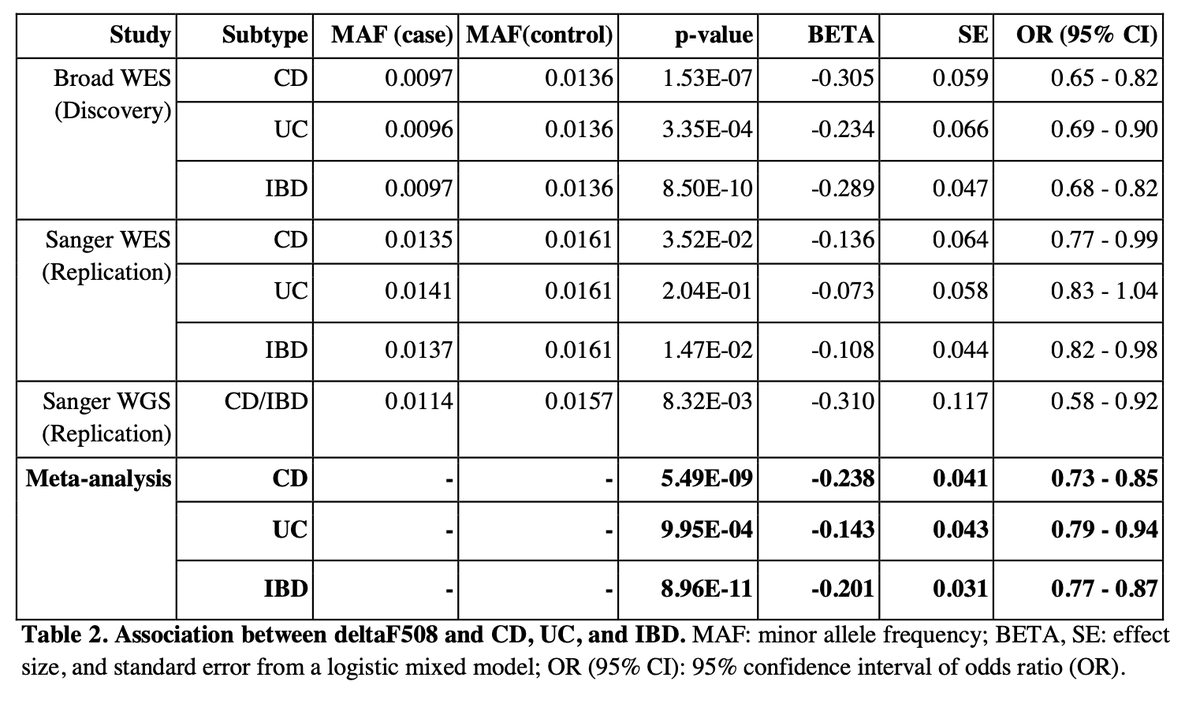
Analysis of sequencing data of 320k individuals (75k cases and 245k controls) shows heterozygous carriers of cystic fibrosis mutations are protected from inflammatory bowel disease. The protection mechanism could be due to an altered gut mucosal barrier that resists penetration by bacterial or other toxins. Prior animal studies have indeed shown that heterozygous state of cystic fibrosis mutation protects against cholera and typhoid bacterial toxins. It's amazing to see validation using human genetics with IBD as outcome. This was one of the ASHG abstracts this year that stood out for me. Nice to see it in preprint.
Yu et al. medRxiv (from International IBD consortium)
https://t.co/gMBNZhlhYe
Prescription charges are a barrier to keeping people with long-term health conditions in England healthy.
That is why I am supporting the campaign to #FreezeTheCharge in 2025 and #ReviewTheList so that people do not lose out on vital medicines which they need to stay well.
@danbrewer@PeterPrinsley I have loved every moment spent with the fabulous GoC team at UEA. Here is a link to our Padlet webpage with a timeline of our projects and links to our publications. Watch this space.... https://t.co/e0S0tvgfB9
"Epidemiology of Cholesteatoma in the UK Biobank" has been published! Great work from PhD student Emma Wilson and something that is outside my normal Prostate Cancer research area.
With @GeneticsMBBS, @PeterPrinsley, Dr Khondoker, and Prof. Philpott
https://t.co/y7KDCUbH76
AMAZING NEWS! Ulster University has just won the prestigious Times Higher Education University of the Year 2024! An absolute privilege to be working at such a progressive, innovative and inclusive university! @UlsterUni#ProudOfUU
Early read out of New York's newborn screening program (GUARDIAN study) using targeted genome sequencing of 4000 rare disease patients yielded a mere 3.7% positive rate. Why are we still doing gene panel? Why not WES or WGS?
Ziegler et al. JAMA
https://t.co/3MzPkpKm4U