These builders account for over 90% of the TVL in the @ethereum ecosystem.
If you want to understand where Ethereum is going, study what these teams are doing. 👇
In Nigeria, from remittances to daily survival, USD₮ has become part of everyday life. 🇳🇬
Watch the new episode of Africa’s Voices 👇
📹USD₮: Nigeria’s Digital Lifeline 🌍
3️⃣ Pencosystem
Now that you've gotten that PT, or YT, or LP, what can you do with it? How do you level up even more?
The Pencosystem tab shows you where you can put that baby to work, including one-click links that bring you directly to the relevant page ✨
"But intern, that's so harddddddd"
Lucky for us, all the steps are listed and guided here: https://t.co/v5OGuoMZ7T
"But intern, that's still too hardddddd"
You mfing spoilt brat, one-click, crosschain PT looping on the way so just STFU already 😩
NFA hehe!
that’s insane.
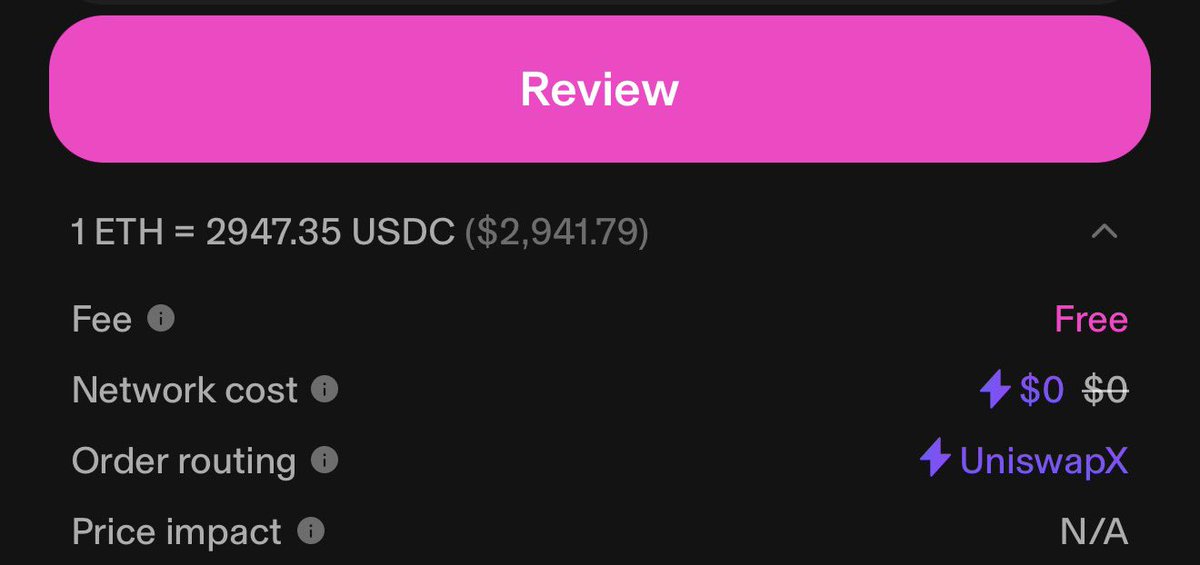
if you’re still using any other dex to buy/sell, stop
you’re literally paying ~1% per tx for no reason.
you can swap everything on uniswap with 0 fees.
These “revenue” comparisons from Alex are so misleading. It’s worth being precise about how these models actually work
Aero takes 100% of LP fees and rebates them back to LPs via token emissions / liquidity incentives.
In practice, this looks like: “we collect $100m in LP fees and distribute $100m in tokens to LPs based on token voting”
This approach makes revenue numbers look large, but it doesn’t represent sustainable fees. It also puts a heavy thumb on the scale of where LP fees go and makes LP returns dependent on the price of a third token
If Uniswap took 100% of LP fees and rebated them in tokens, reported “fees” would be close to $1B and just as meaningless
Uniswap protocol fees are different by design. A portion of swap fees goes to the protocol, while the majority still goes directly to LPs. The objective is long-term sustainability, not inflated optics
Our proposal starts conservatively, with a roadmap of additional fee sources being enabled over time. This lets the DAO learn each step. The real risk would be turning fees up too aggressively and only learning after liquidity leaves.
Another misleading comparison from Alex is conflating token-emission LP rebates (which are required when all LP fees are taken) with Uniswap’s growth and development budget, which funds engineering, developer grants, and integrations across thousands of products worldwide
As for annual fee burn: it’s too early to project. It’s only been live for a few days, several fee sources aren’t active yet, and volume is still ramping. More importantly, this is a long-term strategy, growth still comes first.
The crypto market will grow massively from here, and Uniswap has the potential to see trillions in daily volume. Capturing that opportunity is the goal
Early signals are solid: liquidity has been stable with fees on, the fee collection system is working smoothly, searcher efficiency is improving, and UNI is being burned daily. This is the start of a new era for Uniswap 🦄
Uniswap web app, mobile wallet, and browser extension are now totally free products!!
No frontend swap fees, fees on positive slippage, or any other app level fees
🫡
BREAKING: Tomorrow is Warren Buffett's last day as CEO of Berkshire Hathaway.
Buffett took the stock from $19/share in 1965 to $750,000/share today, up +3,950,000%.
Congratulations to the best investor of all time.
Markets are witnessing history:
The US stock market cap-to-GDP ratio is up to a record 218%.
This comes as the stock market's value jumped to an all-time high of $68 trillion, far exceeding the ~$31 trillion size of the US economy.
This ratio has surged +56 percentage points over the last 8 months.
As a result, the metric is now ~78 percentage points above the 2000 Dot-Com Bubble peak.
Since the 2020 pandemic, the US stock market has grown twice as fast as the world’s largest economy.
Own assets or be left behind.
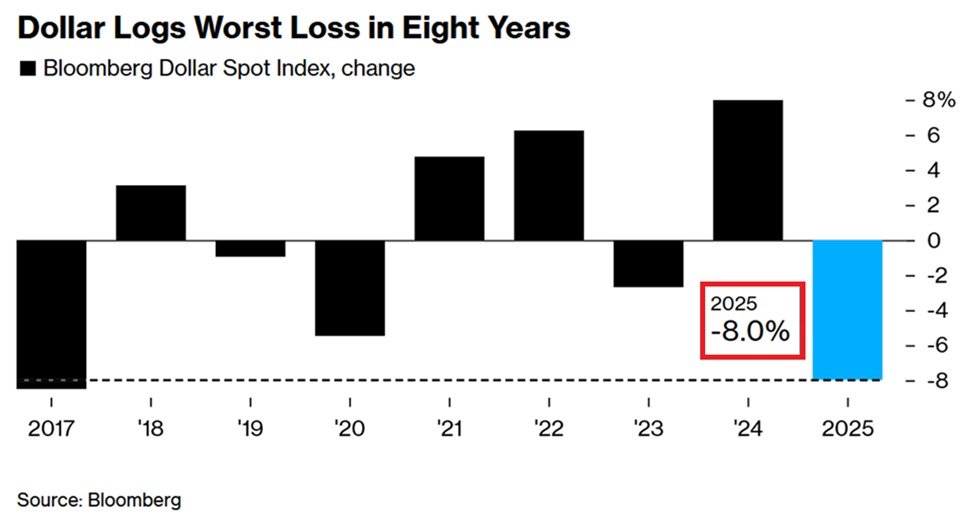
The US Dollar experienced a historic decline in 2025:
The US Dollar Index fell -9% in 2025, marking its worst performance since 2017.
This represents a sharp reversal from the +8% gain recorded in 2024.
Excluding 2017, this was the weakest year for the currency since 2003.
Since 2010, there have been only 5 years in which the US Dollar posted an annual decline.
Meanwhile, hedge fund positioning on the US Dollar turned bearish as of the week ending December 16th, the first time since mid-October, according to CFTC data.
Fed policy will drive the next move in the US Dollar.
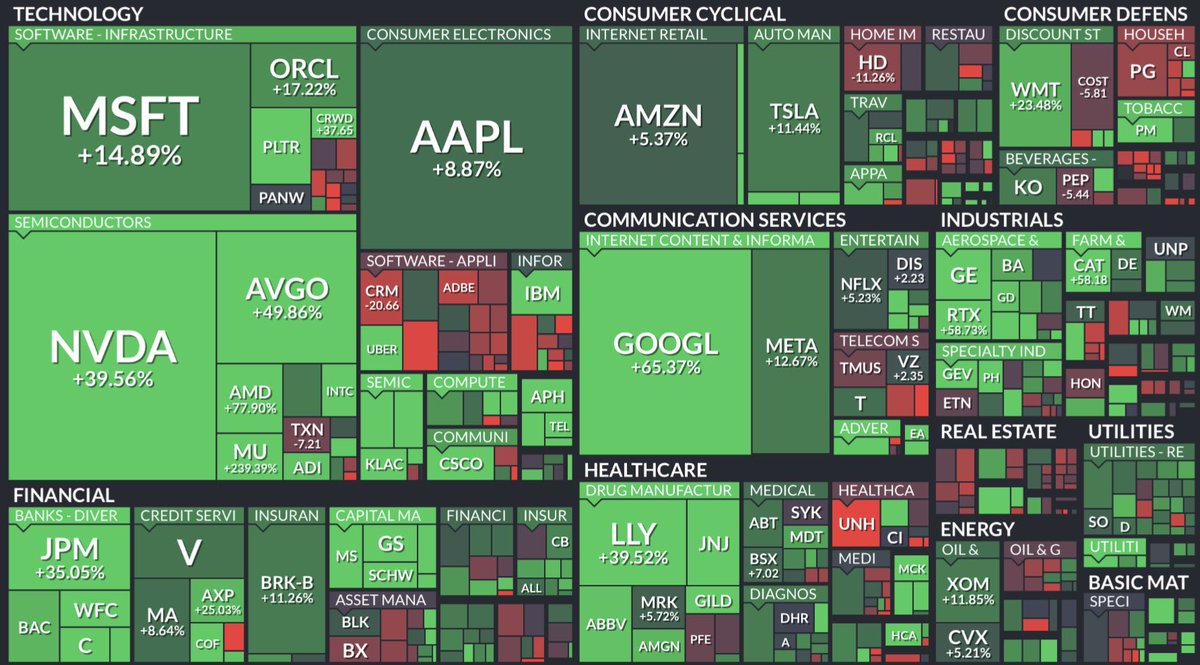
AI stocks experienced a remarkable year:
3 of the S&P 500's top 4 performers in 2025 were data storage companies, benefiting from massive AI-driven spending.
Sandisk, $SNDK, topped the list with a +559% return, followed by Western Digital, $WDC, and Seagate, $STX, at +284% and +225%, respectively.
Meanwhile, Palantir, $PLTR, was the 9th best-performing stock in the index, posting a +135% return last year.
This marked the 3rd-consecutive year of triple-digit gains for the stock.
AI-related stocks dominated equity performance in 2025.
Welcome to 2026! Milady is back.
Ethereum did a lot in 2025: gas limits increased, blob count increased, node software quality improved, zkEVMs blasted through their performance milestones, and with zkEVMs and PeerDAS ethereum made its largest step toward being a fundamentally new and more powerful kind of blockchain (more on this later)
But we have a challenge: Ethereum needs to do more to meet its own stated goals. Not the quest of "winning the next meta" regardless of whether it's tokenized dollars or political memecoins, not arbitrarily convincing people to help us fill up blockspace to make ETH ultrasound again, but the mission:
To build the world computer that serves as a central infrastructure piece of a more free and open internet.
We're building decentralized applications. Applications that run without fraud, censorship or third-party interference. Applications that pass the walkaway test: they keep running even if the original developers disappear. Applications where if you're a user, you don't even notice if Cloudflare goes down - or even if all of Cloudflare gets hacked by North Korea. Applications whose stability transcends the rise and fall of companies, ideologies and political parties. And applications that protect your privacy. All this - for finance, and also for identity, governance and whatever other civilizational infrastructure people want to build.
These properties sound radical, but we must remember that a generation ago any wallet, kitchen appliance, book or car would fulfill every single one of them. Today, all of the above are by default becoming subscription services, consigning you to permanent dependence on some centralized overlord.
Ethereum is the rebellion against this.
To achieve this, it needs to be (i) usable, and usable at scale, and (ii) actually decentralized. This needs to happen at both (a) the blockchain layer, including the software we use to run and talk to the blockchain, and (b) the application layer. All of these pieces must be improved - they are already being improved, but they must be improved more.
Fortunately, we have powerful tools on our side - but we need to apply them, and we will.
Wishing everyone an exciting 2026.
Milady.