The next AI revolution is not just happening on screens. It is happening in the physical world.
Robots, drones, autonomous vehicles, and smart machines all need one thing before they can operate safely: Precise location.
Traditional GPS can be off by several meters. For humans, that may be fine. For autonomous machines, it can be dangerous.
GEODNET is building the spatial intelligence layer for Physical AI, using RTK positioning to improve accuracy from meters to within one centimeter.
Over 20,000 base stations.
170+ countries.
11,000+ cities.
130+ enterprise customers.
Physical AI needs real-world infrastructure.
That infrastructure is being built now.
Survey day packing list:
✅ GEO-MEASURE
✅ Your phone
❌ External antenna
❌ Cable tangle
❌ Your own base station
What's the one piece of gear you'd never leave behind? 👇
Would you want drones outside your window all day? 🚁
Mike Horton and Scott Walter, PhD, discuss the noise nobody mentions.
What's your tolerance?
Watch the full GEODNET x RoboStrategy conversation on our YouTube channel and find out what they have to say.
Weekend challenge: can you find your property line? 🏡
Most of us think we know. The fence, the hedge, an old stake by the driveway. But those are guesses, not measurements.
Whether you’re a surveyor, a builder, a farmer or a homeowner with a theory, we want to hear your method!
How would you find your property line, and how close do you think you’d get? 🤔
Ever needed centimeter accuracy for a job, and wondered if you'd really get it before committing? 📍
Standard satellite positioning is good to a few meters. RTK Fixed with GEODNET gets you to 1 to 2 cm.
Now you can test it on your own project. Request a 14 day free trial in 3 steps:
1. Request a trial
2. Tell us where you'll test and what equipment you'll use
3. Submit and the GEODNET team will be in touch
22,000+ base stations. 177 countries. The world's largest RTK network.
What's the first job you'd put it on? 👇
@blvdr Thanks for flagging this, Keith. Could you share roughly where you were and what receiver you used? We'd like to look into it. Coverage map: https://t.co/YIHjA56yAB
“Close” means different things to different jobs.
Satellite positioning on its own: a few meters.
RTK Fixed with GEODNET: 1 to 2 cm.
Only one of those can tell you which side of the stake you’re on.
That’s the gap GEODNET RTK is built to close. By bringing in real-time corrections from a GEODNET base station, an RTK device can reach 1 to 2 cm with RTK Fixed.
It’s why distance to the nearest station matters, and why the network keeps growing: 22,000+ base stations across 177 countries. The world's largest RTK network!
What’s the smallest error your work can tolerate, and what do you do to stay inside it?
@mahvdiya1 Thanks for asking! You can find more on the network here: https://t.co/wp7Q4gnjU2
If you meant something specific, tell us a bit more and we'll point you to the right place!
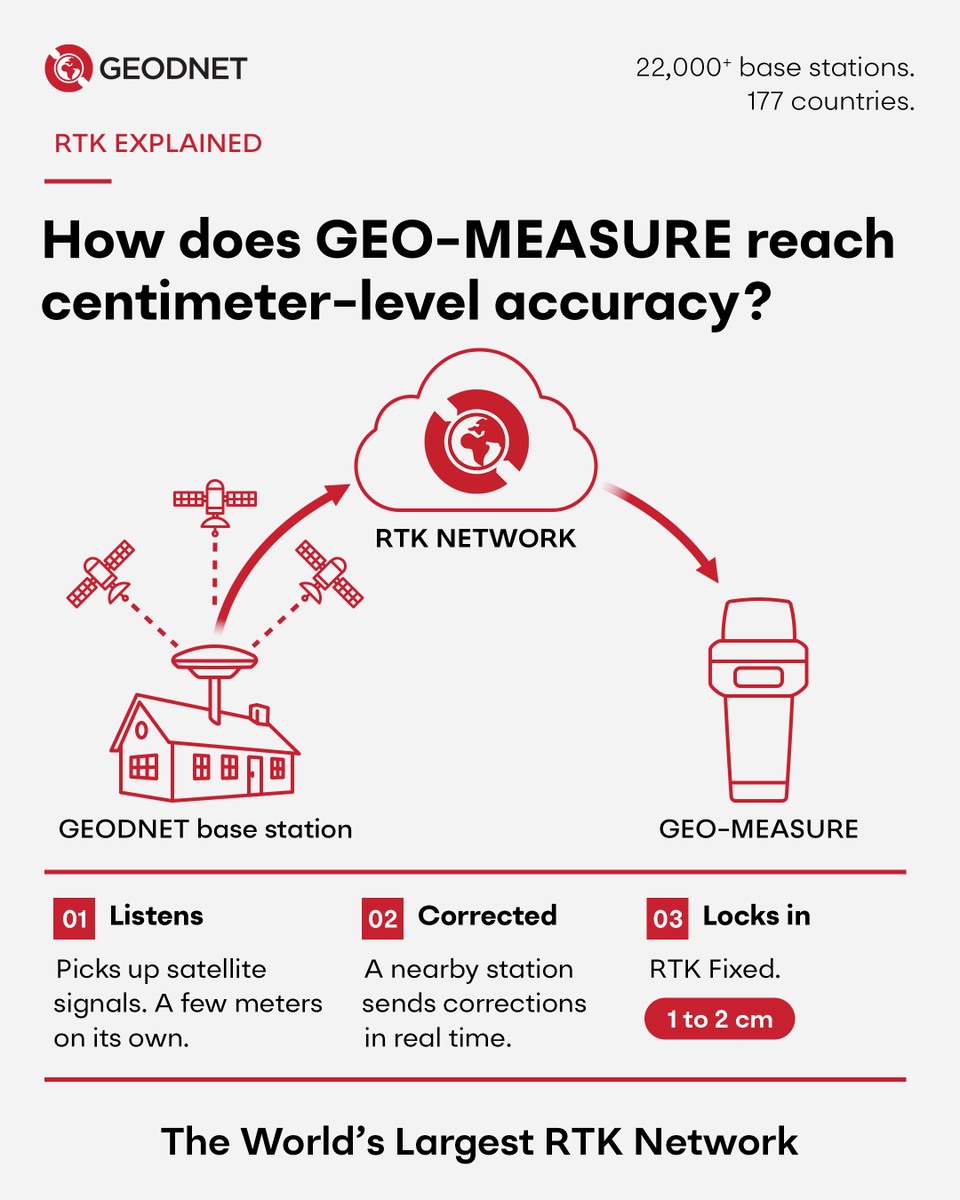
Satellite positioning on its own is good to a few meters. GEO-MEASURE gets to 1 to 2 cm. Here’s how:
1. Base stations communicates with GNSS satellites and receive location data.
2. Corrections flow. GEODNET's RTK network turns signals into real-time corrections and sends them to your GEO-MEASURE.
3. GEO-MEASURE locks in. RTK Fixed: 1 to 2 cm.
22,000+ base stations across 177 countries. The world’s largest RTK network.
What would you measure first if you could trust every centimeter?
9 new places on the GEODNET network this week. 📍
Hankamer TX, Wayne NE, Oak Harbor OH, Wickes AR, Kapuskasing ON, Cross Hill SC, Solon IA, Wills Point TX and Prescott AR.
Each one is another base station strengthening corrections for the people working nearby. 22,000+ and counting, across 177 countries.
Where would a station make the biggest difference for your work?
@DepinWard Thanks for sharing this, Peter! 🙌 "Roughly right" vs. "actually usable" is exactly the gap RTK closes for surveyors, farmers, robotics, and more!
What if your packages traveled underground? Disney World’s ground floor is really the first floor, with everything moving around beneath it. Now picture a whole city built that way for machines.
We dig into it in RoboStrategy Part 4 - The $1 Billion Test: Humanoids or Specialized Robots? 👇