@vkhosla Appreciate you having an opinion on this. It’s hard to comprehend the US taking this stance against such longterm staunch allies - yet here we are.
The CFP National Title will feature:
1️⃣ former JMU Head Coach
2️⃣ former JMU Def. Coords.
1️⃣ former JMU Off. Coord.
7️⃣ former JMU Asst. Coaches
2️⃣ former JMU Players now Coaching
3️⃣ former S&C Coaches
7️⃣ former JMU Players playing in the Game
5️⃣ former JMU commits
JMU. #GoDukes
@Lost1million Trading isn’t the problem, your risk management is. Sorry for the losses, we’ve all been there, it gets better but you need to fix your gambling habits.
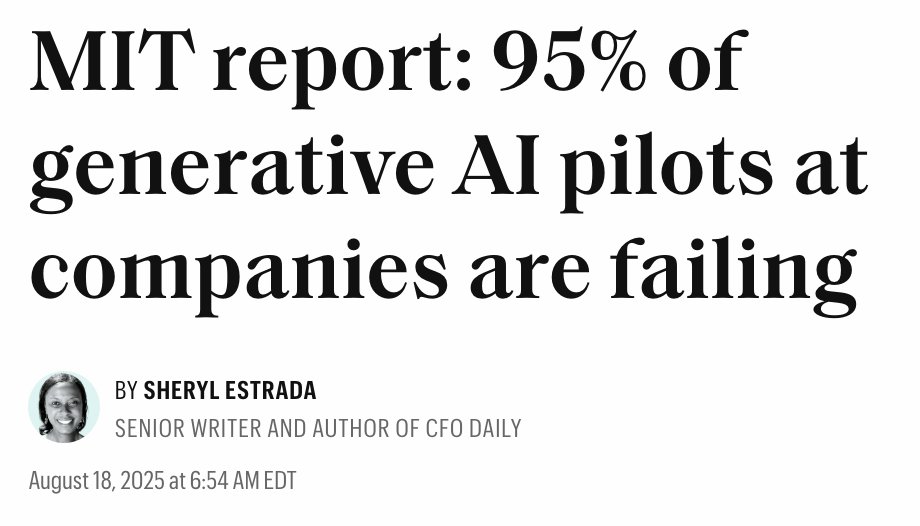
A recent MIT report went viral with the headline that 95% of enterprise AI pilots showed no P&L impact. The real story here is poor scoping and unrealistic expectations.
The hype and internal pressure around AI has been such that company leaders are making bad decisions.
The notion that today’s AI models are capable of replacing experienced employees is not only wrong, but set to cause unnecessary chaos and confusion across teams.
That’s not where we are. Right now, AI is a foundational fulcrum. If planned out and laid thoughtfully with accompanying behavior change training, it’s massive leverage.
But like most shiny new things, companies are struggling with how to properly integrate it.
New companies are at an advantage right now as they can (and should be) building operational stacks to be AI-first from the ground-up with their teams learning through doing.
Larger companies, by the very nature of their size and complexity, must take a significantly more iterative approach, like lifting a multi-story building off its struts to pour a new concrete foundation.
Here are my recs for using AI today:
1/ Treat AI as employee leverage and invest in dedicated time spent on AI. One great operator with a smart stack beats three mediocre hires without one. Ensure your employees are allocating time to understanding what AI is good for, what it isn’t, and discovering the top use-cases for their individual workflows.
2/ Start with the boring, repeatable work. The stuff you quietly do every day is where you’ll find the greatest gains.
3/ Build it into the workflow you already have. If it isn’t living inside the tools and rituals your team uses, it dies on the vine.
4/ Measure in minutes. Track cycle time, error rate, and rework. Then compound those savings across the team.
5/ Plan for 6+ months before the returns show up. That includes training, troubleshooting, and change management.
Treat AI like onboarding a junior hire. You document the job, teach the context, review the work, and keep improving it. Returns will not happen over night, but they will in the long-term.
My rule these days → once I do a task five times (and know I will be doing it again), it gets automated. Incremental time savings compound. And compound interest on time-saved builds strong business.