NGC 7000 - The North America Nebula.
It’s always a bit magical to think that all the light in this image has traveled through space for thousands of years—only to finally land on the sensor here at home on my balcony. ✨
First light with my new refractor — a TS Photoline 107mm f/6.5 — capturing the stunning IC1848, the Soul Nebula. About 12.5 hours of narrowband exposure went into this beauty. Absolutely thrilled with the result!
#Astrophotography#IC1848#spacepics#stargazing#nightsky
From my backyard to the vast depths of the universe 💫✨This is NGC 7822, a stellar nursery located approximately 3,000 light-years away in the northern constellation Cepheus. Narrowband filters mapped to a HOS-palette. 12 hours of integration time.
#Astrophotography
✨ Cosmic beauty alert! ✨A massive star trapped in its own bubble—NGC 7635, the stunning Bubble Nebula. 7,100 light-years away in Cassiopeia, It floats silently in the eternity of space and I’ve been lucky enough to capture it in all its glory.
#Astrophotography#BubbleNebula
I took the opportunity to photograph Messier 51 during a visit to Sollefteå this Easter. No astronomical night at this time of year and latitude.
Lum 30 x 2 min, RGB 10 x 2 min per filter, Ha 5 x 5 min.
ONTC808, PlayerOne Poseidon M, Antlia V-Pro LRGB-filter.
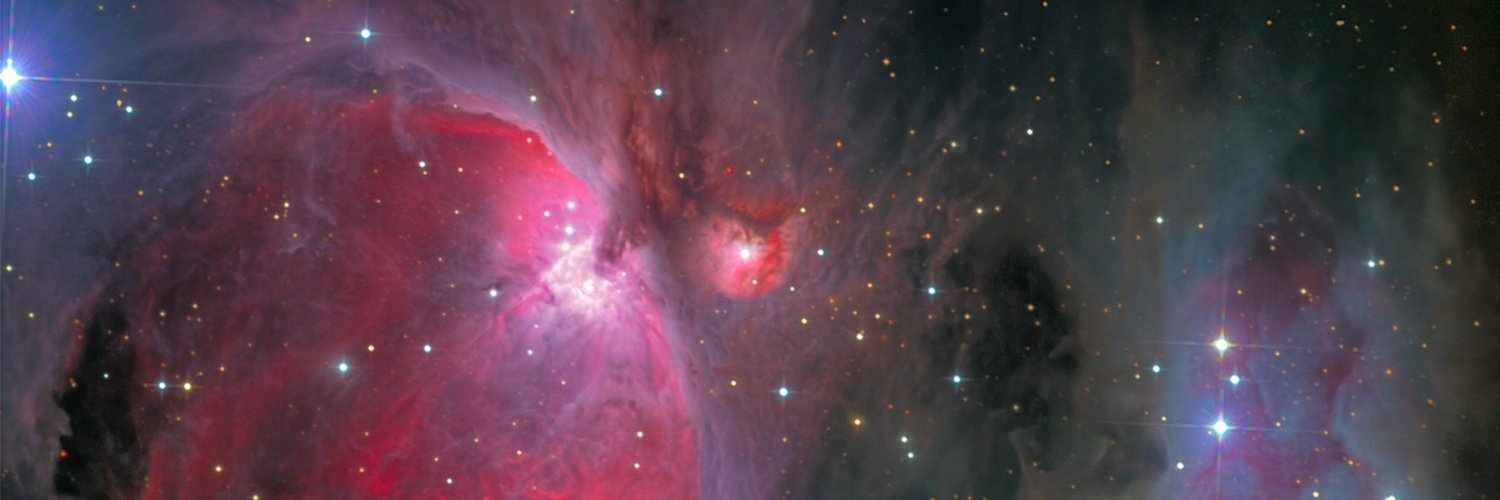
There was no Eurovision, but there was an Orion Nebula.
Messier 42 photographed north of Vira Bruk last Saturday evening.
Lum 89 x 1 min, RGB 15 x 1 min for each filter.
ONTC808, PlayerOne Poseidon M, Antlia V-Pro LRGB-filters.
@ScottUPPSALA What a coincidence, I actually had a remote session with PlayerOne as recently as yesterday. The background was that the filter wheel stopped communicating at minus 10 degrees. Before the remote session I loosened the middle bolt by a quarter turn which tested ok down to minus 18
A very fascinating area in the constellation Gemini, photographed the day before New Year's Eve. IC 443, also known as the Jellyfish Nebula, is the remains of a supernova that occurred 30,000 - 35,000 years ago. The same supernova event likely created the neutron star CXOU J061.
Always fun to see what can be done with old equipment. Here is NGC 1499, the California Nebula, photographed under moonlight from the garden sometime in late October. 360 minutes total exposure time, of which OIII is only 60 minutes. Camera SBIG 8300 M, lens Canon EF 300mm f/4 L.