Procurement nerd in the public sector 💼 Making sense of rules, value, and suppliers | Strategic sourcing with a conscience 🌱 #Procurement#EthicalSpending
@boye4christ2006@carter8f Just to add that he got council flat in London from the UK govt which was later sold to him and it's today worth £1m. Only a fool will listen to him.
The 2023 presidential election exposed a major weakness in INEC’s electoral technology when IReV failed to upload results as expected. INEC blamed a technical glitch, but Nigerians were left with disputed results and told to seek redress in court.
Opposition parties and citizens must demand a clear, publicly available Business Continuity Plan (BCP) from INEC before the next election in January 2027.
The plan must spell out exactly what happens if IReV or other critical election technology fails. Will the process be suspended? Under what circumstances will election be cancelled and rescheduled? What alternative procedures will apply, and how will the public be informed?
INEC cannot wait for technology to fail before deciding what to do. Nigerians deserve to know the rules in advance.
@inecnigeria@SituationRoomNg@YIAGA@EiENigeria
Legacy liabilities are real, but they do not tell the whole story. This government removed fuel subsidy, liberalised the FX market, raised electricity tariffs and is pursuing tax reforms, all in the name of improving government revenue. Yet borrowing continues, while capital investment remains constrained.
At the same time, it has maintained the largest cabinet, created new ministries and agencies, and expanded the machinery of government despite promising to implement the Oronsaye Report and reduce the cost of governance.
These choices have increased the pressure on recurrent expenditure. So why is the focus always on inherited debts, with little scrutiny of the government's own spending decisions?
Someone asked why the most of the borrowings by FG aren’t going into capital projects, well this is your answer .
LEGACY DEBT!!!!
Pension arrears alone- N2 trillion
Debt owed to electricity companies - N 4trillion
Ways and means that was securitized under this administration- N22 trillion
CBN forex obligation backlog - $ 5 billion.
They also had to battle with astronomical rise in personnel cost/ expenditure.
The Tinubu government is seeking approval in November to raise $7.7 billion in external loans to finance 2026 budget that is supposed to end on 31 December.
This is more than a borrowing question; it raises fundamental concerns about fiscal planning, budget execution and expenditure management.
Nigeria has a ₦31.4 trillion budget deficit, yet the government is still scrambling to secure financing towards the end of the fiscal year. Meanwhile, debt-service costs continue to consume an enormous share of government revenue.
What happened to the revenue gains from subsidy removal, FX liberalisation and higher taxes? Why is expenditure reform, particularly budgeting, procurement and spending controls, not receiving the same urgency as revenue mobilisation?
@BudgITng@EiENigeria@FinPlanKaluAja1
The NHS is not just a large spending institution; it has an extensive framework for procurement, commercial management, financial controls and expenditure accountability. It has over 4,000 procurement professionals operating across national, ICS and Trust levels, managing commercial spending across more than 80,000 suppliers.
The lesson is not simply that Nigeria needs more money to spend. It also needs the institutional capacity to ensure that every naira spent delivers value for money.
Where is the equivalent emphasis on professional procurement, competitive tendering, contract management, expenditure controls, budget discipline and independent scrutiny of public spending in Nigeria?
Revenue mobilisation is important, but without spending reforms, more revenue can simply mean more money passing through inefficient systems, with little improvement in public services.
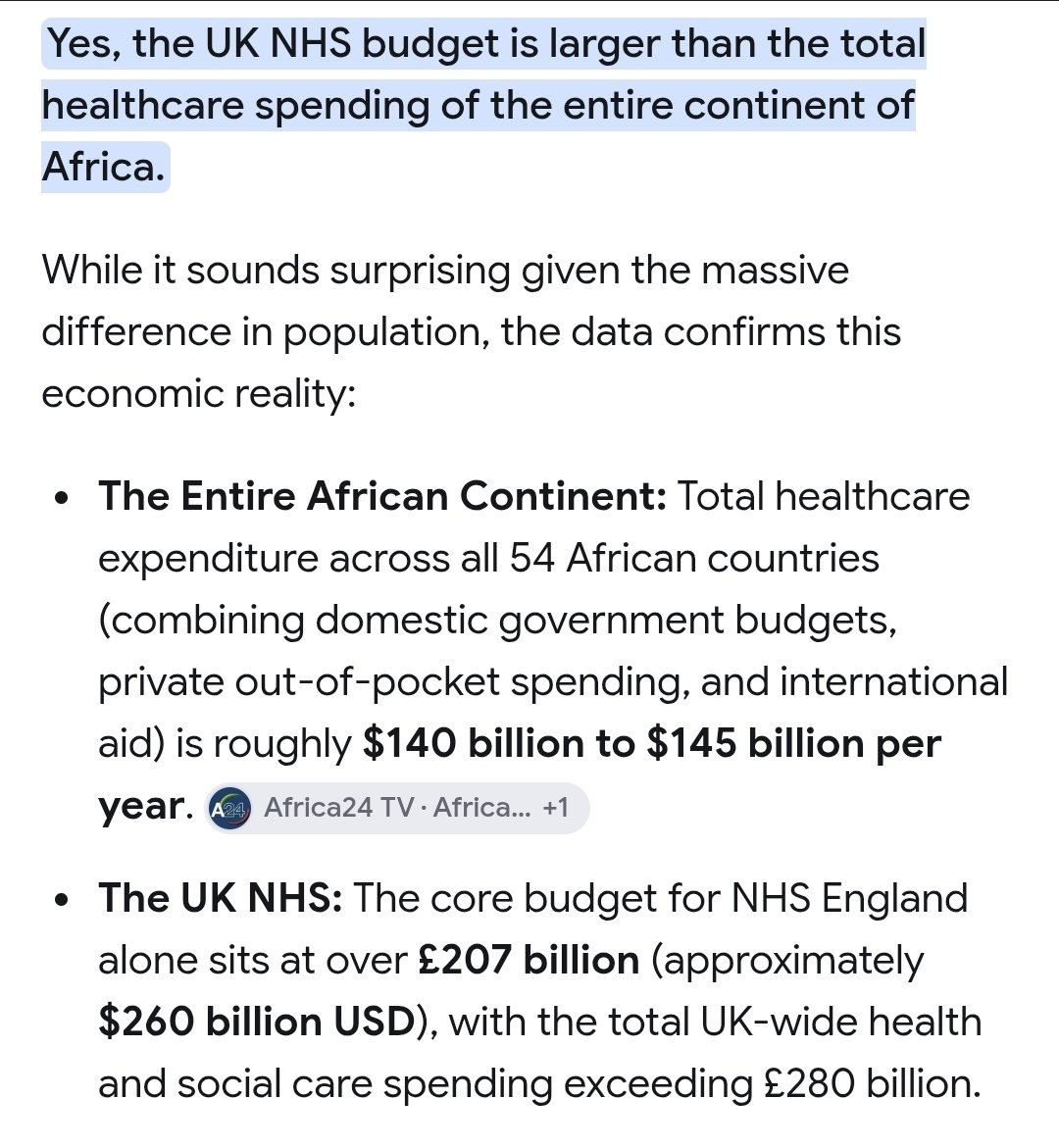
The NHS spends more money on healthcare for 68 million people in the UK than the entire continent of Africa, with 1.5 billion people.
In fact, the NHS spends more on Mental Health and other specialised services than the FG's entire budget.
I’m aware of Taiwo’s work on tax and fiscal policy reforms. My point is that tax reform and revenue mobilisation are not the same as comprehensive reform of public expenditure.
The work on tax reform did not, in itself, resolve the structural problems in budget preparation, procurement, expenditure control, contract management and value-for-money assurance. These are critical to ensuring that additional revenue translates into better public services and productive investment.
We are currently dealing with multiple overlapping federal budgets, while implementation of the capital component of the 2026 budget has yet to commence, according to the information available.
So the question remains: what is the point of aggressively expanding revenue collection if budgeting is weak, procurement is inefficient and capital spending fails to deliver on time?
Nigeria’s problem is not just how much government collects, but how effectively it converts public money into public value. Until expenditure reform receives the same urgency as revenue reform, government may collect more while Nigerians continue to struggle.
@georgeaiyee Then you haven’t followed Taiwo closely enough. This was one of the core themes of the fiscal policy and tax reforms he chaired.
I broke it down in this thread.
Nigeria’s fiscal debate is almost always about how government can generate more revenue, but rarely about how efficiently it spends what it already collects.
The real challenge is not just revenue allocation between the federal and subnational governments. It is the quality of budgeting, procurement, expenditure controls and accountability for public spending. More revenue means little if it is not translated into infrastructure, security, healthcare, education and productive investment.
This is why Nigeria’s revenue reforms are struggling to deliver meaningful benefits at the micro level. You cannot tax, borrow and charge your way to prosperity while ignoring spending efficiency. Revenue mobilisation without expenditure reform risks creating a government that collects more while citizens struggle to live.
“Based on data, the center is the most deprived of resources yet it has the most responsibilities. Roughly 85% are assigned to subnational, only 15% to the federal government… the center needs more resources to meet defense, internal security, foreign affairs.” – Taiwo Oyedele
Approving drilling at the Jackdaw gas field is a pragmatic response to an increasingly volatile geopolitical environment. The UK will continue to need gas for years to come, and recent supply disruptions have exposed the risks of relying too heavily on imported energy.
Domestic production can strengthen energy security, support British jobs, generate tax revenue and reduce dependence on liquefied natural gas imports, which can carry higher production and transport emissions.
However, energy security must not become an excuse to delay the transition to renewables. The government must invest in clean energy, develop alternative industries and ensure that tomorrow’s jobs arrive before today’s oil and gas workers lose theirs. The skills built in the North Sea should be transferred into offshore wind and other emerging energy sectors.
A credible transition must balance energy security, climate responsibility and workers’ livelihoods. Net zero and energy independence should reinforce each other, not compete.
🚨 BREAKING: The Government has officially approved the Jackdaw gas field for North Sea drilling
It's the UK’s largest known untapped gas reserve and will start to supply gas to British homes and businesses from the end of this month
In October 2023, Taiwo Oyedele said the naira’s fair value was around ₦650–₦750/$ and expected it to reach that level by year-end following FX reforms.
Today, he is warning that even discussing a return to petrol subsidy could push the naira to ₦3,000–₦4,000/$.
These are vastly different projections, and Nigerians deserve to know the assumptions behind them. What changed between the confidence of 2023 and today’s warnings?
Economic arguments should be tested against outcomes, not used to frighten people away from debating policies whose costs they are already bearing.
Finance Minister Taiwo Oyedele says even talk of bringing back petrol subsidy could push the naira toward N3,000-N4,000/$.
It closed Monday at N1,333.72.
Campaign promises have an exchange rate.
I disagree that this is the best the FG can do. The analysis focuses almost entirely on revenue growth while treating expenditure as though it cannot be challenged.
Yes, revenue has increased, but at what human cost? Nigerians are paying more for fuel, electricity, transport and basic necessities. Yet the government continues to borrow heavily, with interest payments consuming more than its revenue.
The missing conversation is expenditure reform: credible budgeting, procurement transparency, value-for-money audits, tighter controls on recurrent spending, contract monitoring and accountability for every Naira spent. Revenue mobilisation without spending discipline is simply a more efficient way of feeding a broken fiscal system.
A lot to unpack here.
The FG did grow revenue by more than 100% to ₦6.2trn (from ₦3.6trn). The increase came from higher oil receipts and stronger tax collections.
But interest payments on debt stood at ₦7.7trn, therefore, gulping the entire revenue generated.
The FG spent ₦16.1trn. This means that, aside from interest payments on debt, the FG spent ₦8.4trn on other activities (i.e., recurring and capex).
Of the ₦8.4trn allocated to other activities, ₦700bn went to capital expenditure, while the rest went to recurrent expenditure (including payrolls and overheads).
In effect, fresh borrowings of ₦7.7trn were spent on recurrent expenditure.
If I wanted to be “mischievous”, I’d have said ₦7.7trn was borrowed to pay salaries (which is not false, by the way). But I won’t do that. That’s not my objective.
So in summary, the government is fetching water into a “basket”. The harder they work to “make things happen”, the more the ghost of the past haunts.
And from the looks of things, this may be the best the FG can do. But the jury is out.
Nigeria paid ₦7.7 trillion in interest in just six months, 124.19% of federal government revenue. Let that sink in.
The government is spending more on servicing debt than it generates in revenue, leaving little fiscal room for infrastructure, healthcare, education and other public services.
Yet Nigerians have endured fuel subsidy removal, FX liberalisation and higher electricity tariffs, all justified partly by the need to improve public finances.
How can a country keep borrowing to service existing debt while its citizens shoulder the cost of adjustment?
World Bank: Nigeria’s debt interest payments rose to N7trn in H1 2026 — gulping over 100% of revenue
Nigeria’s interest payments rose to N7.7 trillion in the first half of 2026, from N5.6 trillion in the corresponding period of 2025, amid high domestic borrowing costs, according to the World Bank.
The interest payment gulped 124.19 percent of the federal government revenue.
In its 2026 Nigeria Development Update (NDU) titled ‘Beyond the Federal Purse: How Higher Revenues Reshaped State Priorities,’ the bank said interest payments increased to 3.1 percent of gross domestic product (GDP) from 2.5 percent a year earlier.
https://t.co/1i1Iun9ZuL