This report documents one of the most exciting observations we have ever made. Meticulously carried out by Marty and @GeorgeJSaunders this @J_A_C_S work shows how metastable 3-10 motif can be stabilized and enriched at high T. Should be a useful scaffold.
https://t.co/QRN3MSanVB
Great to see this project out in its final form! We took a deep dive into the role of H-bonds in complex macrocyclic structures and found some interesting effects.
Identification of "Structural Pin" Interactions and their Significance for the Conformational Control of Macrocyclic Scaffolds (Andrei K. Yudin and co-workers) @andrei_yudin@GeorgeJSaunders#OpenAccess https://t.co/BomNWhCBkz
Proud to share this paper from my PhD studies on azetidine modified cyclic peptides! This was a very fun project to work on with some really cool outcomes and applications
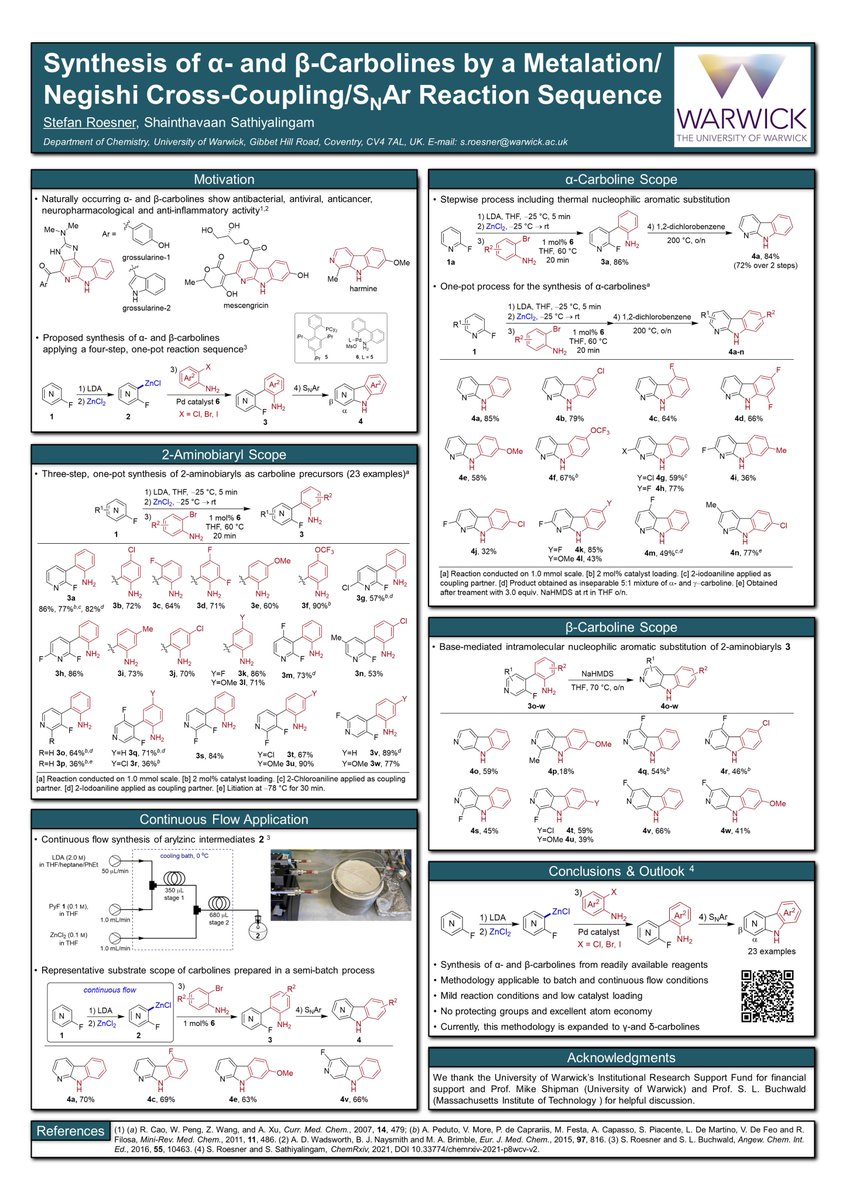
Synthesis and Functionalization of Azetidine-Containing Small Macrocyclic Peptides (Michael Shipman and co-workers) @GeorgeJSaunders, @RoesnerL, @warwickchem https://t.co/O0gld1aajk
Here is our study aimed at understanding cell penetration of oxadiazole-containing macrocycles. These are very peculiar molecules. Indebted to @ChemKritzer and his lab’s wonderful CAPA system. @Sean_SJ_Huh and Nefeli led the investigation. https://t.co/LhxHMI1Ezf
In this study, expertly spearheaded by @DiegoBenDiaz (now at Merck #MerckChemistry) we investigate the role of attractive non-covalent interactions in peptide macrocyclization @JOC_OL https://t.co/lyCVpMp2m9
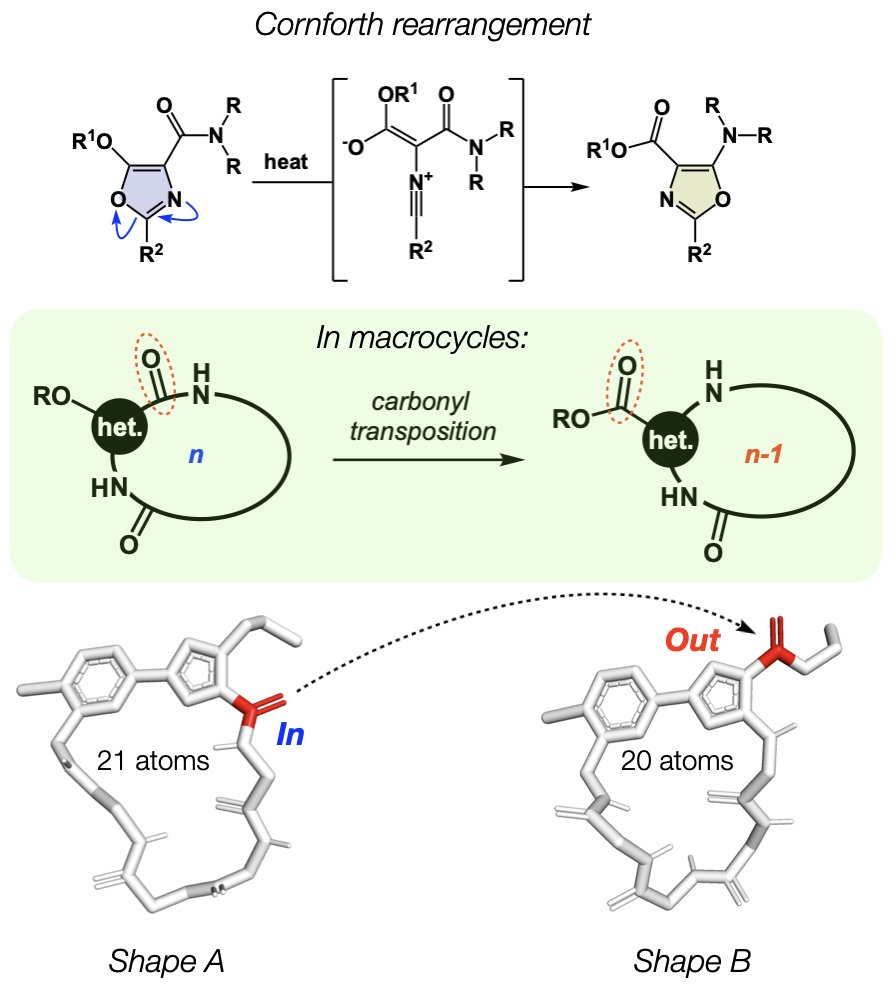
With @Sean_SJ_Huh (our recent PhD!) and @GeorgeJSaunders we deployed the rarely used Cornforth rearrangement to remove an atom from a macrocycle. This @angew_chem paper studies the interplay between reactivity and uncommon conformational states.
https://t.co/8PdZikSMXF
Exciting news this Friday🎉
We’ve just published our second commentary piece by @andrei_yudin and @GeorgeJSaunders which provides additional viewpoints & contextualises earlier results from Alkane Kawamura, et al.
You can read the Commentary here: https://t.co/OQrd33RQyR
[1/2]
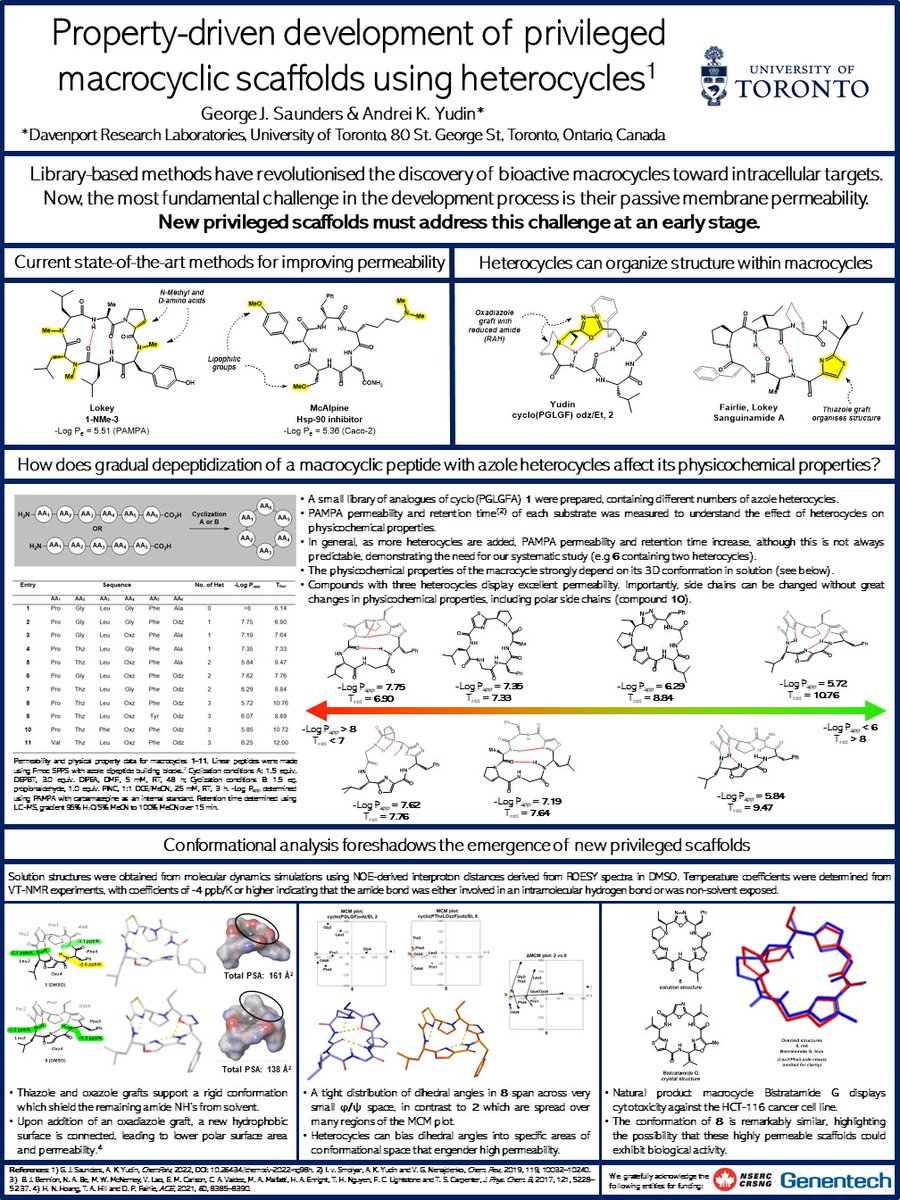
Many factors affect cellular permeability of macrocycles. Together with @GeorgeJSaunders we consider the effect of heterocycles in this paper that just came out. As luck would have it, George is giving a poster on this advance at #APS2022 today. https://t.co/DTPjeWIplR
Tim McTiernan, @DiegoBenDiaz, @GeorgeJSaunders, Fiona Sprang and I describe MCMs (macrocycle conformational maps) that visualize conformational changes taking place in large ring systems. @genentech and @NSERC supported this study.
1/6
@dawber_robert@andrei_yudin Thanks for the question! Check out the solution structure of 6 (bottom left, red part of the arrow, or in Fig 4 of the pre-print article), its backbone conformation features two solvent exposed amide bonds which aren't favourable as it would cross the hydrophobic membrane.
In this #RSCPoster I present work w/ @andrei_yudin towards new macrocyclic scaffolds that solve an unmet challenge in the development of bioactive cyclic peptides. We use heterocycles to discover membrane permeable conformations that are a platform for further development #RSCOrg
@Vy_Dong_Group@andrei_yudin As for bicycles, why not! The backbone conformation drives properties, and heterocycles force the backbone into distinctly unique conformational states compared to regular AA modifications. There are certainly other effects to discover with different heterocycles and combinations
@Vy_Dong_Group@andrei_yudin Great Q! We chose azoles because they are similar to the amide bonds that we are replacing and are easy to make from canonical AA's. One could certainly imagine a pyridine acting in a similar way to our azoles, with the N pointing into the macrocycle to H-bond with amide NH's.




![ChemicalScience's tweet photo. Exciting news this Friday🎉
We’ve just published our second commentary piece by @andrei_yudin and @GeorgeJSaunders which provides additional viewpoints & contextualises earlier results from Alkane Kawamura, et al.
You can read the Commentary here: https://t.co/OQrd33RQyR
[1/2] https://t.co/Fy9wTl9ksR](https://pbs.twimg.com/media/Fgu1yktWYAMQeej.jpg)