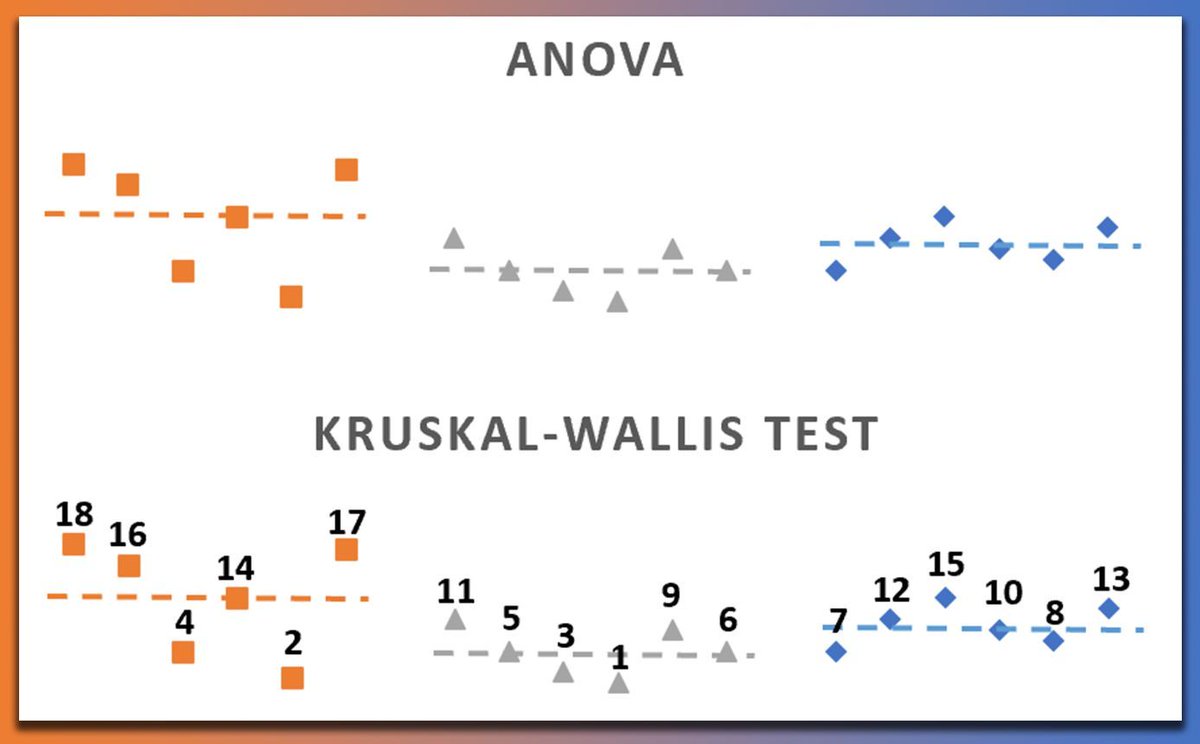
The Kruskal-Wallis test is a non-parametric method used to determine if there are statistically significant differences in the distributions of three or more independent groups based on ranks. Unlike ANOVA, it does not assume a normal distribution, making it versatile for analyzing non-normally distributed data sets.
Advantages of Proper Use:
✔️ Suitable for ordinal data or non-normally distributed data sets.
✔️ Does not assume homogeneity of variance, offering more flexibility.
✔️ Can be used with small sample sizes, increasing its applicability in various research settings.
Challenges If Not Handled Correctly:
❌ Interpretation can be complex, especially if the test is mistaken for a direct comparison of medians when specific conditions aren't met (e.g., independent samples, symmetric distributions).
❌ Less powerful than ANOVA when data is normally distributed, which can lead to less accurate results.
❌ May require post-hoc tests to pinpoint specific group differences, adding complexity to the analysis.
How to Apply in Practice:
🔹 R: Use the kruskal.test() function from the base package to perform the Kruskal-Wallis test.
🔹 Python: Utilize the kruskal() function from the scipy.stats module for the analysis.
Visualization Explanation:
The visualization accompanying this post compares ANOVA and the Kruskal-Wallis test by ranks. This visualization is adapted from a Wikipedia source: https://t.co/1hRzGEFOjY
For those interested in learning more, consider joining my online course on Statistical Methods in R, where we explore this topic and related methods in greater detail.
Take a look here for more details: https://t.co/7YQCRDKSPO
#DataAnalytics #RStats #Rpackage #DataScientist
His Majesty King Charles approved The Royal Army Medical Service name. The amalgamation will ensure that the next generation of the Army will continue to be supported by a modern corps capable of delivering healthcare on exercises and operations at home and around the world.
Most researchers make a critical mistake in their methods section that instantly signals 'amateur' to reviewers. It's so common that I see it in 7 out of 10 papers, yet so simple to fix...
Delay writing your Methods section.
Spend time owning your research process first:
Academic jargon is suffocating your understanding of concepts.
Your writing lacks depth because you don't understand these terms.
I've got your solution:
Repost & reply 🎓
I'll DM you this handy guide in Google Sheets to explain scientific terminology (must be following).
How do we prepare for future crises and conflicts?
Wargaming helps us better understand complex problems and improves our ability to make evidence-based decisions faster.
📽️ Find out more about our new Defence Experimentation and Wargaming Hub 👇
We are pleased to announce the release of CAL insight No.48 - ‘Exploring Metacognition. The Key to Exceptional Leadership.’ by CAL Senior Research Fellow, Major Munish Chauhan MBBS, MRCS, PgDip (RAMC).
Discover the significance of metacognition on the development of leaders, and about the mutually supportive relationship between metacognition and emotional intelligence.
Read it here: https://t.co/4AkyFDfgWH
#metacognition #emotionalintelligence #leadership #britisharmy
Are you a Band 6 Physiotherapist looking for an exciting new role, working alongside the military, that offers numerous benefits and opportunities? 💡
Look no further ... 👉 https://t.co/iak8I3qa6g
Our December newsletter, 'Wrap Up and (Re)introductions' has been published this morning! Grab a drink and have a read of this short bumper edition where we share our work during 2023, our plans for 2024 and a reintroduction of our committee members! https://t.co/TbTVHs0dEx
🚨NEW: USS contribution rates will fall from 9.8% to 6.1% on Monday 1 January - putting money back into your pockets.
Your action did this. Your union did this.
It’s the season, winning back our pensions, Merry Christmas everyone.
We hope you've enjoyed our October newsletter on 'Teaching Defence, Military and Security Studies'! To read previous ones, check out our archive section here: https://t.co/GiVsJdwOcR
📢 OPEN FOR ABSTRACTS!
We're open for abstracts for #PRS2024!
Join us in @AECCUniversityC Bournemouth on 12th April to share your #research & enjoy all the benefits of what the PRS conference has to offer!
Click here for more info:
https://t.co/0zdI7hMI1V