El @JNE_Peru decidió mostrar a Keiko como autoridad vigente. Aún cuando el conteo oficial sigue abierto.
La pregunta es simple: ¿por qué antes de tiempo?
Skip breakfast, and you starve the production line for the chemical that keeps you from feeling anxious and depressed. It’s called serotonin, and 90% of it is made in your gut, not your brain. This study pooled 14 studies and 399,550 people to see what happens.
Breakfast skippers had 39% higher odds of depression, 23% higher odds of chronic stress, and 55% higher odds of psychological distress. For teenagers it was worse. Anxiety odds jumped 51%.
The obvious pushback here is that maybe depressed people just stop eating in the morning. A 2024 genetics study in Nutrition Journal tested exactly that, using DNA from 193,860 people. The method uses inherited gene variants as a kind of natural experiment to tease apart cause from effect. Skipping breakfast raised depression risk by 36%. Depression had zero effect on whether someone skipped breakfast. The arrow only goes one direction.
Serotonin is built from tryptophan, a nutrient your body can’t produce on its own. You have to eat it. After 10 to 12 hours of fasting overnight, your tryptophan levels bottom out. Caltech researchers showed in a 2015 Cell paper that specific gut bacteria signal your intestinal cells to start producing serotonin, and without those bacteria doing their thing, mice lost roughly 60% of their gut serotonin. Food is what turns the whole system on.
Cortisol (your body’s stress hormone) adds to the picture. Researchers at UC Davis tracked women who regularly skipped breakfast and found their cortisol was elevated from morning through midafternoon, even on completely calm days with zero external stressors. Their daily cortisol rhythm was blunted, a pattern normally seen in people dealing with chronic stress.
About 15% of American adults skip breakfast regularly. Among 20 to 39 year olds, closer to one in four. That same age group leads in new depression diagnoses.
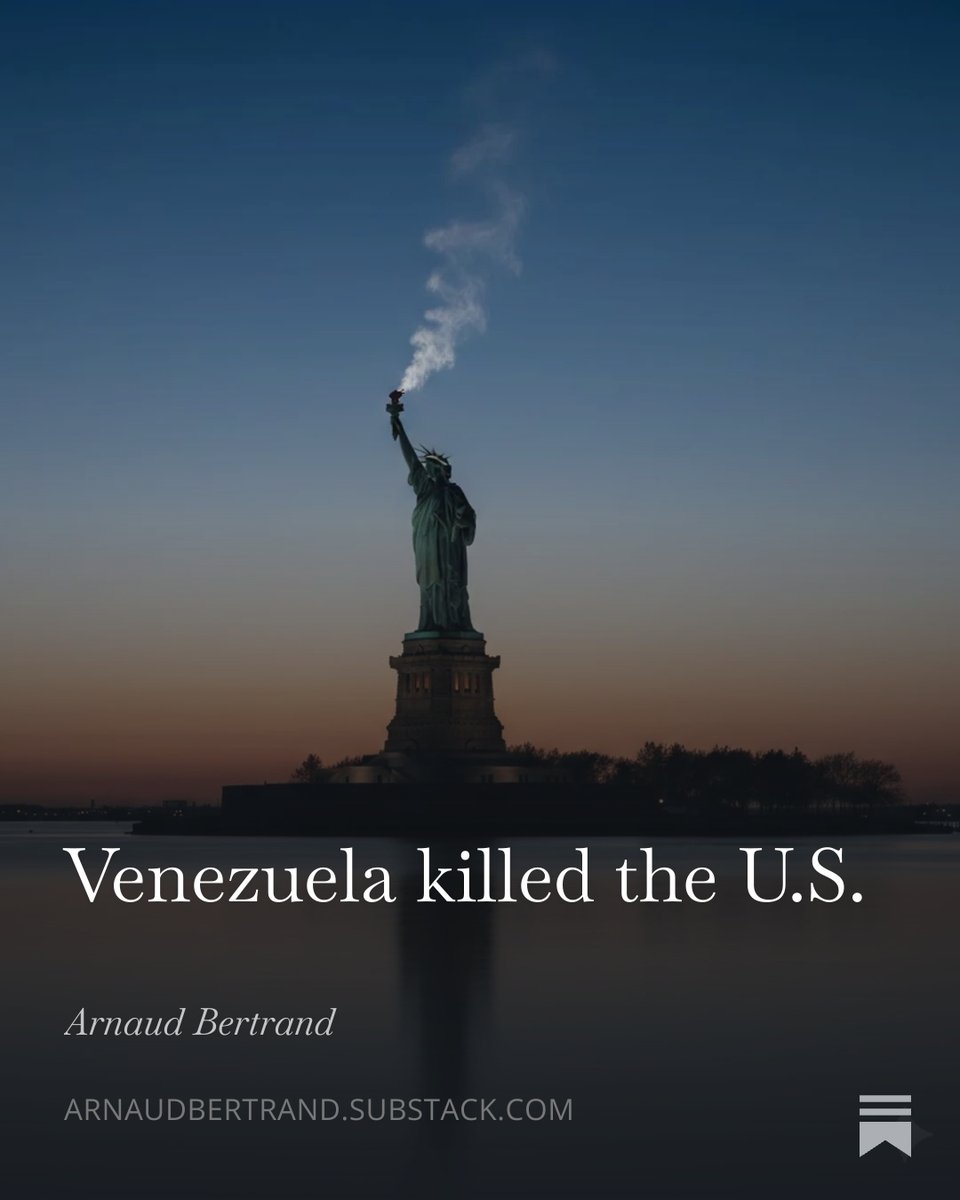
Venezuela killed the US. Or rather, it revealed it was already dead.
In the history of the US’s relation with Latin America, what just happened in Venezuela is hardly unique: the U.S. government has intervened to change governments in Latin America a total of 41 times (https://t.co/3CDBc7fbez).
What is unprecedented however is the brazenness, the unabashedly predatory nature of the intervention.
Trump is not pretending this is about anything else than resource extraction. He explicitly stated "we're going to be taking out a tremendous amount of wealth out of the ground" and that this wealth would “go to the United States of America in the form of reimbursement for the damages caused us by that country." (https://t.co/5ZVibGjEBd).
Stunningly, the US isn’t even insisting on regime change. They’re quite happy for the Chavista government to stay in place under acting president Delcy Rodríguez as long as she “does what we want,” (said Trump: https://t.co/Mm8rSftT1f), vowing to bomb the country again if she didn’t.
In other words, there is absolutely zero pretense there: submission to the U.S.’s will is the only variable that matters.
Never before in its entire history has the U.S. been so nakedly… bad.
This might sound almost trivial. “So what if they admit they’re bad, at least they’re not hypocritical about it anymore,” you might tell yourself. Some might even find that refreshing in its honesty.
Quite the contrary. The story a nation tells itself is not trivial - it is everything.
We, human beings, for better or worse, are structured by mythology and self-deception.
Think about yourself, what drives your own behavior? You have, doubtlessly, ideals you want to live up to. If you have kids you have ideals of what a good parent ought to be. If you have a spouse you have ideals of what fidelity and partnership mean. If you have a job you have some conception of integrity.
You probably fall short - we all do - but the ideals still structure your behavior. They give you something to reach for, they provide the terms in which you can be criticized - including by your own internal dialogue. They make it possible for you to do better tomorrow.
The hypocrisy - the gap between ideal and reality - is not the problem. It's the proof that the ideal still has a hold on you, that you can still be called back to it. As the saying goes, hypocrisy is the tribute vice pays to virtue.
Now imagine you renounce all this. Imagine you stop being a hypocrite in the sense that you abandon your ideals entirely, that you start owning up to your worst self and become comfortable with your vices. You cheat on your spouse and stop pretending it bothers you. You neglect your children and make peace with it.
Have you thus become “refreshingly honest”? Maybe. But you’ve also died inside. You’ve become something deeply broken - beyond shame, beyond appeal. You’ve lost the internal architecture that makes moral life possible. The little light that said “this is not who I want to be” is extinguished.
That is what the United States just did.
The consequences of this are, frankly, terrifying. What happens when a nation stops telling itself it should be good? This is precisely what I try to answer in my latest article: https://t.co/KNoPdy028H
Annexing Greenland would probably
➖Destroy NATO
➖Create a EU-US trade war
➖Compel the US to militarily rule a reluctant Greenlandic population
➖Encourage a Russian attack on the Baltics
➖Destroy a range of US commercial interests: from the lock-out of (all/some) US defence, energy and tech companies as well as investors from EU markets
➖Create a political backlash in the US probably affecting the midterms
Fees like a long list of bad things. Are the supposed benefits really so great that they outweigh all those downsides?