I just heard a pundit on a financial media outlet here in the US express to their viewers that we are still in the early innings of this bull market.
Not only is that assessment wildly incorrect, but the pundit’s sentiment is eerily reminiscent of how Wall Street personalities communicated to their naive audience back in late 1999.
This is the most overvalued, over-concentrated, and over-leveraged market in history. If you believe that adding fresh long positions to stocks will result in higher prices a couple of years from now, you are setting yourself up for significant losses.
Source: Advisor Perspectives
In January 2024 the CBO projected US deaths would overtake births in 2040.
A year later they revised it to 2033. 7 years closer, from one year of new data.
The fertility rate is 1.6. Replacement is 2.1, and it hasn’t been above that since 2007.
17 states already record more deaths than births. Through most of the 2010s that number was 4.
The CBO’s own words: without immigration, the US population starts shrinking in 2033.
Projected growth over the next 30 years is 0.2% a year. From 1975 to 2024 it was 0.9%.
That’s the part people miss. This isn’t a story about population, it’s a story about who pays for everything.
Social Security, Medicare, housing demand, consumer spending, tax receipts. All of it assumes more workers arriving than leaving.
Japan hit this in 2007. Their 30 year bond just went to record highs and they’ve spent two decades trying to grow with a shrinking workforce.
The US is roughly 7 years behind them and the date keeps moving closer.
Scott Bessent looks to be intentionally crashing the $.
I studied currency collapses and found that there were 7 indicators that preceded every major currency collapse in modern history.
I then measured the US dollar against those 7.
And as of right now, based on what Scott Bessent did last week, we have hit all 7 indicators.
No country in modern history has met all 7 and avoided a currency collapse. None.
And this doesn't look to be happening to us, it looks to be being done to us, by the people who swore an oath to prevent it. And they are getting rich while they do it.
Full article is up on Substack now (link in bio and it's free). I also give the things I am eyeing to hedge it and what we can do to fight it.
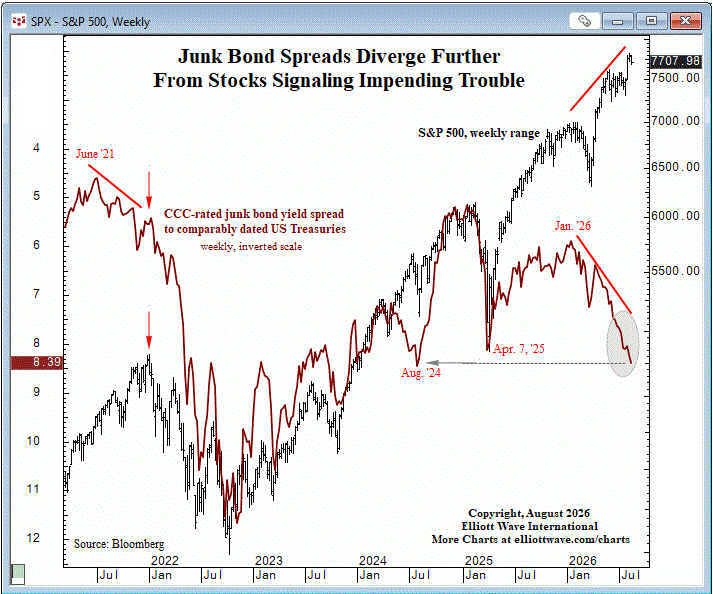
One of the stock market's most important warning signs is getting louder.
Junk bond spreads and equities usually move together.
When they don't, pay attention.
CCC-rated spreads have been widening for eight months while the S&P 500 has continued climbing to new highs.
A similar divergence preceded the 2022 market peak.
Credit markets may be flashing a warning that stock market bulls can't afford to ignore.
See our analysis and outlook for stocks, gold & silver, forex, interest rates and more: https://t.co/BDR0ZpxGc9
While global yields are surging... China’s are plunging.
China can now borrow ~60% cheaper than the US.
And through Panda bonds, foreign nations and corporations can access China’s cheap yuan funding.
Brazil is preparing its first Panda bond... the largest-ever debut by a foreign sovereign.
Issuers can raise yuan and use it directly to buy Chinese goods and fund operations in China instead of first raising USD.
Every transaction funded directly in yuan reduces the need for dollars at the margin...
And by extension, chips away at marginal demand for USTs.
10 COMPANIES THAT BEAT THE S&P FOR DECADES!!!
Save this and send it to whoever is not sure which stocks to buy.
First, so you understand what’s actually at stake here.
$10,000 compounding at 10% for 30 years becomes $174,000.
The same $10,000 at 20% becomes $2.37 million.
Twice the return. BUT 13 TIMES THE MONEY. That’s why this matters so much more than people realise.
Now the list.
1️⃣ Monster Beverage
The best performing US stock of the last 3 decades. Roughly 25% a year for 36 years.
$10,000 in the early 90s turned into over $30 million. They sell caffeine in a can.
2️⃣ O'Reilly Automotive
Auto parts. Around 20% a year since the early 90s, and they have bought back over half the company along the way.
Nobody has ever posted a thread about auto parts.
3️⃣ Copart
They run online auctions for wrecked cars.
Compounded at roughly 20% a year for 3 decades because they own the land, the logistics and the buyer network, and nobody can rebuild that.
4️⃣ Constellation Software
Buys tiny vertical software companies nobody has heard of and never sells them. Around 30% a year since 2006.
The most impressive capital allocation record of the last 20 years and most investors can’t even name the CEO.
5️⃣ Fastenal
Screws, bolts and industrial fasteners.
Decades of double digit compounding from a business that is genuinely as unglamorous as it sounds.
6️⃣ Cintas
Uniform rental. They wash your work clothes.
Beat the market for 30 years because once a company outsources uniforms, they basically never switch.
7️⃣ TJX
Off price retail. Bought the inventory nobody else could sell and beat the S&P through the entire death of retail narrative.
8️⃣ Old Dominion Freight Line
Trucking. Actual trucks on actual roads.
One of the best performing stocks in the entire market since its IPO, in the most competitive industry imaginable.
9️⃣ Sherwin-Williams
Paint. Over a century old.
Compounded relentlessly because contractors do not switch paint suppliers and the company kept buying its own stock.
🔟 Berkshire Hathaway
19.9% a year for 60 years against the S&P's 10.4%.
That gap turned $100 into over $5 million instead of $37,000.
So what do they all have in common?
➡️ Almost none of them are technology
➡️ All of them have pricing power in something people rarely switch away from
➡️ Most of them had somewhere to reinvest for decades, whether that was new stores, new locations or acquisitions
➡️ Most of them bought back enormous amounts of their own stock
➡️ Every single one was available cheap at multiple points, and nobody wanted them at the time
That last one is the actual lesson.
None of these were secrets. You could have bought any of them in almost any year of the last 20 and done extremely well.
The reason people did not is that they were busy looking for something more exciting.
One honest caveat, because most lists like this leave it out.
This is a list of survivors. For every O'Reilly there were auto parts retailers that went bankrupt, and picking the winner in advance was much harder than it looks from here.
That’s exactly why the pattern matters more than the names. High returns on capital, a durable reason customers stay, and somewhere to keep reinvesting.
Final thought: nobody gets rich from the stock everybody is talking about.
They get rich from the boring one they held for 20 years while everyone else rotated through 6 different ones.
If you’re serious about investing, follow me with notifications so you don’t miss the next alert. This is EXTREMELY important because the market moves fast.
A lot of people are going to wish they followed me sooner.
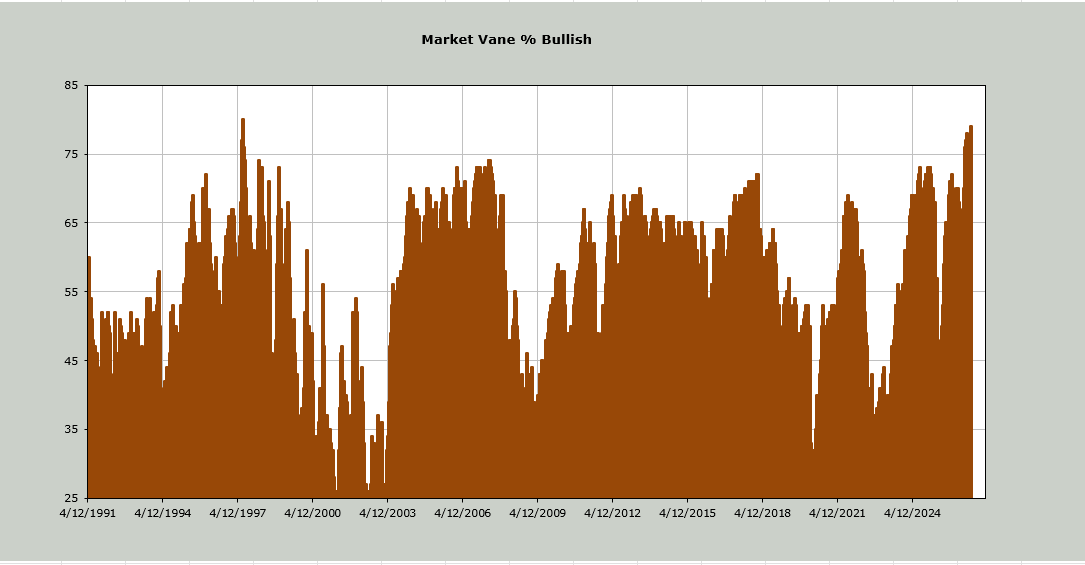
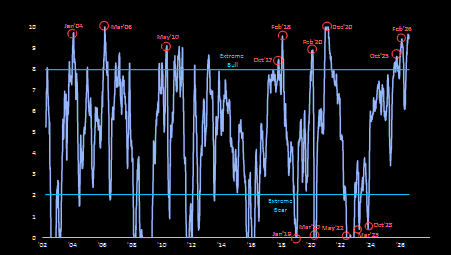
BofA WARNS BULLISH SENTIMENT HAS GONE TOO FAR
Bank of America says investor optimism has reached its most extreme level since 2021, signaling it may be time to cut risk.
Its Bull & Bear indicator jumped to 9.7, driven by strong stock markets, credit inflows and tighter spreads.
BofA recommends rotating toward defensive assets, bonds and the US dollar.
The warning comes as global equities hit record highs, with Friday’s US jobs report the next major test for markets.
BREAKING: Call option volume in the S&P 500 spiked to a record 4.0 million contracts on Tuesday.
This figure has more than doubled over the last several weeks.
By comparison, daily call option volume never exceeded 2 million contracts until Q4 2023.
Furthermore, call option volume averaged ~700,000 contracts a day in 2020-2021.
Meanwhile, the S&P 500 put/call skew, measuring the relative demand for downside protection versus upside exposure, posted its largest two-day decline since 2017.
Risk appetite is absolutely exploding.
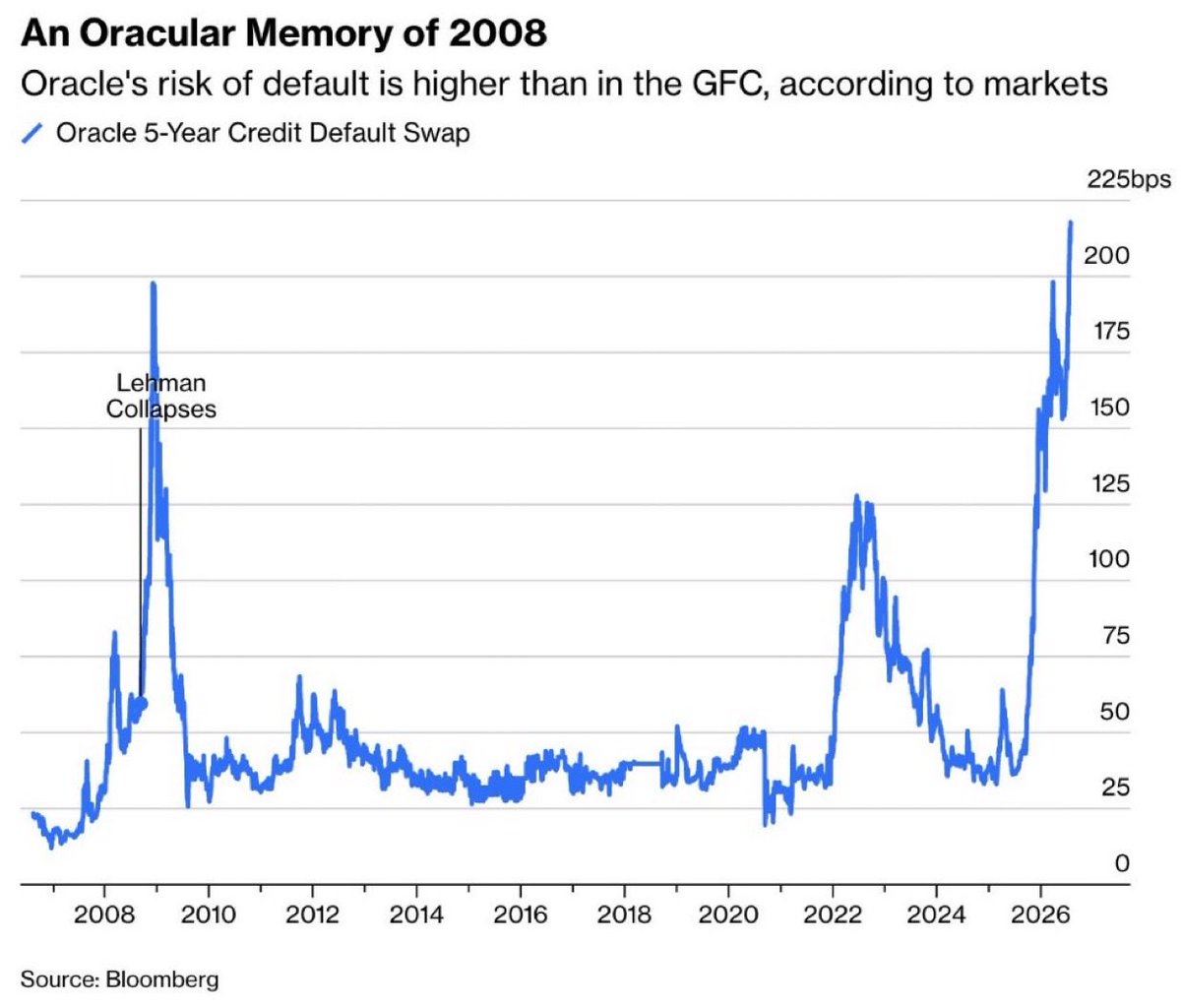
🚨 It costs more to insure Oracle's debt today than it did the week Lehman collapsed.
The five-year credit default swap is above 200 basis points. That is higher than anything it printed in 2008.
Nothing in the business broke. Revenue grew 21% last quarter. Cloud infrastructure revenue grew 93%. The order backlog hit $638 billion, up 363% in a year.
Free cash flow was negative $23.7 billion for the fiscal year.
Oracle raised $43 billion in debt to cover the gap. It plans roughly $40 billion more. Total debt sits near $130 billion. S&P cut the rating to BBB- in July, one notch above junk. Moody's has a negative outlook.
A CDS spread is not a forecast. It is the price of protection, and protection got expensive.
The equity market looks at that backlog and sees the future.
The credit market looks at the same backlog and sees the bill.
Who‘s right?
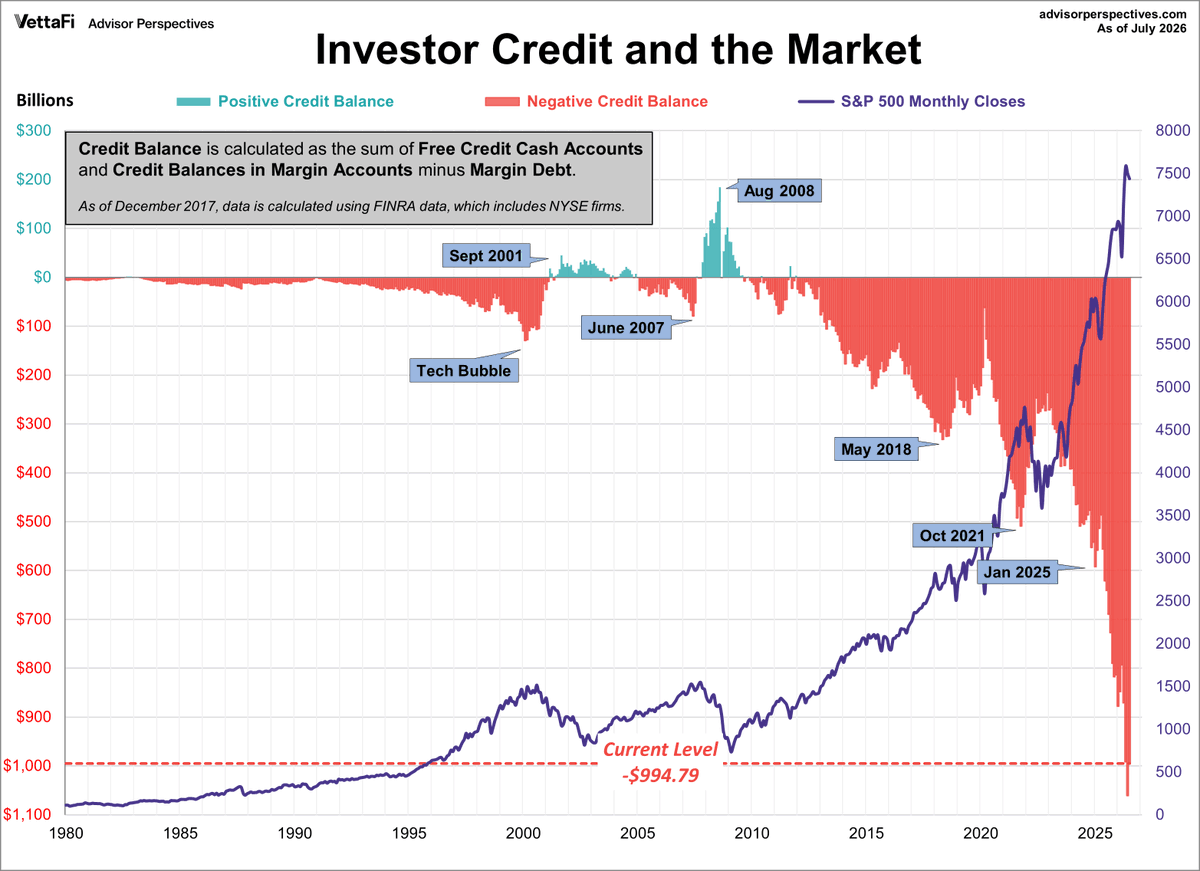
BREAKING: Net credit balances fell -$70 billion in June, to a record -$1.06 trillion.
This metric tracks how much margin debt investors carry relative to the cash in their brokerage accounts.
Since the 2022 bear market, this figure has more than quadrupled.
This comes as margin debt has surged +$895 billion over this period, to a record $1.50 trillion.
By comparison, throughout the 2008 Financial Crisis, the net credit balance remained positive, meaning investors held more cash than margin debt amid widespread deleveraging and a flight to safety.
Investor risk appetite is at unprecedented levels.