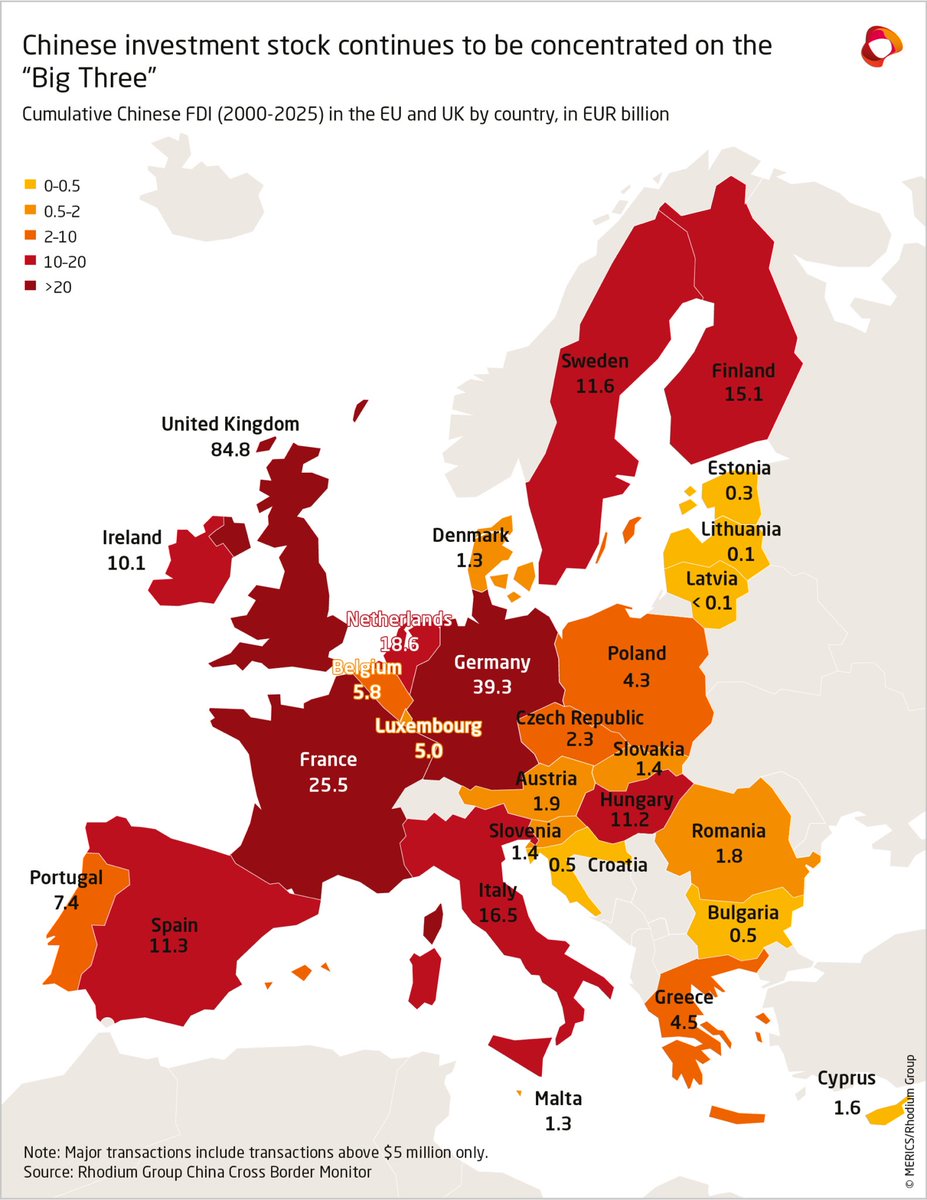
Hungary retained its position as the top destination for Chinese FDI in 2025. Germany and France ranked second and third. Germany raised its share of Chinese investment from 10 percent in 2024 to 15 percent in 2025. France boosted its share from 5 percent in 2024 to 12 percent in 2025.
Porsche Consulting: Automotive Industry 2026
Restructuring as a matter of survival
👉 “without deep transformation, neither competitiveness nor value creation in Germany can be secured in the long term”
https://t.co/Lfz0oYillU
How governments are weaponising the private sector
What is often referred to as “economic statecraft”, meaning the use of the economy for national security purposes, is not new. States have always used economic instruments as tools of power. Traditionally, conflicts between states were understood through borders or conventional trade wars based on tariffs. What we are seeing now, however, is that the interconnectedness of the global economy has itself become an instrument of state power. Governments increasingly rely on companies because these firms control strategic infrastructures, technologies and flows. These can be domestic companies as well as foreign ones.
…
Because companies control energy infrastructures, data systems, critical technologies or semiconductors, they become central to the exercise of state power.
…
There is a body of literature on what is called “weaponised interdependence”, meaning the use of global economic interdependence as a weapon against rivals. This logic rests in particular on two mechanisms. The first involves chokepoints, strategic passages capable of strangling the global economy. A state controlling an area such as the Strait of Hormuz can exert considerable pressure because a crucial share of world trade depends on these maritime routes. By controlling such passages, states can obtain political or economic concessions from other actors.
…
The second mechanism is sometimes referred to as the “panopticon effect”, namely the ability to monitor global economic flows. Through financial transactions, digital infrastructures or data, some governments can know who is exchanging with whom and intervene directly in those flows. This enables the implementation of highly targeted sanctions, for example. This logic expanded significantly after September 11th, when the United States developed tools aimed at tracking financial flows linked to terrorism.
https://t.co/xsBJcvo2s6
Canada risks losing critical minerals infrastructure race, PwC warns
Canada risks losing its competitive edge in critical minerals, energy and other strategic sectors unless it accelerates infrastructure investment and project approvals, according to a new PwC Canada report.
https://t.co/Y5fYryBzaI
Top-15 relative co-usage values for each stablecoin, illustrating the distribution of token co-usage patterns for the three major USD-denominated stablecoins on Ethereum👇
The Trump administration clearly views this strategy through the prism of the benefits to the US economy and industry. But it is also as a source of leverage to achieve geopolitical goals, such as securing alignment with US/NATO interests, deterring competitors, and creating incentives for regional cooperation.
…
From a security perspective, a larger US economic presence in the region, and the removal of Russian instruments of coercion, creates a vested interest for Washington to remain engaged in defending the regional order it helped shape.
…
Under US President Donald Trump, energy dominance has emerged as a strategic doctrine of US foreign and security policy. US efforts to replace Russia as the dominant exporter of natural gas in Europe have seemingly become the main frame through which Washington views its engagement and partnerships in the Balkans as well. The region both needs reliable energy for itself and can serve as an entry/transition point to move US liquefied natural gas (LNG) into Central and Eastern Europe. Reliable energy is also needed to boost US private investments in the region, such as the recently announced multibillion-dollar artificial intelligence data center project in Croatia. The Trump administration has unleashed various financing instruments to advance this goal of reliable energy, including the Export Import Bank and the International Development Finance Corporation, to support energy infrastructure projects from Turkey to Poland and Slovakia.
https://t.co/acqQm9Dw8w
Konjunktur: Deutschland gerät immer tiefer in die Investitionskrise
Nur der Staat gibt demnach noch Geld aus, die Privatwirtschaft streicht viele Ausgaben.
https://t.co/kkiDwkr2XM
From rules to discretion: How Trump reconfigured US tariff policy
Market access is more conditional across partners and more responsive to political and economic pressures. This more flexible and active approach has given the administration a powerful tool of economic statecraft, turning tariffs from primarily economic policy instruments into tools for pursuing a broader and more discretionary set of foreign policy and national security goals.
For firms making long-term decisions about sourcing, hiring, investment, and production, the implications extend beyond the level of duties to higher compliance costs. Origin, classification, and eligibility are now central to strategic decisionmaking for manufacturers and downstream firms alike. This new approach also introduces greater uncertainty over the duration, scope, and application of tariffs. A framework intended to promote domestic manufacturing capacity, economic security, and bargaining leverage may, in practice, introduce costs and instability that undermine those objectives.
@TheMichaelEvery
https://t.co/AT4u2HDsqg
📍New public opinion polling
Like little Kevin in the comedy film, European citizens have woken up to an uncomfortable truth: they've been left Home Alone. Not by their parents and siblings, but by an America on whom many thought they could depend, write @j_kobzova and Pawel Zerka
https://t.co/HMDpyEEuLh
Rare earths: from a strategic autonomy perspective, our dependence on China must be lowered, but from a strategic indispensability perspective, our active engagement with China remains crucial.
Together, Japan and the EU have very strong cards in semiconductor machinery which China needs for the semiconductor and AI boom.
Maybe Brussels should give Tokyo a call to co-ordinate.
EU’s von der Leyen on Russia sanctions:
For the first time, we will introduce the possibility of a full third-country ban for crypto asset services.
It will act as a strong deterrent for countries hosting platforms that help Russia evade our sanctions.
A fifth of EU enterprises engage in two-way trade
👉 In terms of value, two-way traders accounted for the vast majority (95.4%) of all goods traded, ahead of enterprises that only imported (3.7%) and those that only exported (0.9%).
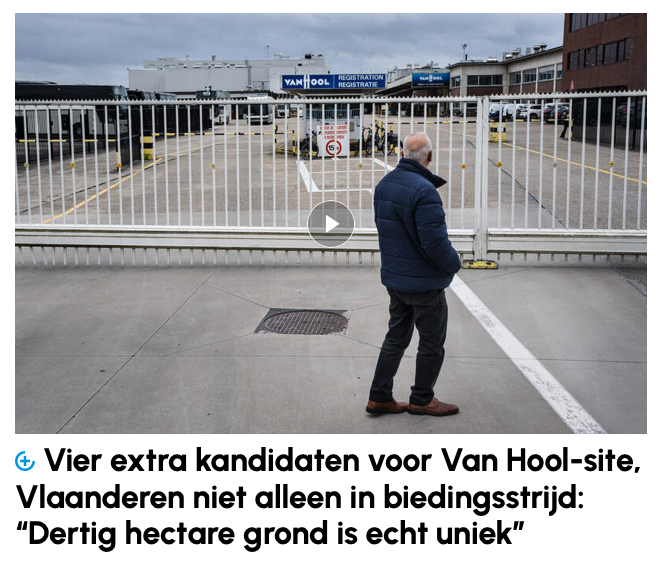
Hoe ‘stel je strategische sites veilig’, zonder te concurreren met de private markt ?
De Vlaamse overheid heeft destijds ook terreinen van Ford Genk gekocht (ca 100 hectare).
Dat een overheid biedt tegen private ondernemingen voor een bedrijfssite in handen te krijgen is pervers, hoe je het ook draait of keert.
Veiligstellen van strategische sectoren/sites: harde ja.
Concurreren met de private markt: harde nee.