Government & International Affairs Consultant | Former Comms Dir. & Senior Advisor to CA Lt. Gov. Abel Maldonado | Sports Writer & Researcher| Mr. Carmel |
Was Thailand’s 2026 election really a surprise? Our analysis argues it wasn’t — media narratives missed the signs behind the Bhumjaithai win. Read the full take: https://t.co/lKpXCksHxt
#thailandelection69#thaipolitics#politicalanalysis#indopacific
Thailand’s 2026 election result is being called “shocking.”
It wasn’t.
It was predictable — and the media missed why.
By Brandon Gesicki
This was a huge victory for the Bhumjaithai Party—but it should not have been that surprising.
What was surprising was how confidently much of the international press and left-leaning Thai media dismissed the possibility of it happening at all. In doing so, they once again confused aspiration with analysis and narrative with reality.
In the final days before Election 69, political analyst Ken Lohatepanon, writing “2026 Election: Closing Thoughts – An Ambiguous Election” for his Substack The Coffee Parliament | Thai Politics and Policy, noted that if opposition leads failed to sweep away local Bhumjaithai incumbents, Anutin would have a very good night.
That insight proved decisive.
I highlighted that same point at the time—and it bears repeating now—because it explains the result better than any post-election handwringing. The opposition did not sweep incumbents. Local machinery held. Regional support consolidated. And Anutin Charnvirakul did, in fact, have a very good night.
As unofficial results came in on February 8, caretaker Prime Minister Anutin declared victory, with Bhumjaithai projected to secure 194 seats in the 500-seat parliament, well ahead of the People’s Party’s 116. Opinion polls and international headlines had placed the reformists comfortably in front. Voters had other ideas.
This was not a fluke. It was a correction.
Results Over Noise
Anutin has governed—and campaigned—like a leader who understands that results matter more than noise.
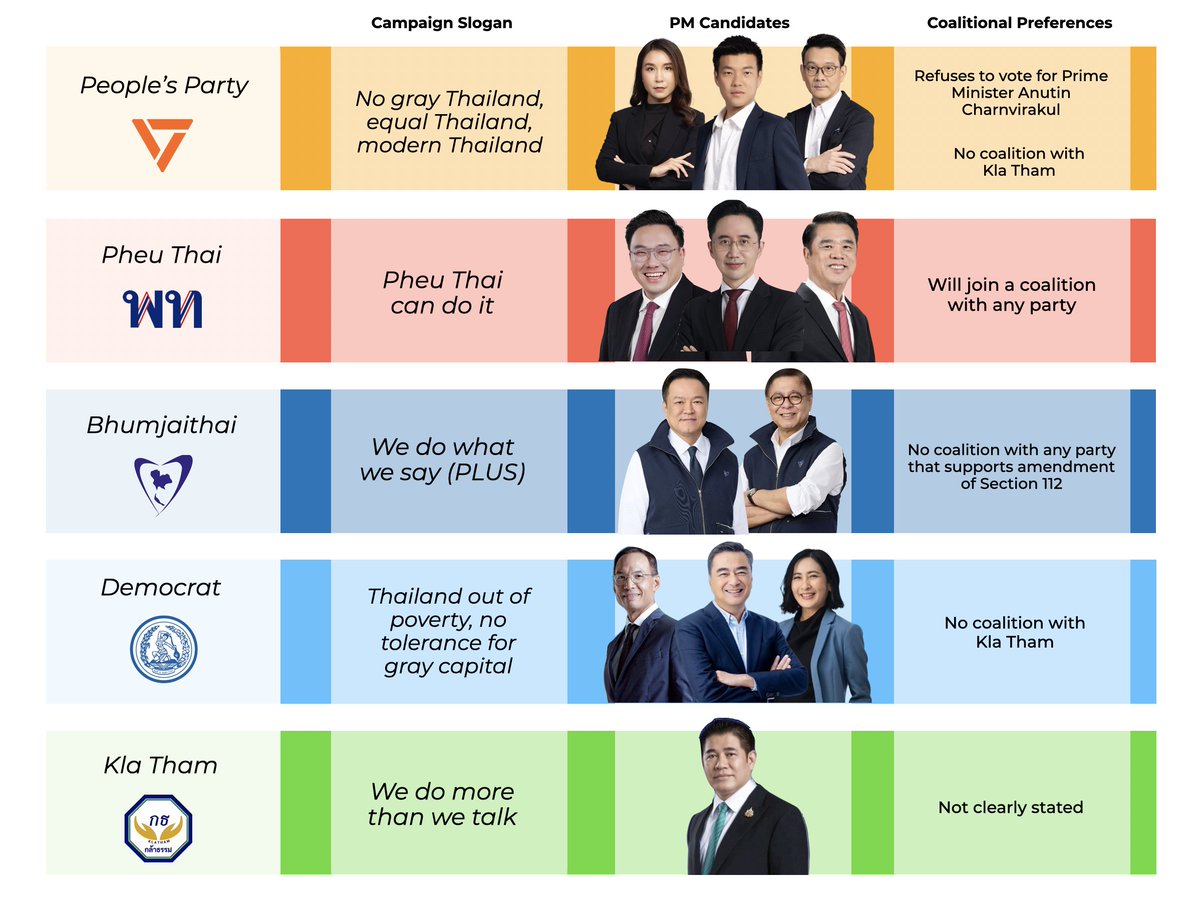
While rivals and commentators focused on social-media momentum, international validation, and recycled assumptions from the 2023 election, Bhumjaithai focused on fundamentals: incumbency, ground organization, policy delivery, and voter trust beyond elite urban circles.
The party’s message was blunt but effective. Bhumjaithai argued that it was:
The only party Cambodia is afraid of, foregrounding national security and sovereignty
A party of technocratic professionals capable of actually transforming the economy
This was not messaging designed for headlines. It was messaging designed for ballots.
Even Anutin admitted surprise at the scale of the win, saying voters gave his party “more than what we expected.” But surprise at scale does not mean surprise at outcome. For anyone paying attention to coalition math, incumbency strength, and Thailand’s electoral geography, this result was always plausible.
Coalitions Decide Governments
This outcome also validates a broader point I made earlier in the campaign. On February 2, I wrote that leading in polls does not mean governing, because coalitions—not headlines—decide governments in Thailand.
(“Thailand’s Reformists May Lead the Polls, but Coalitions Decide Governments” – Capitol Consulting, Feb. 2, 2026)
That argument now looks less like contrarianism and more like realism.
Thailand’s political system rewards organization, alliances, and credibility across regions. It punishes movements that mistake momentum for mandate. The People’s Party ran a strong campaign, but elections are not frozen snapshots, and voter sentiment does not move in straight ideological lines.
An Election About Security and the Economy
If you translate Election 69 into American political terms, the comparison is clear: this was an election about national security and the economy.
Not vibes.
Not ideology.
Not online enthusiasm.
It was about who voters trust to govern under pressure—and who has delivered. On that test, Bhumjaithai won the mandate clearly.
After claiming victory, Anutin emphasized unity, saying the win belonged to “all Thais, no matter whether you voted for us or not.” People’s Party leader Natthaphong Ruengpanyawut appeared to concede, signaling readiness to serve in opposition if Anutin succeeds in forming a government.
The Media’s Blind Spot
The real lesson of Election 69 isn’t that Thailand “shifted unexpectedly.” It’s that much of the media continues to misread Thailand by underestimating conservative and centrist voters, dismissing incumbency, and treating governance as secondary to narrative.
This election was not unpredictable.
It was misinterpreted.
I currently have an op-ed with the Bangkok Post on Prime Minister Anutin written before Election Day. In light of these results, it deserves to run—with modest modification—because the election has borne out the core argument: competence, stability, and results still matter in Thai politics, no matter how unfashionable that conclusion may be in international commentary.
Thailand’s electorate spoke clearly.
The problem wasn’t the vote.
It was the reading of it.
Disclosure
All analysis, interpretations, and conclusions expressed in this article are solely those of the author.
#ThailandElection69 #ThaiPolitics #Bhumjaithai #BangkokPost
About the Author
Brandon Michael Gesicki is a veteran U.S. political consultant and government-affairs advisor with over two decades of experience advising campaigns, corporations, and public-policy initiatives. Over the past five years, he has specialized in analyzing Southeast Asian political risk, Indo-Pacific strategy, and regional investment opportunities.
He is the founder of Capitol Consulting Communications & Government Relations and can be reached at:
👉 https://t.co/eEzx313YkI
Thailand’s Reformists May Lead the Polls — But Coalitions Decide Governments
International coverage is increasingly framing Thailand’s Feb. 8 election as a likely reformist breakthrough, with the People’s Party surging in polls.
But Thailand is not a majoritarian system — it’s a bargaining system. Polling momentum does not automatically translate into governing power. Coalitions do.
Thailand’s most useful data point so far is the Jan. 11 NIDA poll, which shows the People’s Party leading in support (~30%) as undecided voters sharply decline.
But NIDA’s seat modeling tells a more decisive story:
People’s Party: 120–130 seats
Bhumjaithai: 140–150 seats
Pheu Thai: 70–80 seats
Democrats: ~40 seats
Kla Tham: ~40 seats
Others: ~60 seats
This is not a landslide — it’s a fragmented parliament.
And in fragmented parliaments, Bhumjaithai’s constituency machine and local power networks (“baan yai”) may matter more than national vote share. A party that doesn’t win the most votes can still control coalition formation.
For investors, the takeaway is straightforward: the key risk isn’t who tops the polls — it’s whether Thailand produces a government that can secure 251 votes and execute policy without prolonged deadlock.
The real contest begins after election day.
Sources and Acknowledgements:
-Reporting and polling references in this article draw in part from:
-Reuters, Jan. 20, 2026: “Surging in polls, Thailand’s reformist opposition tests new election playbook.”
-Analysis and polling interpretation by Ken Lohatepanont, Ph.D. candidate at the University of Michigan and author of The Coffee Parliament, used for contextual understanding of Thai electoral dynamics.
All analysis, interpretations, and conclusions are the author’s own.
About the Author:
Brandon Michael Gesicki is a veteran U.S. political consultant and government-affairs advisor with over two decades of experience advising political campaigns, corporations, and public-policy initiatives. Over the past five years, he has specialized in analyzing Southeast Asian political risk, Indo-Pacific strategy, and investment opportunities.
He is the founder of Capitol Consulting Communications & Government Relations and can be reached at https://t.co/DanLnnycFY
BIG NEWS
This was widely expected under the Biden administration—yet it is happening under Trump.
Cannabinoids should be researched far more extensively. There is strong and growing evidence that cannabis-based compounds may offer meaningful medical benefits, and public policy should reflect rigorous scientific inquiry rather than ideology.
#TRUMP #MAHA #CancerResearch #CannabisPolicy #MedicalResearch #CBD #RFKJR
Trump Directs Administration to Reclassify Cannabis to Allow for Medical Research https://t.co/fvLXC9k2fX via @epochtimes
Carmel Beach today! Large crowd shows up showing support for Pickleball and reminding Carmel Council that Pickleball is not a crime! It would seem "the outsider" Mayor has not figured out Carmel yet! #PickleballIsNotACrime#Pickleball#Carmel#Beach#CarmelBeach
It's Official — Carmel-by-the-Sea Council Is a National Embarrassment: Votes to Ban Pickleball Despite Overwhelming Community Opposition and Make It a Crime Punishable by $1,000 Fine!
FOR IMMEDIATE RELEASE
CARMEL-BY-THE-SEA, CA — December 3, 2025
In a stunning display of government overreach that has sparked outrage among residents, the Carmel City Council voted unanimously last night to ban pickleball at Forest Hill Park and make it a misdemeanor offense punishable by fines up to $1,000. The decision disregarded overwhelming public support and a compromise previously approved by the City's Beach and Parks Commission, effectively criminalizing a harmless, community-building sport enjoyed by seniors, families, and tourists for over 13 years.
The chamber was packed to capacity with one of the largest turnouts in recent memory. After nearly an hour of ceremonial proceedings, when Mayor Dale Byrne attempted to take a dinner break before hearing the item, the audience erupted in loud boos, forcing him to retreat and take only a brief five-minute pause instead.
The Mayor also limited public comment to one minute instead of the traditional three minutes, drawing further outrage from attendees.
During public comment, the divide was stark: roughly 90% of speakers supported pickleball while only about 10% opposed it. Yet the Council voted 100% in favor of the ban. Residents say the decision was driven by outsiders, political favoritism, and a tiny group of neighbors—not the community's actual needs.
Southern California transplant Mayor Dale Byrne has lived in Carmel only since 2017 and was elected in a three-way race winning by just 118 votes in November 2024. He positioned himself as a cultural authority over lifelong residents, many of whom noted this was not an issue before Byrne became Mayor. Attendees observed it seemed possible Byrne was siding with a personal friend—one of the handful of neighbors demanding the ban.
A fully vetted compromise unanimously approved by the Beach and Parks Commission had balanced hours, noise mitigation, and shared use, but Mayor Byrne rejected it outright.
"This wasn't a process — it was a setup," said Cara Franklin, organizer of the Pickleball Is Not a Crime Committee and a regular Forest Hill Park player. "Five complaining neighbors got exactly what they wanted, and the community was ignored."
Residents emphasized that surrounding cities including Monterey, Pacific Grove, Seaside, and Marina have all embraced pickleball with reasonable compromises, making Carmel the only city on the Peninsula to ban the sport outright. The City's own website had promoted the courts as pickleball courts, and the sport had been played peacefully for over 13 years.
It was also learned that local community leaders helped fix the tennis-pickleball courts 13 years ago and that it has been the senior pickleball players who have kept the courts maintained ever since.
The ordinance makes pickleball a misdemeanor with fines up to $1,000. Criminalizing a healthy, community-building activity—played by seniors, families, and tourists—is government extremism. No reasonable city uses police power to stop exercise. The City Council is considering using law enforcement to address pickleball "violations" in a low-crime town where police resources should not be wasted policing playgrounds. The ban is driven by five neighbors, not the community—a fact confirmed by the Mayor in an interview with KSBW TV. A tiny minority living next to the park is pushing the ban.
Public spaces belong to everyone, not just adjacent homeowners. Policy should reflect community needs, not the loudest complainers. If you live near a park, you should expect people, kids, movement, and sound. Parks are not meant to be silent courtyards curated for a few. Banning recreation undermines Carmel's identity as an active, welcoming coastal community.
The decision has already generated national mockery with headlines describing it as "wealthy California town bans pickleball over noise" and "peak rich-people politics." National headlines and viral meeting footage have made Carmel a punchline on social media. Residents warn the ban damages Carmel's image, sends the wrong message to visitors who are the town's economic lifeline, and reinforces perceptions that newcomers run the town.
"This makes Carmel a national embarrassment," said Brandon Michael Gesicki, a public affairs strategist and Carmel area resident. "It tells visitors we're hostile to recreation, families, and fun." The Council has damaged Carmel's reputation as a desired international place to visit.
Serious questions have been raised about the fairness of the process. The City held a special meeting for Forest Hill Park in September that pickleball players were never notified about. The Mayor made statements that allegedly misrepresented the process and contradicted the public record. Public input was minimized or dismissed.
"This looks like a predetermined outcome designed to give a few friends exactly what they demanded," Gesicki said.
Other cities solved pickleball noise with adjusted hours, modest sound barriers, court resurfacing or relocation, and better scheduling. Carmel skipped every reasonable solution and went straight to a ban. Meanwhile, Carmel faces urgent issues including housing shortages, worker gaps, aging infrastructure, library modernization needs, business corridor decline, and tourism resiliency problems. While the Council debates quiet balls and decibel tests, major development projects sit stalled, infrastructure needs remain unmet, housing pressures continue, business corridors need revitalization, and tourism management requires urgent planning.
"Instead of solving a single real problem, the Council spent months eliminating a harmless sport enjoyed by kids, seniors, and families. It's weak leadership — and it hurts Carmel," Gesicki said. Government should facilitate recreation, not eliminate it. When City Hall starts banning normal activities instead of managing them, it has lost perspective.
If pickleball is banned because it's "too loud," what's next? Barking dogs? Kids playing tag? Basketball? Banning one sport sets a precedent for banning others. How much in taxpayer dollars was spent on staff time, legal reviews, and hearings for this ban?
About Pickleball: Pickleball is the fastest-growing sport in the U.S., with nearly 20 million players in 2024 and 45.8% year-over-year growth from 2023. The sport's accessibility, ease of learning, and social nature have driven participation, with over 19% of U.S. adults having played in the last 12 months. There are now over 68,000 courts nationwide, with the number expanding rapidly.
#Pickleball #Pickleballisnotacrime #Carmel #California
CONTACT:
Brandon Michael Gesicki
[email protected]
Pickleball Is Not a Crime Committee
Cara Franklin, Organizer
Pickleball is Not a Crime -But in Carmel-by-the-Sea it is!
For 13+ years, the community kept the Forest Hill courts alive:
✔ Seniors repaired and maintained them
✔ Families played safely
✔ Zero problems
✔ The City proudly promoted the courts
No complaints until Christmas of 2024, right after Mayor Byrne was elected.
Then suddenly 5 neighbors demand a ban…
…and the Council bans and criminalizes pickleball over other priorities? Wasting thousands of taxpayers $$$ to ban and criminalize a sport! In America!
Something doesn’t add up.
“This wasn’t a process — it feels like a setup.”
#PickleballIsNotACrime #Carmel #Pickleball #California #Ban
“Pickleball is not a crime — unless you live in Carmel-by-the-Sea, where City Hall just made it one.”
$1,000 fines. Police enforcement.
Over a harmless sport played for 13 years.
This is government overreach on steroids.
#PickleballIsNotACrime#Carmel#Pickleball#California
Carmel-by-the-Sea just became a national joke.
Headlines: "Wealthy California town bans pickleball"
Meeting footage going viral for all the wrong reasons.
The Council damaged Carmel's reputation more than the sport ever could.
Peak rich-people politics.
#Carmel#Pickleball #California
Carmel-by-the-Sea is now using POLICE RESOURCES to enforce a pickleball ban.
You can literally get a misdemeanor for playing a sport in a public park.
Meanwhile: housing crisis, crumbling infrastructure, stalled projects.
Priorities? 🤷♂️ #Carmel#Pickleball#California