Join a simple stock strategy built for growth. The exact positions I hold arrive in your inbox every Monday before the open, and take 30 minutes to follow.
Start here.
Join a simple stock strategy built for growth. The exact positions I hold arrive in your inbox every Monday before the market opens, and take 30 minutes to follow.
It has beaten the market since going live in January 2026, and every trade is public.
It is the portfolio I run with my own money. Most weeks it holds ten stocks, with a few large positions doing most of the work, and every weekend the system ranks several hundred large US companies again and updates the list. On Monday at 7:30 one table lands in the inbox: each stock, its weight and its stop. About one coffee later the orders are in, and the week is mine.
As of October 9 it is up 109% since January 12, 2026, against about 13% for the broad market. The record is on Dub, and I cannot edit it. Growth comes unevenly, and the losing weeks are there too. My goal is to grow $30K into $1M, one Monday at a time.
The weekend review is free every Saturday. The full Monday list is $39 a month or $350 a year.
Start here: https://t.co/jUZG5oLiCZ
The record: https://t.co/TDsNSbz5wm
This morning, before the market opened, the exact positions I hold for the week went out to paying readers. It is one fund again, for the eighth Monday in a row. Conditions are still unfavorable for my strategy, so the portfolio stays in a single fund until they improve.
What changed is the fund itself. The system picked a different one from last week's, so the whole portfolio moved at the open. I sold last week's fund, bought the new one and set its stop. One sale, one buy and one stop was the whole trade this week.
When I put real money into my portfolio on January 12, I started with $30K. It was what I could put in that was large enough for the growth to mean something, and not so large that losing it would put me in a desperate place. $1M is the stretch goal I set for it, and it is mine. Every Monday before the market opens I share the exact positions that money holds, so the road from one number to the other runs in the open, the slow weeks included.
This week's list is out. It is a single fund for the eighth Monday in a row, and a different fund from last week, so the whole portfolio moves at the open. Paying readers get the position, its weight and its stop before the market opens.
Tomorrow at 7:30am New York time, one email goes out with the positions I hold this week. Each comes with its weight and stop. Two hours later, at the open, my own money goes into exactly those.
For seven weeks the portfolio has held one fund outside the stock market. Tomorrow's email says whether it stays there or moves back into stocks.
As of November 13 the portfolio is up 95.2% since January 12, and every trade is public on Dub.
The list is $39 a month or $350 a year. Subscribe today and tomorrow's email is in your inbox.
When I share my portfolio on Monday, each position comes with two things besides the ticker: its weight, and a stop price where it gets sold. Without those, a ticker is half a trade. You know what to buy, and nothing about how much or when to leave.
When you copy someone's trade, what do you copy besides the ticker?
I wrote about why I share every position every week, the losing ones as well as the winners. Sharing one part of it below:
A lot of them just share when a great position has climbed a lot and has grown a lot, and then it is often a screenshot or a reference to "remember when I said the stock will blow up" or "the stock will grow". But then you go back and they've made 20 different stock picks that wasn't super clear. And if you go look at it, some of them would have declined significantly and maybe one or two of them would have grown, and it feels like luck.
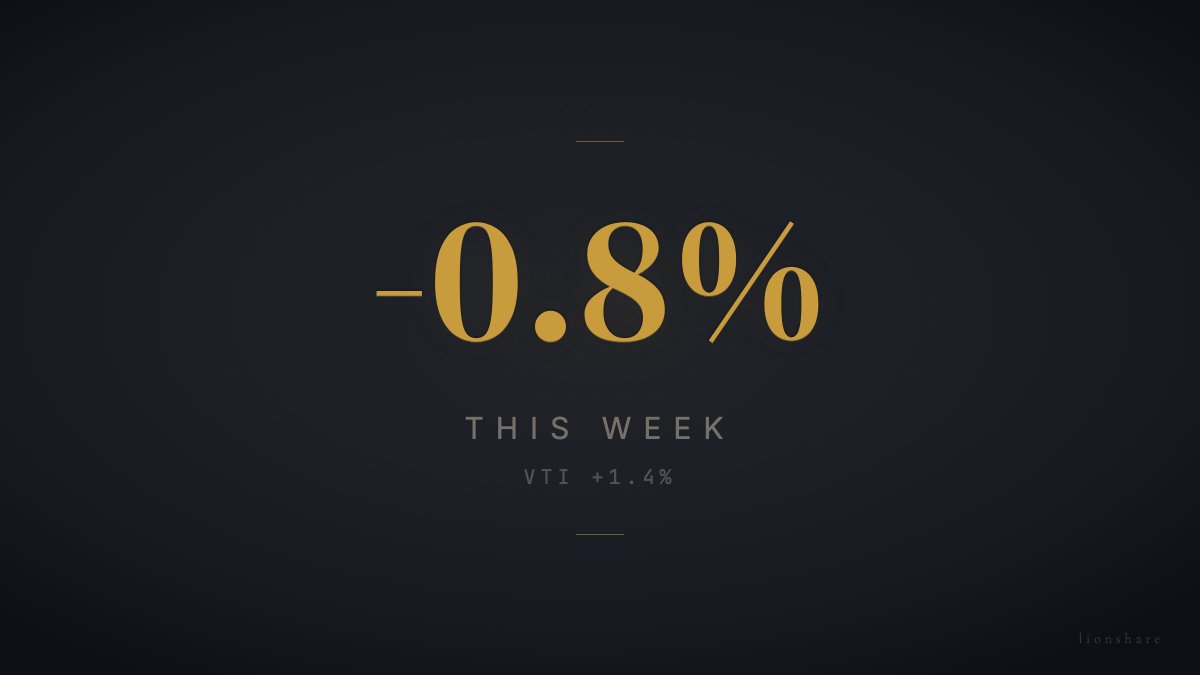
Every Monday before the open, I publish the portfolio my own money is in. This week it slipped 0.8% while the market rose 1.4%, and nearly all of that gap opened by Tuesday's close. Up 95% since Jan 12, 2026, public on Dub.
Before I had rules, I read more about markets every week: analysis services, newsletters, stock ideas. It felt like progress. It rarely changed what my portfolio held. What changed it was placing trades on a plan. Now that plan is a set of tested rules, and on Monday morning my own money goes into the positions they give, each with its weight. I still read about the markets, without the stress, because the decision is already made.
I keep a page that answers the common questions about how Lionshare works and how to check it. Sharing one of them below:
What happens in a bad week? You get the same email, written the same way. The weekend review reports the week down to the number and says what fell. My own money is down in those weeks too. In June and July, the worst stretch so far, every week went out on time and every loss was reported. The losing weeks sit on Dub next to the winning ones.
The portfolio that I share is designed to run within your own brokerage account and I send an email update on Monday, sharing the positions I'm holding, their weights and their stops. It is up to you what to do with it, but I never use your money and you don't need to open an account with me, or deposit anything. The only thing you need to stop doing, if you so choose, is to stop receiving the email.
From November 5 to November 11, my portfolio fell 2.6%. Over the same days, a fund that holds the whole US stock market fell 0.6%.
For a seventh week in a row, the portfolio holds one fund outside the stock market. On Monday there was nothing to buy or sell. I set a new stop on that one position and closed the app.
It is my own money, and every trade has been public on Dub since January 12, 2026. As of November 11, it is up 95.3% since then.
So I, from day one, built Lionshare to only take a few minutes every week and then that's it. The rest of the week runs its course without me needing to update anything. And we repeat the process at the Monday morning open, which is 9:30 a.m. New York time.
The name Lionshare comes from the saying "take the lion's share", the largest cut of the winnings. When I set out to build a strategy for my own money, that is what I wanted from it: the largest part of the growth stocks can give. A basic index fund gives you the average of the whole market. I wanted a portfolio built for growth, run on tested rules.
If you cannot place trades right at Monday's open, the portfolio I share still works. My own money goes into the positions at the open, 9:30 in New York. Place yours at lunch instead, and the prices will have moved a little, sometimes your way and sometimes against you. It is a weekly portfolio, so nothing in it is timed to the minute. The closer you are to the open, the closer your result tracks mine.
The bar I measure my portfolio against is an index fund. Dub, where every trade of mine has been public since January 12, 2026, compares it with VTI, a fund that holds the whole US stock market. That is the right bar, because the index is what I would own if I did nothing. If my portfolio could not beat it across a full market cycle, I would hold the index.
For the seventh Monday in a row, the list of positions I hold is one fund outside the stock market.
It went out at 7:30 this morning, New York time. Nothing came in and nothing went out. My only order today was to move the stop-loss, the price where my broker sells if the fund falls that far. Then I closed the app.
Conditions are still against stocks, so I stay out of them. Seven weeks is a long time to sit still with my own money in it. I will run the same process again next Monday.
I have a day job, and I am keeping it. I enjoy the work, and it gives me stability. I also know I can make my money work harder. So my own money runs on a set of tested rules, and setting the positions takes me about 30 minutes a week. The strategy is how my money grows and creates more opportunities while I do the work I enjoy.
The weekly list is out and this week it is one fund out of the stock market for the seventh Monday in a row. There is nothing to be traded at the opening. Paid subscribers can see the position, its weight and its stop.