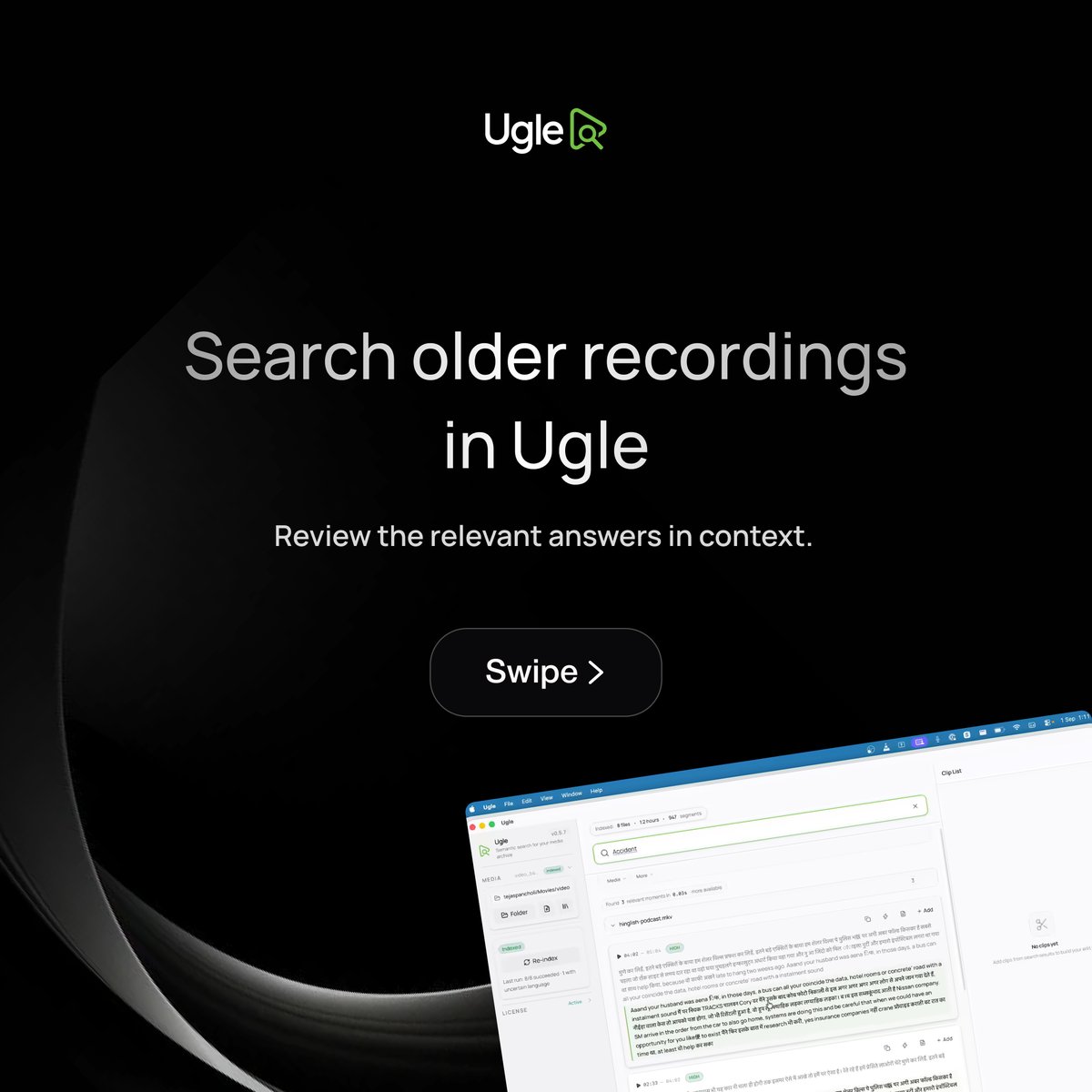
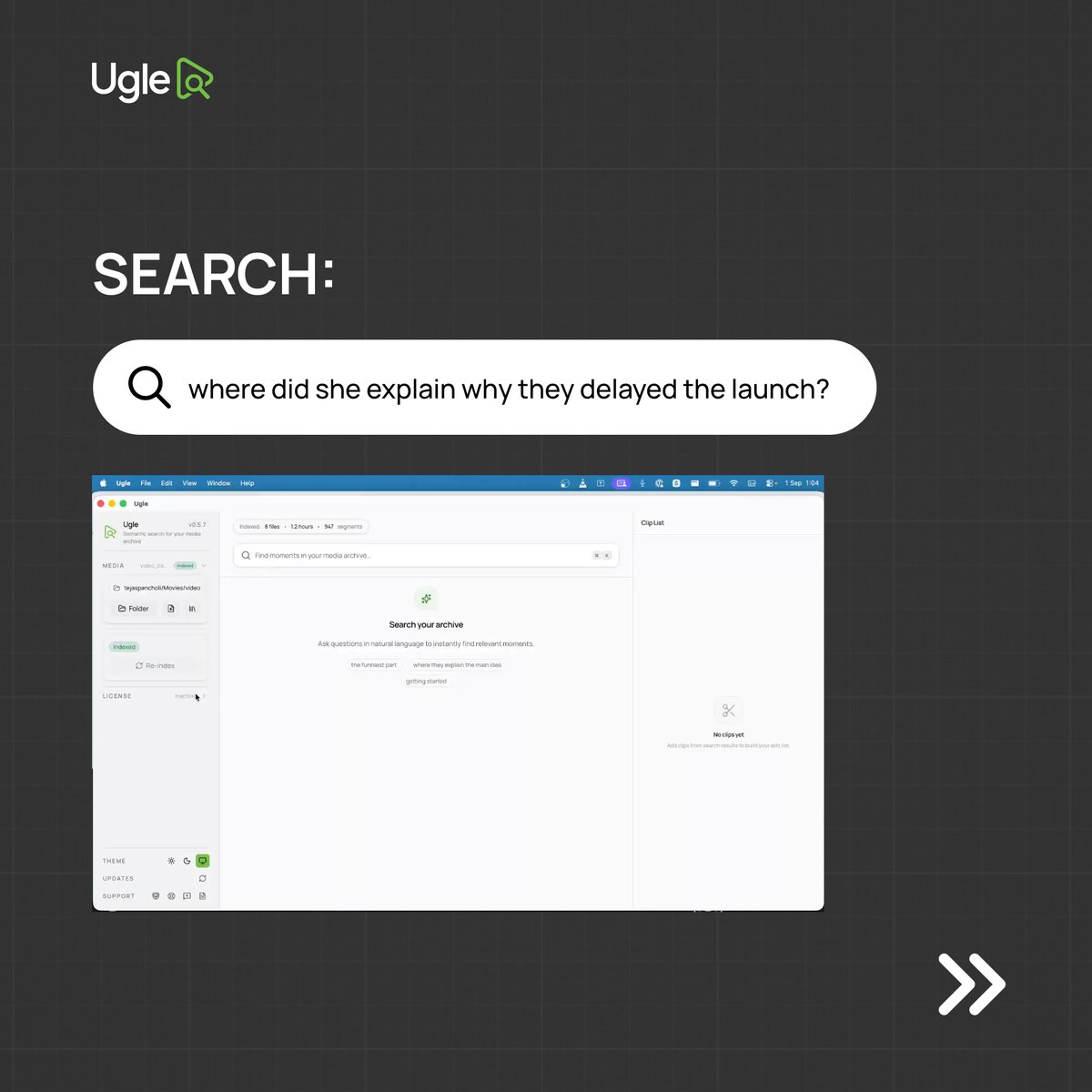
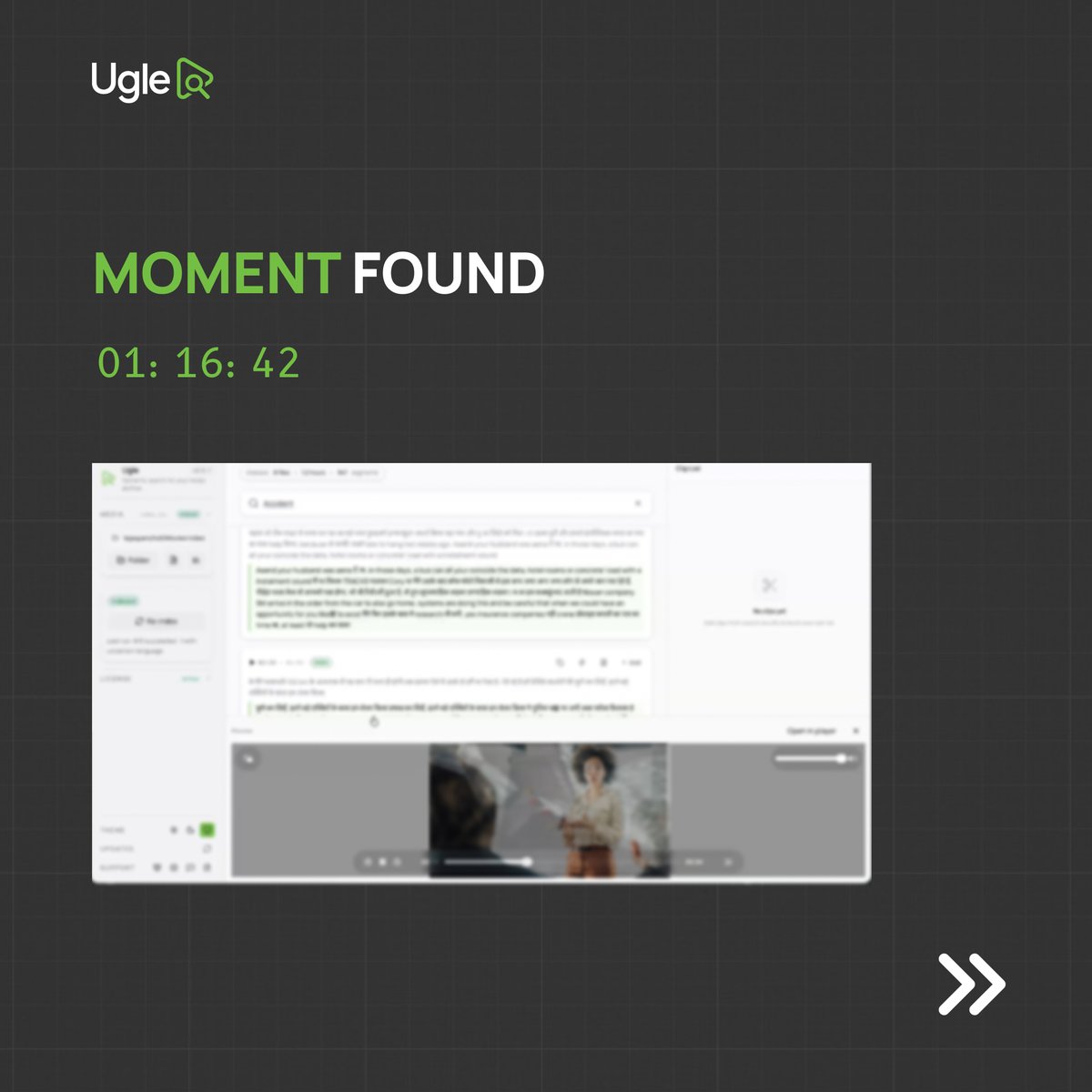
Try Ugle with a recording you know: index it, search for an idea, review the matching moments, and collect one for your next edit.
15-day free trial. No credit card required.
https://t.co/7cKUOPsbLO
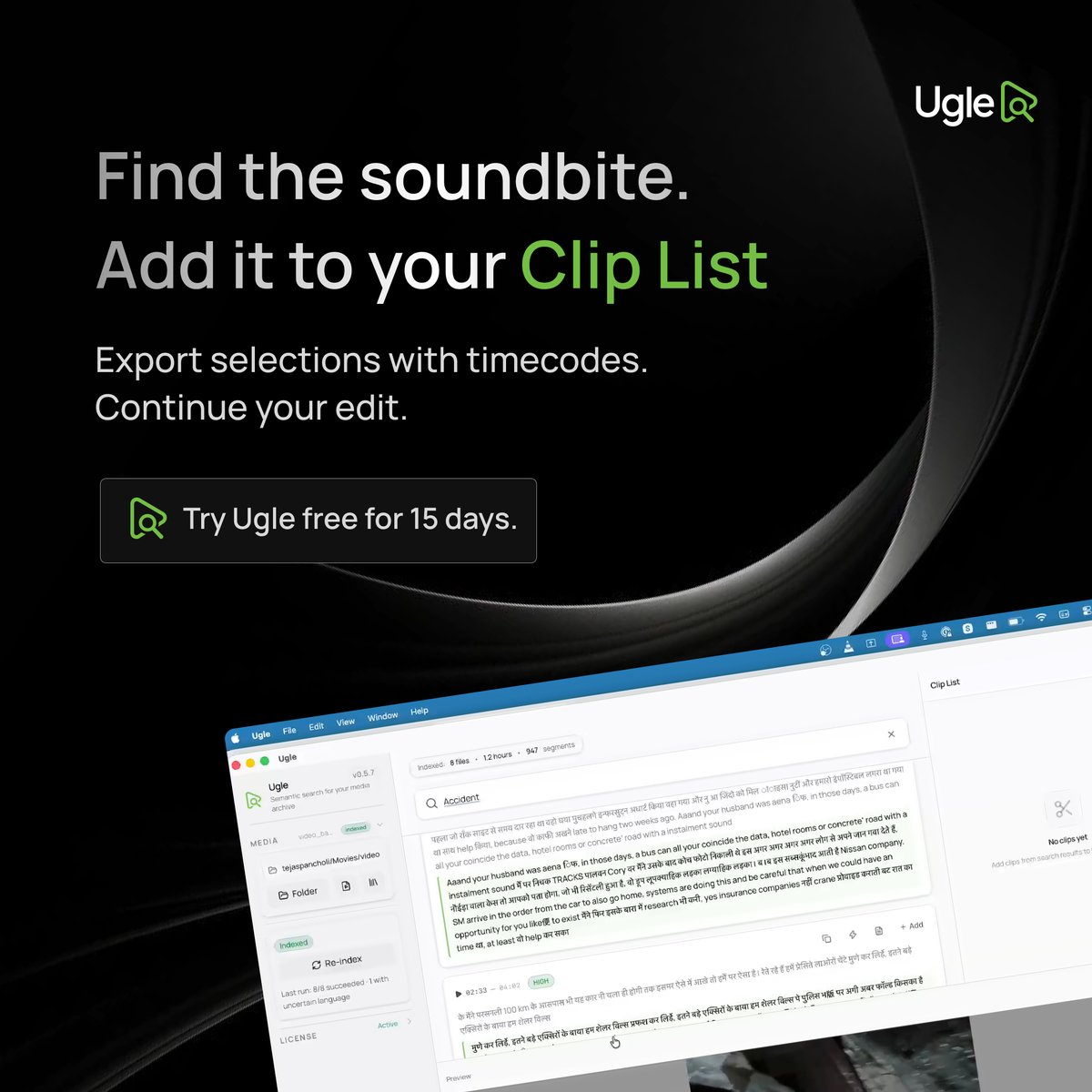
From a useful search result to your next edit: add moments to Ugle’s Clip List and export selections with timecodes and source references.
Try Ugle free for 15 days. No credit card required.
https://t.co/7cKUOPsJBm
Ugle is live on Product Hunt.
Find useful moments in your recordings and collect them for your next edit. Search runs on your machine.
15-day free trial. No credit card required.
Explore and share feedback:
https://t.co/odJ1zyaXui
Tomorrow: Ugle on Product Hunt.
Search your recordings. Review the moment. Add it to your Clip List for the next edit.
30 October, 12:31 p.m. IST / 12:01 a.m. PDT.
We’ll share the live link here.
Save the launch date!
The moment you need could already be in your archive.
Ugle helps you search inside audio and video recordings and collect useful moments for reuse.
Coming to Product Hunt on 30 October at 12:31 p.m. IST.
Follow Ugle for the launch.
It is not trying to become the editing system.
Edit where you already edit. Find what you could not find before.
Find the Moment. Then get back to the edit.
A newsroom editor rarely starts with a perfect keyword. They start with memory.
“The spokesperson explained the budget issue somewhere in the second interview.”
“The strongest answer came after we asked about the delay.”
“There was a clean soundbite about the announcement.”
The traditional retrieval process converts that incomplete memory into manual work: open, scrub, listen, skip, rewind and repeat.
That is the deadline tax.
Ugle’s job is to convert remembered meaning into a timestamped Moment connected to the original source.
Ugle makes private audio and video archives searchable by meaning while the underlying media, transcripts and indexes stay on the user’s machine.
Find Your Moment.
The file is only the container.
What professionals actually need is often somewhere inside it.
A quote.
A scene.
An objection.
A soundbite.
A source.
A Moment.
A deadline does not care that the interview is 94 minutes long.
You remember the answer. What you need is the exact Moment and the source it came from.
Search the archive by meaning.
Open the timestamp.
Keep working.
This protects sensitive content and enables offline search without token costs or cloud-hosted archives.
Ugle uses external services for licensing, payments, downloads and updates.
Your media, transcripts and indexes remain local. On your machine.
For Ugle, local-first is the architecture, not just a privacy feature.
Original audio and video stay on your device, while transcripts and indexes are generated and stored locally, never uploaded to Ugle for processing.
Ugle has one job: help you retrieve a Moment from media you already own.
Your media becomes a Library.
The Indexer prepares it locally for search.
You use Spotlight to describe what you remember.
Ugle finds matching Moments, connected to their original timestamps and sources.