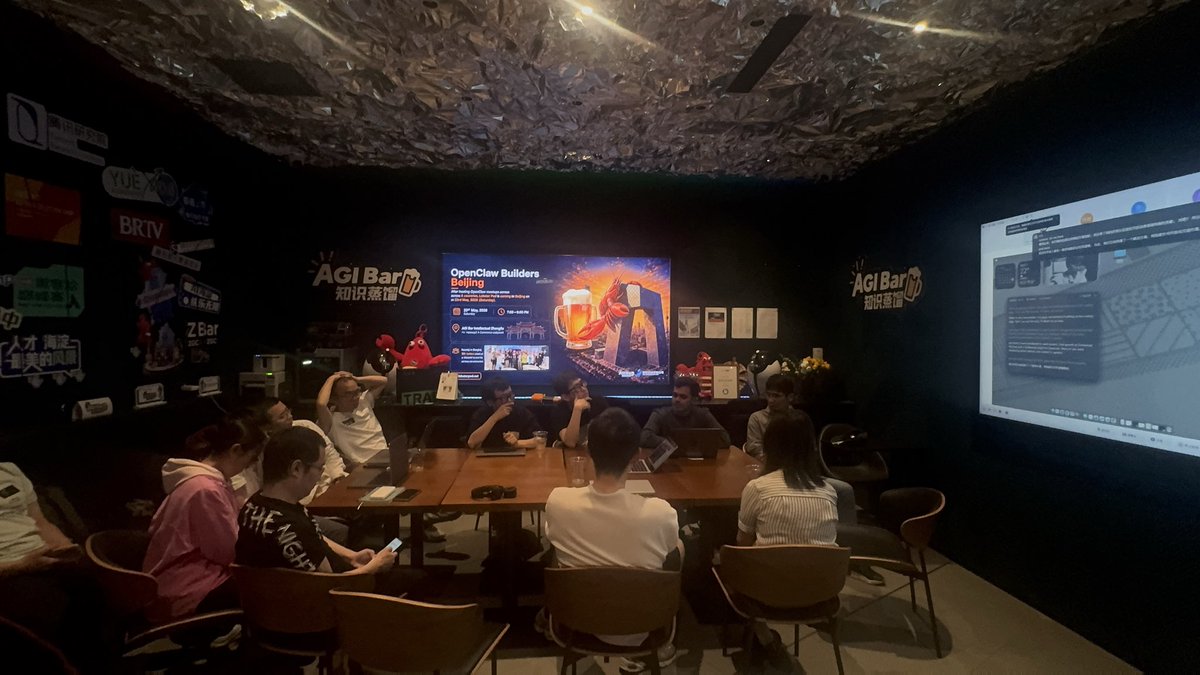
today, agents are on their islands isolated.
we are focussed on enabling agents in multi-player mode
we believe human should be in the loop to bring in judgement and taste
we are starting a new chapter towards human-agent collaboration
follow the journey
21/21 @CaptVenk
Laksh is just 8, and he has used openclaw for a bunch of things. to apply for grants, finding them, filling the forms, tracking emails, replying, and telling him when he gets selected.
he then took it to hardware: running it on an ESP32, experimenting with picoclaw on a raspberry pi, and now trying to run a local model on a jetson board.
his latest project is Hardvare, call an agent, tell it what you want to build, and it writes the code, checks the pins, and flashes the device.
20/21
built a store of ready-made ai employees you deploy in about 5 minutes.
crewclaw gives you 200+ pre-built agents for actual roles — metrics, seo, devops, support, sales — each shipping with its soul.md, skills, and integrations (stripe, ga4, github, notion) already wired up. pick a role, drop in your api keys, run two commands, and it lives on your telegram, slack, or discord — messaging you proactively, not waiting to be asked. $9 to self-host and own the code, or $29/mo and they run it on hermes 24/7.
19/21
he built a way to clone your expertise into an agent and put its time to work.
tokenaissance takes your articles, courses, and faqs and trains an agent that answers in your voice — strictly from what you taught it, nothing made up. deploy it across whatsapp, telegram, slack, discord, wechat, and web from one dashboard, your brand on top, openclaw and clawhub skills underneath. it works the hours you don't, so your income stops being capped by your time.
18/21 @vincent_koc
who better to ask than the chief architect of @openclaw himself. his advice for everyone using it: stop chasing use cases, just experiment.
the models are good enough now that the move isn't picking a vertical — it's sitting down and talking to the agent to find out what it can actually do. think of it as someone who helps you solve problems, not a tool for one domain. it's a different way of working. and the next 6–12 months? he won't call it — "i still operate in weeks and days and hours."
17/21
Ming turned openclaw into a one-message publishing tool for creators.
ex-google research pm (open-sourced mediapipe). he fixed the messy part — connecting tiktok/youtube to openclaw usually means storing oauth locally, a real risk if your agent's compromised.
so: mybrandmetrics for safe account linking + clawbus, a social-media skills marketplace. install clawbus, add a tiktok publisher, then drop a video link in telegram with a caption and it goes live. no upload flow, no clicking around.
16/21
Xander built odini to fix how multi-agent systems waste context.
most agent frameworks have agents chatting with each other, lots of thinking, lots of unused tokens, lots of cost. xander's bet is that agents shouldn't talk. they should behave like functions: take an input, deliver a defined output (a report, a dashboard, an archive), and hand it to the next one in the pipeline. memory lives in the pipeline, not in the agents.
15/21 @satwikkansal
Satwik made openclaw control his phone like a real assistant.
he and a friend built roy, a mobile agent that reads what's on your screen and operates apps the way you would — order biryani, book an uber, text your wife on valentine's, check what's trending on x — five tasks, zero taps. it uses accessibility services first and falls back to vision when an app has no metadata, and it learns your behavior over time so "order my usual coffee" actually means something.
his bet: the next billion AI users won't spin up agents on servers. they'll pick up their phone.
14/21 @samzong
Samzong turned openclaw into a proper client — desktop and mobile.
ClawWorker is his open source app for mac, windows, and linux that gives OpenClaw real windows, sessions, file management, and slash commands instead of one terminal stream. scan a QR code and the same agents run on your phone.
best part: tell it "i want an open source marketing team" and it spins up four agents, picks the right skills for each, and installs them for you.
13/21 @raunaqness
Raunaq built an obsidian sync layer for contexto.
he asked his openclaw agent on telegram: "what's my best friend's favorite food?" something only he knows. the agent shrugged. he opened his obsidian vault on his phone, typed one line "my best friend loves ice cream" saved it, asked again. the agent answered.
that's the whole loop. your personal knowledge in your vault, synced to your VPS, fetched into the prompt the moment your agent needs it. obsidian first, google drive next so teams can share a brain.
12/21 @sh1sh1nk
Shashank is building the context layer openclaw plugs into.
most people think a smart model + a good prompt is enough. it isn't. tools break silently, context collapses mid-task, agents quietly drift and you don't notice until your agent makes an outdoor dinner reservation in the rain because the weather API was down.
contexto is one layer for all of it: memory from past conversations, knowledge from your obsidian, notion, drive, and a real-time picture of which tools actually work for you. models will keep getting better.
your context is what you should actually own because the day you own it, you stop being a consumer of AI and start shipping your expertise as a product others can call into.
we hosted our 8th openclaw meetup, this time in Beijing.
20+ Chinese builders shared their use cases, products and workflows built with OpenClaw.
i have seen more power users of openclaw in China than anywhere else by far.
Beijing was a special one, language was the biggest barrier. we literally had a live translator on the screen. Yet everyone was so supportive and patient.
the excitement, enthusiasm and warmth that Chinese builders showed me by the end of the session was truly surreal.
OpenClaw, Shenzhen🦞
After receiving such an overwhelming response to our events in Shanghai and Beijing in China, we are now doing an event in SHENZHEN!
In Collaboratoration with @0xqiuqiuu and Asia’s biggest OpenClaw community @OpenClaw_ASIA
Join us:https://t.co/TTxTq7WwHA
12/21 @sh1sh1nk
Shashank is building the context layer openclaw plugs into.
most people think a smart model + a good prompt is enough. it isn't. tools break silently, context collapses mid-task, agents quietly drift and you don't notice until your agent makes an outdoor dinner reservation in the rain because the weather API was down.
contexto is one layer for all of it: memory from past conversations, knowledge from your obsidian, notion, drive, and a real-time picture of which tools actually work for you. models will keep getting better.
your context is what you should actually own because the day you own it, you stop being a consumer of AI and start shipping your expertise as a product others can call into.
11/21 @SKharvi55143
Siddharth put openclaw on a chip.
instead of a laptop or a cloud VM, he deployed an openclaw agent onto an arduino q board (arduino + qualcomm's QRB2210). fed it the STM32 datasheet and the pinout. the agent wrote the embedded C, compiled it, and lit up an arrow across the LED matrix display.
the bigger point: most agent demos need wifi and a fat machine. this one runs at the edge, smart cameras, remote sensors, places with no internet, processing locally without burning tokens to send everything back to the cloud.
10/21
Rushant demoed two projects. opposite ends of the spectrum.
the first was redclaw, a platform he built for enterprises where AI employees ("claws") have names, personalities, and persistent memory. one claw researches a company in slack, hands it to another claw that builds a working app and ships it to vercel — same thread, no human in the loop.
the second was a pokemon-style game he hacked together that morning. instead of a dashboard, your openclaw mission control is a game world. you walk up to NPCs to edit your soul.md, change models, talk to your agents. open-sourced.
9/21 @bartomolina
Barto turned openclaw into his own DevOps engineer, managing a whole VPS of self-hosted tools.
instead of being locked into one company's cloud, barto self-hosts services like n8n, excalidraw, and streamlit on the same VPS as openclaw, then lets openclaw manage, upgrade, and even add features to them for him.
he built his own custom dashboard to see every app, database, and website on the box, plus a kanban where he assigns tasks straight to his agents and they ship the changes.
he open-sourced the whole dashboard.
8/21 @Tonnny_Punk
not every demo is a tool. this one's an idea.
he built a decentralized "nation" of openclaw agents, seeded with a hundred of them, each tasked with onboarding more, running on their own token, staking, and elections. no monetary goal, no user.
just a question: if agents ever get real independence, what does a society of them look like?