Personal update:
We found a way for agents to deliver more accurate and reliable results - at runtime.
Here’s a 35 second sneak peek of an agent answering a user question, fetching data from backend systems, and verifying its own response at runtime.
Exciting update!
We’re building tools that let AI agents prove where their answers came from.
- Eliminates hallucinations & poisoning.
- Verifiable in near real time by humans or machines.
- Multi agent systems propagate only correct answers.
See demo:
2/ So I tested @GetProvably's verifiable databases to see if they'd fix it.
Simple demo: API gives me BTC + USD/CHF prices (stored in a JSON file). The agent reads it and converts BTC into CHF.
On the right → Provably gives cryptographic assurance the data is correct.
@GetProvably is 2 years old this month.
Our qedb: Expressive and Modular Verifiable Databases (without SNARKs) paper has been accepted to CCS 2026 (Conference on Computer and Communications Security).
https://t.co/5vfvyRRpSx
🎙 This week @AnnaRRose & @nico_mnbl talk with Shyam & Emanuele from @GetProvably about verifiable databases, proving SQL queries on private data using KZG & polynomial commitments, why this outperforms Merkle-based approaches, proof sizes under 1.5 KB, data pricing with privacy budgets, and emerging use cases in multi-agent AI.
https://t.co/Mu22WikIQL
We are getting ready to ship the next version of Provably. Heres a teaser.
1. You can bring your own data or find other peoples.
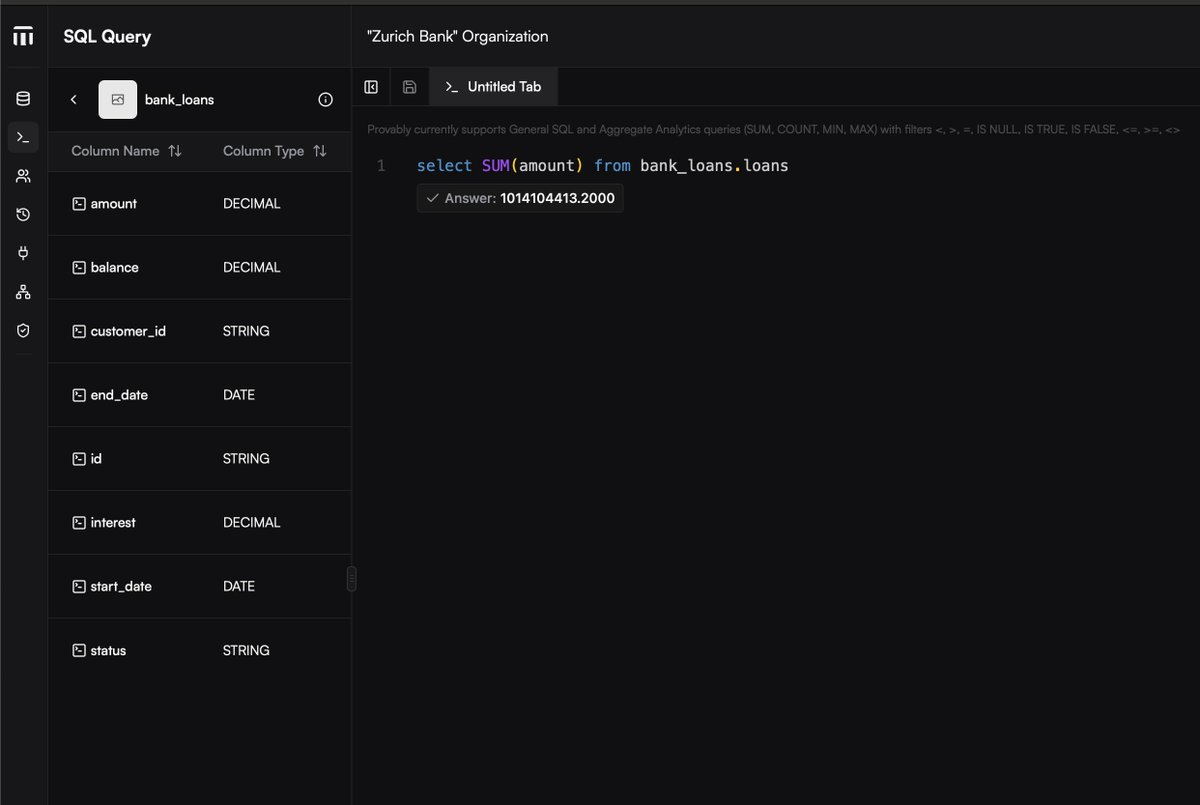
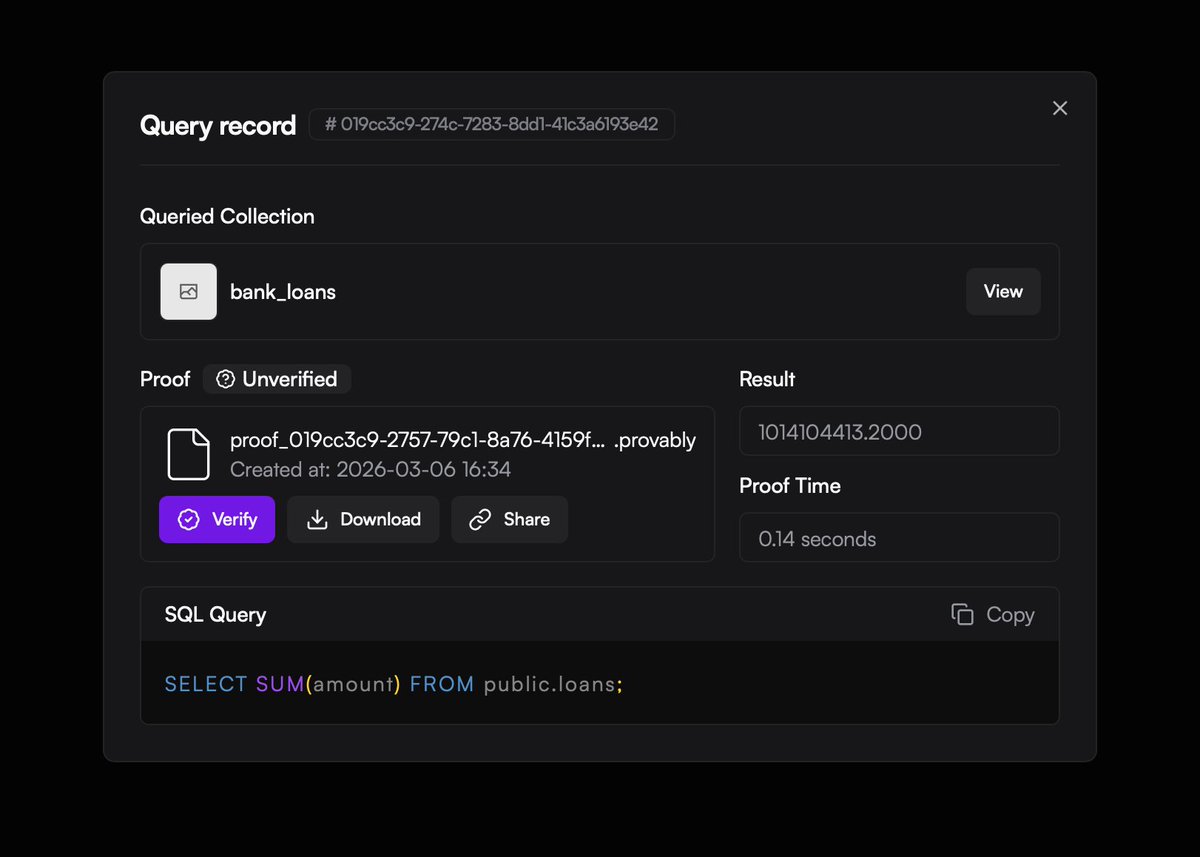
2. It will have a new SQL IDE to write queries.
3. Results come back instantly with proofs.
No circuits to build or compile.
#zk#verifiabledata
Telco networks can verify calls from sim cards but not VOIP calls or completely digital calls.
You can use different Verifiable techniques, but key lesson is - IDENTITY alone is not enough.
A verifiable intent - on why someone calls is very important too if the caller is unknown.
Another cool way but needs to be adopted by email, messaging or VoiP platform is this:
- caller must place funds in escrow.
- if receiver accepts their call as legitimate - they can return the funds in escrow.
Verifiable Vector Databases for the AI Era
Yesterday at @GetProvably, we welcomed Nicole Emanuele for a three-day research visit hosted with @SteDziembowski at the University of Warsaw.
Provably CTO and co-founder @EmanueleRagnoli led the sessions, including a deep dive on Verifiable LSH in Halo2.
Whilst at Provably we focus on verifiability of queries on relational databases, we work on another stream of research that is #verifiability and #privacy for Vector Databases such as #pgvector.
This is becoming an important feature in AI infrastructure that uses private datasets. A vector is sensitive information, it is a semantic fingerprint of the original data.
From leaked vectors, attackers can infer topics, reconstruct text, detect whether specific documents or people are in the database. An adversary could use leaked vectors to design poisoning attacks that mislead AI agents at retrieval time.
To achieve privacy and security, @EmanueleRagnoli , Nicol and @atrombetta68, map group theory to floating-point arithmetics, and design #ZeroKnowledge systems in mathematical spaces that define cosine similarity, embeddings, approximate nearest-neighbour search and semantic distances based on inner products.
We are adapting proof systems like #Halo2 to support quantisation and the noisy geometry of vector search.
cc @DanBoneh, @BryanParno, @fanzhang, @TomGur, @Pinecone_io, @IronCoreLabs
We keep saying:
“Humans are the weakest link.”
Now we’re replacing them with AI agents.
Soon might be:
Sorry, the model updated and also deleted your keys.
Progress?
If humans can’t be trusted with cryptographic keys… can AI?
IACR 2025 election just failed because a trustee irretrievably lost their private key.
State-of-the-art crypto vs. human memory 1-0 (not cumulative)
https://t.co/EXZqP8TPiS
fn keys_being_stored_somewhere() -> Result<(), HumanError>
{
Err(HumanError::LostForever)
}
The only truly trustless system is one where nobody is trusted with the keys.