Attention agencies offering SEO and AI search services:
Rankability 2 will help you deliver results easier, faster, and more predictable than ever before:
Most people are overthinking “agent optimization.”
Yes, it’s entirely possible that agents will handle most searches online in the future.
But that doesn’t mean you need a completely new strategy.
If you want to win in agent-driven search, start by winning in traditional search.
Why?
Because most agents still rely on traditional search engines to discover and retrieve information. When someone asks an agent to search, it’s usually pulling from Google, Bing, Brave, or some mix of the three.
That means the foundation hasn’t changed as much as people think.
If your site is crawlable, indexable, and actually visible in search, agents can usually access your content and use it correctly.
The mistake is thinking “SEO for agents” is some brand-new game.
It’s not.
What is changing is where authority comes from and how visibility compounds across platforms.
And let’s be clear about something else:
- SEO is not adding a sitemap.
- SEO is not checking a few technical boxes and calling it done.
- SEO is not checking a few technical boxes and calling it done.
That’s like saying being great at baseball is owning a glove.
Real SEO requires execution across three core disciplines:
1. Technical SEO
2. Content
3. Off-site authority
If you’re missing even one of those, your performance suffers.
And this is where most people are still getting it wrong.
They’re obsessed with their own website.
Meanwhile, search is becoming an ecosystem.
If you want visibility across all search surfaces, the majority of your effort can’t be isolated on your site alone.
A huge amount of leverage now comes from what happens off your website, through mentions, links, citations, distribution, and brand presence across the broader web.
That’s why the future isn’t just SEO.
It’s search everywhere optimization.
The first step of this process is benchmarking your current SEO performance. I'm using @getrankability because it tracks your performance across traditional search, local, and AI.
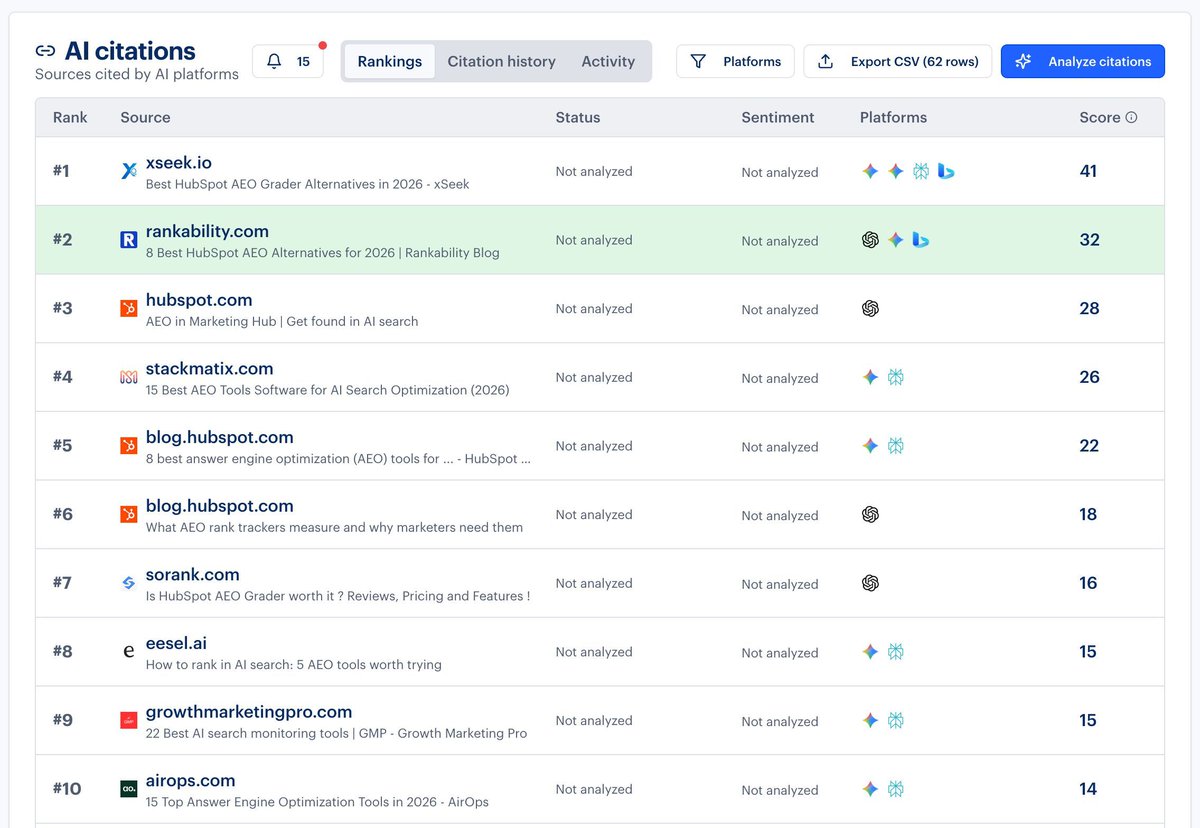
HubSpot launched its new AEO tool.
Within hours, Rankability was:
• #1 in traditional Google search
• the #1 cited source in AI results
• the #1 recommended alternative in Google AI answers
This wasn't luck.
We identified the opportunity, built the right assets fast, optimized them with Rankability, and published before the SERP got crowded.
That's what search everywhere optimization looks like.
Most AI SEO writing tools stop at suggestions.
Rankability now goes a step further.
You can prompt the AI directly on any content asset, tell it what to change, and it will make the update inside the editor.
Less copy and paste.
Less manual revision.
More execution.
This is the kind of AI workflow that actually saves time.
Reporter v5.5 just made Search Domination more accurate.
You can now flag owned assets like your LinkedIn profile, YouTube channel, Crunchbase page, or any other property you control.
Why this matters:
If your website ranks #1, your LinkedIn page ranks #4, and your YouTube channel ranks #7 for the same query, that’s not just visibility. That’s SERP control.
Now those owned assets count toward your Search Domination score.
What’s new in Reporter v5.5:
• Flag owned assets with one click using the shield icon
• Get a more accurate view of your real SERP footprint
• See owned assets highlighted with an “Owned” badge
• Keep owned properties out of competitor analysis
• Save owned assets at the client level once
• Include asset type in CSV exports: Primary, Owned, or Competitor
Search Domination shouldn’t stop at your primary domain.
Because if you control multiple positions in the SERP, that’s your real estate.
If you’re already using Rankability: connect GSC today and look at:
- positions 2–15 opportunities
- decaying pages
- what changed on your timeline
That’s your fastest path to more traffic without publishing more.
Rank tracking alone is a lie (or at least… incomplete).
If clicks drop but “rankings look fine,” you don’t have an SEO problem.
You have a visibility + demand signal problem.
The real issue:
Most teams track positions, then guess why performance changed.
No context, causality, or “what do we do next?”
We just shipped the fix in Rankability:
Reporter v3.0 with Google Search Console built in.
Now you see clicks, impressions, CTR, avg position next to rank tracking + AI citation visibility.
This matters because rankings are a proxy while clicks are reality.
And when you overlay both, you stop debating and start fixing.
Here's how to use it:
Attention agencies offering SEO and AI search services:
Rankability 2 will help you deliver results easier, faster, and more predictable than ever before: