Tracer solves the biggest flaw in today’s identity systems by giving users full ownership and control of their data—unlike traditional logins that silo data and expose it to breaches, Tracer’s decentralized network enables secure, portable, and privacy-preserving identity across platforms.
Users create a Tracer trust ID—a decentralized, encrypted profile they own—which lets them selectively share verified information (like age, credentials, or preferences) with apps and platforms without exposing underlying personal data. All data permissions are user-controlled, revocable, and transparent.
In Episode 606 of the Blockhash Podcast, our President and Co-founder @MoynihanP1 joins @blockhashpod and @zempcapital to discuss the future of privacy-first digital identity.
https://t.co/KwYKqG9i45
Google just launched a new system to blur suspected nudity in Messages, automatically protecting minors from explicit content. It’s a milestone for on-device AI safety.
Tracer President and Co-founder Patrick Moynihan spoke with CNET about:
🔍 How AI image filters have evolved
🔐 The importance of pairing detection with privacy-preserving infrastructure
📱 Why Android’s open ecosystem creates both opportunity and risk
At Tracer, we believe consent, context, and control should be embedded in every digital interaction, especially when it comes to protecting kids online.
Check out the full article here: [Article Link]
https://t.co/n36XHRJgLw
Excited to share this @hackernoon piece on why digital identity is tech's missing infrastructure layer. In a world of fraud & privacy woes, a unified, user-centric solution is key.
At @TracerLabs, Trust ID does just that: verify once, use everywhere—no tracking, full user control. Like Stripe for trust!
Thoughts? 👇
https://t.co/sW3wjkVbzB
Trust ID: The Only Digital Identity You'll Ever Need.
Trust ID is your permanent, secure, and universally accepted digital identity wallet. It protects all your credentials and digital assets in one place — guarding against theft and fraud.
With Trust ID, your consents and preferences are enforced wherever you go, giving you control over how and when you share your information.
Best of all, it's completely free for users — services and brands cover the cost because they want to empower you to transact with trust and ease.
With Trust ID, you own your identity and transact on your terms.
The Trust Equation: A Story of Tracer Labs’ Trust ID
In the bustling digital city of Nexus, where data streams flowed like rivers and every interaction left a trace, trust was the rarest currency. People moved through virtual marketplaces, shared stories on social platforms, and built businesses online, but a shadow lingered. Bots masqueraded as humans, scammers hid behind polished profiles, and skepticism clouded every click. In this world, Tracer Labs emerged with a vision: to restore trust as the foundation of the digital age. Their creation, Trust ID, wasn’t just a tool—it was a promise.
Chapter 1: The Trust Deficit
Lila Carter, a small business owner, stood at the heart of Nexus. Her online boutique, woven with her passion for sustainable fashion, thrived on authentic connections with customers. But lately, her virtual storefront felt like a battleground. Fake reviews eroded her credibility, and spam accounts flooded her comment sections. Customers hesitated, wary of scams. “How do I prove I’m real?” Lila wondered, her frustration echoing a universal cry in Nexus.
Across the city, Marcus Reed faced a different struggle. As a freelance developer, he relied on platforms to connect with clients. But every pitch was met with suspicion. Clients demanded endless verifications, fearing he might be another faceless bot or fraudster. Marcus knew his skills were solid, but without a way to signal his authenticity, opportunities slipped away.
In Nexus, trust was fraying. The article Lila read on her phone one evening, landed. “Brands don’t need bigger marketing budgets. They need to be smarter about building trust and creating real connections.” Trust wasn’t bought with flashy ads but earned through transparency and community. Lila and Marcus, though worlds apart, both needed a solution to bridge the trust gap. That’s when Tracer Labs’ Trust ID entered their lives.
Chapter 2: The Spark of Trust ID
Tracer Labs wasn’t a sprawling tech giant with endless budgets. It was a team of innovators who believed that trust could be engineered—not with algorithms alone, but with a human-centered approach. Their Trust ID system was a digital passport, a secure, verifiable identity layer that let users prove who they were without sacrificing privacy. It wasn’t about shouting louder; it was about whispering truth in a noisy world.
For Lila, Trust ID became her boutique’s shield. By integrating it into her website, she could verify her business’s legitimacy with a simple badge, backed by Tracer Labs’ blockchain-based authentication. Customers saw the Trust ID seal and knew her shop was real, her products genuine. The badge wasn’t just a logo—it was a signal that said, “You can believe in us.” She quickly realized “Focus on utility and connection, not just promotion.” Trust ID didn’t overwhelm customers with ads; it quietly empowered them to shop with confidence.
Marcus, meanwhile, used Trust ID to transform his freelance career. By linking his profile to a verified Trust ID, he could prove his identity to clients instantly. The system cross-referenced his credentials—work history, certifications, even endorsements from past clients—without exposing sensitive data. When a potential client saw Marcus’s Trust ID, they didn’t just see a profile; they saw a person they could trust. He understood “Brands and individuals thrive when they solve real problems for their audience.” For Marcus, Trust ID solved the problem of doubt.
Chapter 3: A Community of Trust
Trust ID didn’t stop at individual verification. Tracer Labs understood that trust was communal, not solitary. In Nexus, Trust ID began to weave a network. Businesses like Lila’s and freelancers like Marcus could join a Trust ID ecosystem, where verified users supported each other. Lila partnered with other Trust ID-verified artisans, creating a curated marketplace that customers flocked to, knowing every seller was authentic. Marcus joined a Trust ID-verified freelancer collective, gaining visibility among clients who valued vetted talent.
This wasn’t about scale for scale’s sake. “Bigger isn’t better—relevance is.” Tracer Labs didn’t chase millions of users with generic promises. Instead, Trust ID focused on communities—small businesses, freelancers, creators—who needed trust the most. Each verified user became a node in a growing web of credibility, proving that trust could scale without losing its human touch.
Chapter 4: The Ripple Effect
As Trust ID spread through Nexus, the city began to change. Shoppers like Lila’s customers felt safer, knowing they weren’t being duped. Clients like Marcus’s trusted their hires, confident in their verified identities. Even platforms in Nexus adopted Trust ID, using it to filter out bots and bad actors. The result was a cleaner, more human digital space—a place where connections flourished because trust was no longer a gamble.
Lila’s boutique grew, not because she spent more on ads, but because Trust ID let her focus on what mattered: quality products and real relationships. Marcus landed bigger projects, his Trust ID badge opening doors that skepticism once closed. And Tracer Labs? They didn’t just build a product; they sparked a movement. Insight became their mantra: “Build trust, not noise.” Trust ID wasn’t about dominating the market—it was about making the market work for everyone.
Epilogue: The Future of Trust
In Nexus, Trust ID became more than a tool; it was a symbol of a new digital ethos. Tracer Labs showed that trust didn’t need to be loud or expensive. It could be simple, secure, and human. As Lila and Marcus thrived, they shared their stories, inspiring others to join the Trust ID network. The digital city began to shine brighter, not with the glare of ads, but with the quiet glow of authenticity.
Tracer Labs’ Trust ID proved that in a world drowning in noise, trust was the signal that mattered most. And in Nexus, that signal was growing stronger every day.
President Trump has already survived TWO assassination attempts.
Now, former disgraced FBI director James Comey is either threatening to kill Donald Trump or suggesting someone should. This is as outrageous as it is dangerous.
Grateful @Sec_Noem and @FBIDirectorKash are looking into this.
Don’t shoot the messenger, I’m just going to tell you what I’ve been told.
There is extreme frustration, rightfully so and I agree, not seeing DOGE cuts being passed through Congress in the form of rescission bills.
I have been told that White House OMB is working with the House Appropriations Committee on a rescission package that we are supposed to see after we get done arguing with each other over this reconciliation bill - Trump’s big beautiful bill.
And I’m still unclear why we aren’t passing executive orders every week. I was told we are waiting to get done with reconciliation. And that a portion of them have already been drafted with input from the WH.
In my opinion we should walk and chew gum at the same time.
So far this week, we saw members of Congress fall asleep in absurdly long overnight committee markups for reconciliation, we have voted to rename a park and a historical site, and voted on the 19th antisemitism bill since I’ve been in Congress. 19! I skipped that vote yesterday because I’m not going to participate in that constant demand.
I just want to pass President Trump’s America First agenda that America voted for in November!
That’s all.
I have no idea why it’s so hard.
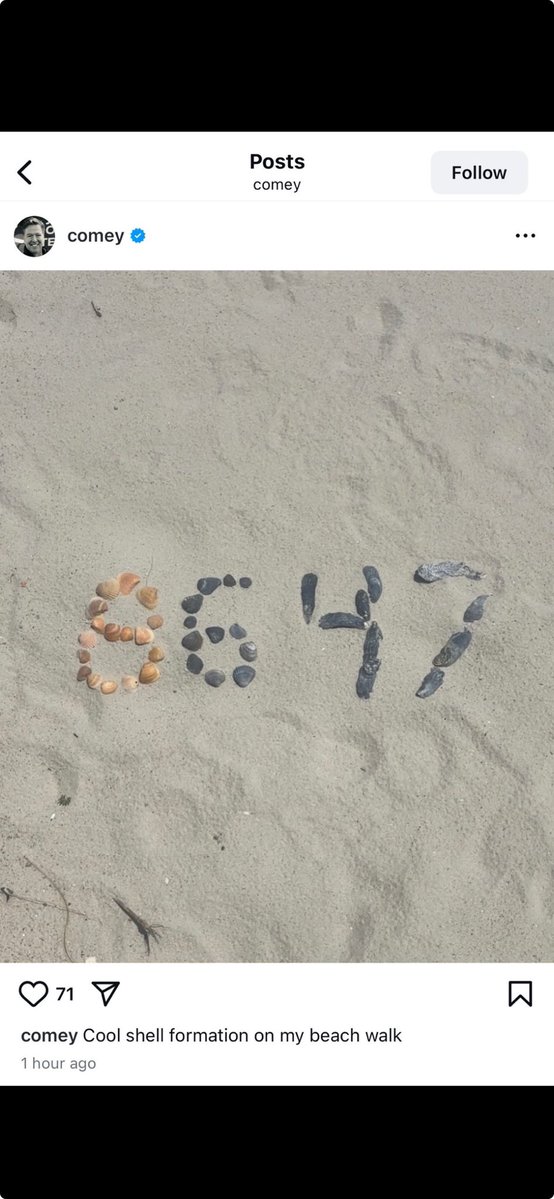
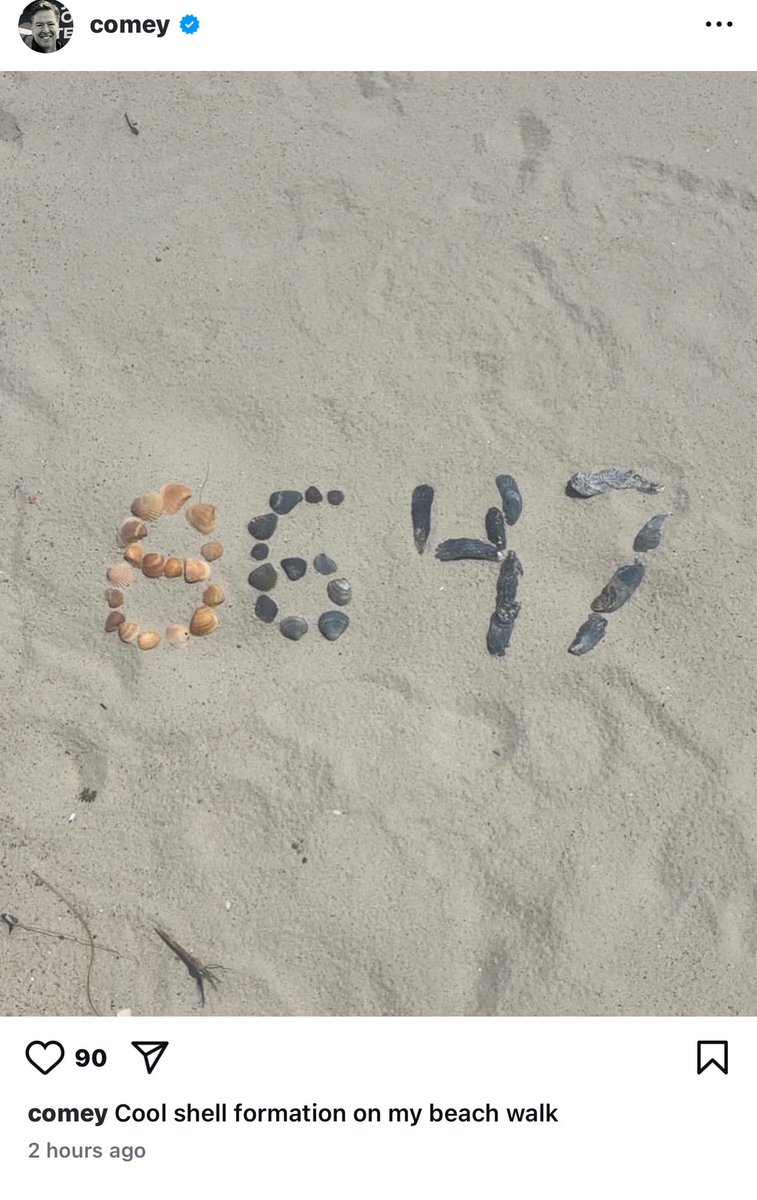
🧵 Former FBI Director Jim Comey posted a cryptic message that—as far as I can tell—can be read only to mean “kill Trump”
I’m speechless
Literally speechless
1/
Is there any other reasonable explanation for this post other than that…
…the former head of the FBI is publicly calling for the murder of the President of the United States?
WOW!
Former FBI Director James Comey @Comey just posted this on his Instagram 2 hours ago, with the caption “cool shell formation on my beach walk”. It’s a pic of shells in the form of “86 47”.
This is a call for the assassination of President Trump by the former FBI Director!
We are aware of the recent social media post by former FBI Director James Comey, directed at President Trump. We are in communication with the Secret Service and Director Curran. Primary jurisdiction is with SS on these matters and we, the FBI, will provide all necessary support.
Excellent point, @HillaryClinton. No one knows this better than you.
To use a random example in support of your assertion, let's look at foreign government contributions to the Clinton Foundation while you held positions of influence in government vs. contributions after you lost the election - and your influence on foreign affairs - in 2016: