I live in Little Rock, Arkansas. I’ve never even visited LA.
I just donated to @spencerpratt campaign for mayor because anyone willing to fight the Marxists has my support.
In addition to supporting our good candidates in AR, check out his campaign at: https://t.co/Y0p4f3NpUe
True:
“They gave stock to everyone. There are a bunch of highly skilled workers that we on X never think of, like Tube Benders, Orbital Tube Welders, Cleanroom Technicians, etc. that are going to make significant fortunes.”
I just had the craziest experience at the airport.
We are about to board a flight to Atlanta when the pilot from the incoming plane walks out of the jetway. Guy is probably late 50s, salt and pepper hair, military look. The kind of pilot you instantly feel good about seeing on your flight.
Pilot walks over to the counter, gets on the PA system, and starts addressing everyone. “Folks, I’ve been doing this a long time. Flying one of these jets is easy. The hard part is looking at 130 people and telling them their flight is going to be delayed.”
Audible groans throughout the boarding gate. Most people here are flying to Atlanta as a layover before another flight. 130 people just had their day become a complete mess.
The pilot goes on. “I get it, trust me. But here’s the deal: During our landing, we had a small mechanical issue. I’m not your pilot for the next leg, but I don’t feel confident the jet’s safe to fly until we have a mechanical team look it over, and I don’t feel comfortable asking the next pilots to fly you guys until we get confirmation.”
He points at the agents next to him behind the counter: “Now, none of this is the agents’ fault. Please be kind to them. I’m the one who made this decision, not them, so any inconvenience you experience is my fault. Just please know that I don’t do this lightly, and I’m only doing it because I believe it’s in the best interests of everyone’s safety.”
Now this is where the story gets crazy. The pilot puts the microphone down, grabs his suitcase, and all the people in the gate…
Start clapping.
I’m not joking, everyone starts clapping for the guy. 130 people who just had their travel plans ruined give an ovation to the guy who made the decision and delivered the message.
All because he addressed them with decency and transparency, took ownership of the decision, made it clear that it was necessary, and explained why it was in everyone’s best interest.
It’s honestly one of the best examples of strong communication—of strong leadership, for that matter—that I’ve seen in a long time.
@Delta, whoever your Atlanta to Wichita pilot was this morning, he’s one of the good ones. Please tell him the delayed passengers of flight 1637 appreciate what he did.
A news reporter asked Michael Jordan if he thought the ’90s Bulls could beat LeBron’s Lakers.
MJ: Yes.
Reporter: By how much?
MJ: Two or three points.
Reporter: Why so close?
MJ: Most of us are almost 60 now.
"The single most important thing for anybody wanting to break into any industry is go to the headquarters or cluster of that industry. Move to wherever that thing is. And all the advice that you can do anything from anywhere and everything's remote is all BS. With AI, 91 percent of private technology market cap is in the Bay Area. Ninety-one percent of the entire global set of AI market cap is all in one 10 by 10 area."
— Elad Gil
Listen to my interview with @eladgil:
https://t.co/Z1cjLkdcX0
When I was a third-year medical student on my obstetrics and gynecology rotation, I spent time working with an Ob-Gyn named Bruce who had a favorite line.
As he scanned the bellies of expectant mothers, he would ask:
“Do you have a name for the baby?”
If they did, he would enthusiastically discuss the name.
If they didn’t, he would grin and say:
“You know, if it’s a boy, Bruce is a pretty great name.”
As the rotation went on, I started doing admission histories and physicals for women arriving in labor.
They say we absorb our clinical style from our teachers.
So one day, while taking a history from a woman who had recently immigrated from Cape Verde, I decided to imitate my attending.
“Do you have a name for the baby?” I asked.
She told me she was still thinking about it.
Without much thought, I replied:
“Sachin is a pretty great name.”
She paused.
“What does it mean?”
I told her:
“It roughly translates as truth.”
She smiled.
“I like it.”
I was suddenly caught off guard.
What had started as a throwaway conversation starter borrowed from my attending had unexpectedly become something real. A few hours later, another “Sachin” was born into the world.
I have thought about that moment many times over the years.
Medicine gives us extraordinary access to people’s lives at moments of enormous vulnerability, hope, fear, and possibility. Sometimes we underestimate how much even small interactions can matter.
And sometimes, without realizing it, we leave pieces of ourselves behind in other people’s stories.
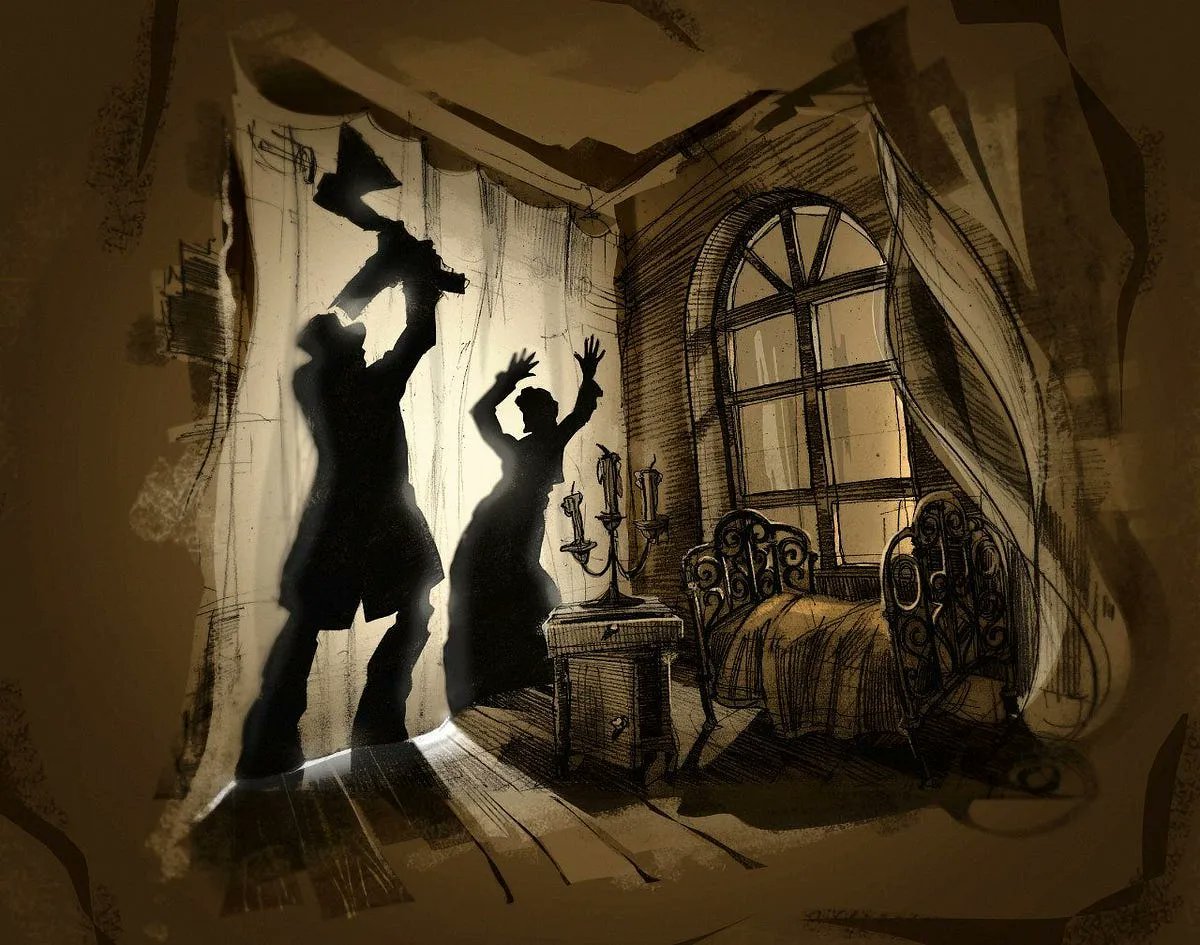
Crime and Punishment isn't about a single murder, but the *idea* that can justify murdering millions.
Raskolnikov famously kills a predatory pawnbroker, reasoning that she won't be missed, and he can use her money for the greater good.
Strangely, however, he never uses her money. He instead buries it under a rock and forgets it.
What was his true motivation then?
Later on, you discover he's motivated by a much darker ideology, which he shares in an article titled "On Crime."
He argues there are only 2 types of people:
1. Ordinary people: who live by the status quo and obey the law
2. Extraordinary people: who have the strength to break the law
He concludes that extraordinary people SHOULD break the law to serve the greater good of humanity…
The problem of this ideology is it doesn't justify just one murder, but two, or three, or three thousand, etc. Raskolnikov proves this himself: after murdering the pawnbroker, he then murders her innocent sister, solely for self-preservation.
Ultimately, Dostoevsky warns that when man rejects objective morality, not only is murder justified, but moral relativism — taken at scale — can justify mass murder itself.
What is brilliant about Crime and Punishment is that the greatest damage to Raskolnikov is not the legal or social consequences that eventually catch up to him.
Instead, Raskolnikov's actions destroy him bit-by-bit from the inside. Where Raskolnikov thought that his own superiority would allow him to commit crimes with impunity, he finds that it is the personal cost that actually damages him.
Thus Dostoevsky makes a poignant argument that morality is objective. And if we live according to our own will, and to our own ambition, disaster is lurking...
This door in Westminster Abbey is older than most modern nation-states. Made in the 1050s from an English oak, it's the only surviving Anglo-Saxon door in Britain.
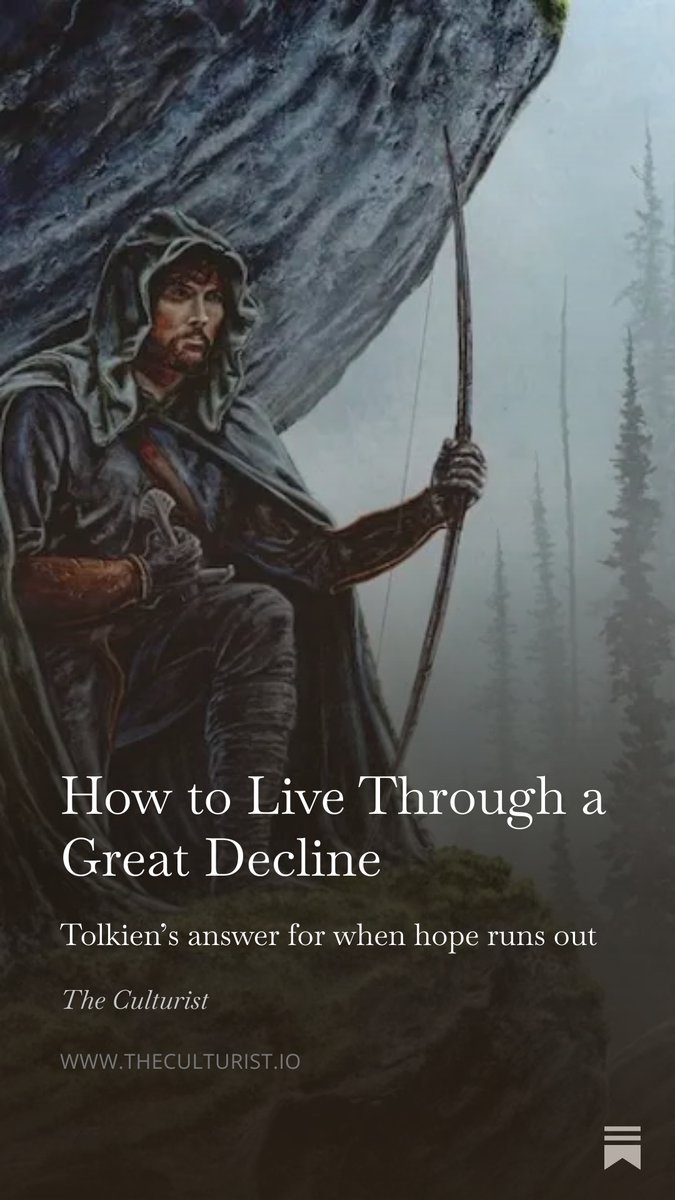
If you're living through a great decline, how should you personally live and act in the midst of it?
This is the question at the heart of "The Lord of the Rings," and it's best answered by the scene following the death of Boromir.
After Boromir gives his life to save the Hobbits from Saruman's Orcs, the Fellowship is in tatters. With time against them, Merry and Pippin swept away by the enemy, and Frodo passing out of their control, Aragorn and company make a decision that seems strange.
They pause to mourn Boromir's passing with a proper ritual.
To many readers, this feels entirely reckless. Their "best" course of action is surely to prioritize what is most urgent: that the fate of their quest hangs in the balance. We recognize that, in any "normal" context, it would be wrong to let Boromir's body lie out in the open, but the nature of their mission surely doesn’t allow for the luxury of a funeral — right?
But the fact that abandoning Boromir's body is wrong in normal times is precisely why it is wrong even now. At the heart of LOTR is the idea that moral decisions lie beyond their immediate context: some things just are wrong and others right, and once context becomes an arbiter of that distinction, you've lost your grip on what it means to be good.
Aragorn's next statement helps us understand this further:
"I would have guided Frodo to Mordor and gone with him to the end; but if I seek him now in the wilderness, I must abandon the captives to torment and death. My heart speaks clearly at last: the fate of the Bearer is in my hands no longer."
Aragorn makes yet another decision to halt progress on the greater mission in favor of that which speaks directly to his heart: he will pursue Merry and Pippin, rather than sacrifice them for the "more important" quest.
Tolkien's heroes recognize that they are not in control of everything. They cannot force the Ring to be unmade through their own will to power, and they're aware that their universe is guided by forces beyond their own and of their enemies. All they do is done in that humility, and they are bound by moral laws beyond themselves.
Indeed, Middle-earth is guided not just by the opposing wills of Good and Evil but by another, providential force beyond the material.
It is precisely because Tolkien's heroes believe in objective good that they can trust that a great, providential turn in fortune — a "eucatastrophe" — is around the corner. To believe in the objective good is to live in accordance with destiny, and to act on what is inherently good at all times, and to die for it if necessary.
To live in submission to divine providence is to recognize that the right actions also lie in the little things, and that you yourself play only a small part in the grand story.
A good world is brought into being by small acts of courage and kindness, even when they seem superfluous in the wider context of your quest...
https://t.co/HyhHZGGYde
Because we get asked a lot.
The Technological Republic, in brief.
1. Silicon Valley owes a moral debt to the country that made its rise possible. The engineering elite of Silicon Valley has an affirmative obligation to participate in the defense of the nation.
2. We must rebel against the tyranny of the apps. Is the iPhone our greatest creative if not crowning achievement as a civilization? The object has changed our lives, but it may also now be limiting and constraining our sense of the possible.
3. Free email is not enough. The decadence of a culture or civilization, and indeed its ruling class, will be forgiven only if that culture is capable of delivering economic growth and security for the public.
4. The limits of soft power, of soaring rhetoric alone, have been exposed. The ability of free and democratic societies to prevail requires something more than moral appeal. It requires hard power, and hard power in this century will be built on software.
5. The question is not whether A.I. weapons will be built; it is who will build them and for what purpose. Our adversaries will not pause to indulge in theatrical debates about the merits of developing technologies with critical military and national security applications. They will proceed.
6. National service should be a universal duty. We should, as a society, seriously consider moving away from an all-volunteer force and only fight the next war if everyone shares in the risk and the cost.
7. If a U.S. Marine asks for a better rifle, we should build it; and the same goes for software. We should as a country be capable of continuing a debate about the appropriateness of military action abroad while remaining unflinching in our commitment to those we have asked to step into harm’s way.
8. Public servants need not be our priests. Any business that compensated its employees in the way that the federal government compensates public servants would struggle to survive.
9. We should show far more grace towards those who have subjected themselves to public life. The eradication of any space for forgiveness—a jettisoning of any tolerance for the complexities and contradictions of the human psyche—may leave us with a cast of characters at the helm we will grow to regret.
10. The psychologization of modern politics is leading us astray. Those who look to the political arena to nourish their soul and sense of self, who rely too heavily on their internal life finding expression in people they may never meet, will be left disappointed.
11. Our society has grown too eager to hasten, and is often gleeful at, the demise of its enemies. The vanquishing of an opponent is a moment to pause, not rejoice.
12. The atomic age is ending. One age of deterrence, the atomic age, is ending, and a new era of deterrence built on A.I. is set to begin.
13. No other country in the history of the world has advanced progressive values more than this one. The United States is far from perfect. But it is easy to forget how much more opportunity exists in this country for those who are not hereditary elites than in any other nation on the planet.
14. American power has made possible an extraordinarily long peace. Too many have forgotten or perhaps take for granted that nearly a century of some version of peace has prevailed in the world without a great power military conflict. At least three generations — billions of people and their children and now grandchildren — have never known a world war.
15. The postwar neutering of Germany and Japan must be undone. The defanging of Germany was an overcorrection for which Europe is now paying a heavy price. A similar and highly theatrical commitment to Japanese pacifism will, if maintained, also threaten to shift the balance of power in Asia.
16. We should applaud those who attempt to build where the market has failed to act. The culture almost snickers at Musk’s interest in grand narrative, as if billionaires ought to simply stay in their lane of enriching themselves . . . . Any curiosity or genuine interest in the value of what he has created is essentially dismissed, or perhaps lurks from beneath a thinly veiled scorn.
17. Silicon Valley must play a role in addressing violent crime. Many politicians across the United States have essentially shrugged when it comes to violent crime, abandoning any serious efforts to address the problem or take on any risk with their constituencies or donors in coming up with solutions and experiments in what should be a desperate bid to save lives.
18. The ruthless exposure of the private lives of public figures drives far too much talent away from government service. The public arena—and the shallow and petty assaults against those who dare to do something other than enrich themselves—has become so unforgiving that the republic is left with a significant roster of ineffectual, empty vessels whose ambition one would forgive if there were any genuine belief structure lurking within.
19. The caution in public life that we unwittingly encourage is corrosive. Those who say nothing wrong often say nothing much at all.
20. The pervasive intolerance of religious belief in certain circles must be resisted. The elite’s intolerance of religious belief is perhaps one of the most telling signs that its political project constitutes a less open intellectual movement than many within it would claim.
21. Some cultures have produced vital advances; others remain dysfunctional and regressive. All cultures are now equal. Criticism and value judgments are forbidden. Yet this new dogma glosses over the fact that certain cultures and indeed subcultures . . . have produced wonders. Others have proven middling, and worse, regressive and harmful.
22. We must resist the shallow temptation of a vacant and hollow pluralism. We, in America and more broadly the West, have for the past half century resisted defining national cultures in the name of inclusivity. But inclusion into what?
Excerpts from the #1 New York Times Bestseller The Technological Republic: Hard Power, Soft Belief, and the Future of the West, by Alexander C. Karp & Nicholas W. Zamiska
https://t.co/8igjazz1On
Milton Friedman on how reform actually happens:
“You can’t reform any institution from inside because people don’t act against their own interest. The only way you reform institutions is by competition from the outside.”
I’ve covered the Masters since 2005. What makes it so special? Well, plenty. But here’s the best explanation I can come up with: It’s the only place you’ll ever go where everyone is exactly where they want to be. DisneyWorld? No way. Family wedding? Doubtful. But Augusta National during Masters week? You won’t find a single person who’d rather be somewhere else. Add in the device-free environment and it makes for such a unique dynamic that you literally won’t find elsewhere. Everyone is just happy to be where their feet are.