Google just released a free 2-hour course on full Graph Engineering.
How to go from one prompt to an agent graph that can build itself:
0% → 10:16 - build your first AI agent
25% → 41:05 - master prompt engineering
50% → 54:45 - turn agents into graphs
75% → 1:20:10 - run loops inside agent graphs
100% → 1:43:33 - build a graph that builds itself
Most people build one agent and stop there.
Google is teaching everything that comes after:
Prompt → Agents → Graphs → Loops → Self-Building Systems
Single agents are the old workflow.
Graphs that evolve themselves are the next one.
This 2-hour course is worth more than most paid agent engineering courses.
Bookmark it and watch today
Then read how to run 1,000 agents from one prompt below ↓
10 GitHub repositories that feel almost illegal to be free.
And yes — they're all open source.
1. Archify
Turn your codebase into beautiful architecture, workflow, sequence and data-flow diagrams with AI.
Perfect for developers who want system design without manually drawing everything.
https://t.co/FCv7b8YlQP
2. OpenMAIC
An open-source multi-agent environment built around interactive AI workflows.
It shows what happens when multiple AI agents can collaborate inside the same environment.
https://t.co/YmoEeurwr1
3. DeepSeek Harness
A powerful open-source harness for building and running AI coding workflows.
Built for developers who want more control over how AI agents work with real codebases.
https://t.co/R6bhDirKV3
4. Ponytail
Makes AI coding agents follow a surprisingly simple principle: write less code when you don't need it.
A fascinating approach to making agents behave more like experienced senior developers.
https://t.co/HBMfFxQZBr
5. Agent Skills
A collection of reusable skills that upgrade what AI coding agents can do.
Plug these into your agent workflow and give your AI much more specialized capabilities.
https://t.co/iyWBG5buKJ
6. OmniVoice Studio
An open-source AI voice generation and processing studio.
Useful for experimenting with modern voice workflows without depending entirely on closed platforms.
https://t.co/BXTpGydT9w
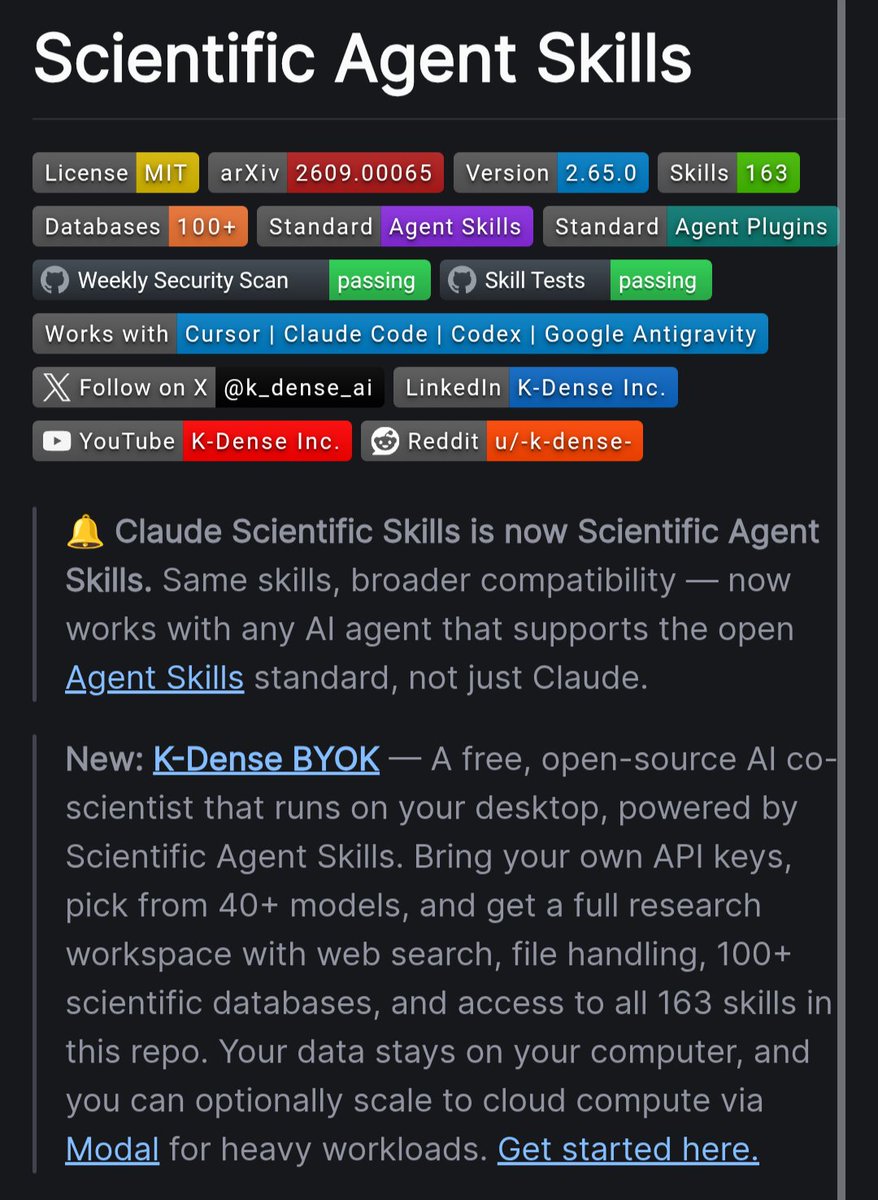
7. Scientific Agent Skills
A collection of specialized skills designed to help AI agents perform scientific research.
One of the more interesting projects if you're exploring AI agents beyond coding.
https://t.co/lVnFW0GysU
8. Orca
An agentic development environment for running multiple coding agents in parallel.
Think of it as giving your development workflow a whole fleet of AI workers.
https://t.co/GsA7Xbsjp0
9. MiniMind
A surprisingly compact project for understanding how modern language models work.
Great for developers who want to learn by actually building instead of only reading theory.
https://t.co/36mwVOOYPl
10. God's Eye View
A visual project exploring how AI can understand and represent complex systems.
A very interesting repository for anyone working around AI visualization and agent workflows.
https://t.co/EYSzVX5HEV
All open source.
Some are useful today.
Some are worth studying.
And some might become huge.
Bookmark this list and save it for the weekend.
you don't win a game by mastering the visible rules, you win by understanding the incentives driving the players.
in this video prof. jiang breaks down the three elements of game theory (players, boundary conditions, and incentives) to reveal how to predict human behavior, read macro trends, and claim sovereignty over your decisions.
in my opinion, no one has explained game theory better than professor jiang.
the framework and key concepts bellow.
Google's former CEO just said what everyone in AI already knows
Building wealth is getting easier if you actually learn the tools
Not by scrolling AI threads
By understanding agents, Codex Code, prompts, memory, skills, MCP, and routines
Save this before it disappears from your feed
Everything below is free:
ChatGPT basics
https://t.co/p1ZEv4vG4f
OpenAI Academy
https://t.co/5AVN9CgCZq
Prompt engineering
https://t.co/gFV0OAXnQo
GPT-5.5 prompting guide
https://t.co/TJOxZ77Y6C
OpenAI API docs
https://t.co/24OlDTxEcA
Responses API
https://t.co/DLnWfUZEUS
Agents SDK
https://t.co/irt7DTJ745
Agents SDK quickstart
https://t.co/Mm2kgeMs39
Tools + function calling
https://t.co/A40Dege36x
Structured outputs
https://t.co/Jawb4njrJa
Conversation state
https://t.co/YkbSXmUk3A
ChatGPT memory
https://t.co/ojhvlLbVWp
ChatGPT projects
https://t.co/Svo7ATFTGc
Custom GPTs
https://t.co/chrd6IBz8L
Tasks in ChatGPT
https://t.co/pIEnCC5K8F
Codex overview
https://t.co/CVPKvEz9MY
Codex quickstart
https://t.co/sKNEmSMCXF
Codex CLI
https://t.co/kUySSiEBL5
Codex GitHub repo
https://t.co/FoiGgP5ash
Codex best practices
https://t.co/E1PtLvDDaj
AGENTS.md
https://t.co/eaAJkQDp4x
Codex skills
https://t.co/OsrLujQnkX
Codex MCP
https://t.co/uHCuY9Ram7
Codex subagents
https://t.co/QboZoCEzHT
ChatGPT Apps SDK
https://t.co/keDQV4wPUp
Apps SDK quickstart
https://t.co/OYKfU6EXaW
ChatGPT developer mode + MCP
https://t.co/iUE04OldHB
OpenAI Cookbook
https://t.co/LxteqEFzWZ
All of this costs $0
Most people will keep asking AI one question at a time
Save this and start learning the stack
The person who built Claude Code just showed exactly how to use it.
This single session is worth more than any $1000 course.
30 minutes. Free. Straight from Boris Cherny himself.
Bookmark this before you forget.
Most people using Claude daily are missing 40+ features hiding in plain sight.