I truly believe in local models.
On my last flight, I used Gemma4 to chat about some of my thoughts. It's fascinating to me that I could do this without any connection and how well it worked.
Local models are slower and not as accurate yet, but they are getting better.
A month ago, I started an experiment and switched my Hermes agent to 100% local. I used a Mimo 2.5 quantization version that fits on my DGX with 128gb ram. It is slow, so I use it for cron jobs and async tasks. The quality is really good and free to run anytime. It has worked without any issues since then.
Never running out of tokens. And no refreshing the OAuth token every few weeks!
What local models are you using?
Not moving countries is like never switching phone plans.
You pay more for the same thing!
I switched phone plans every year. I paid less for the very same service year over year and kept my number. No one noticed.
Same with electricity providers. I wrote a script that filled out the form to switch my electricity provider every 12 months. Again, the very same thing for less money.
I would have never thought that this could be applied to countries too.
A few years ago I moved from Austria to Portugal for the ocean. During tax preparations, I learned about tax incentives that I was not aware of before.
To my surprise, these tax incentives were available for people who were not residents for a certain number of years. So even if your plan is to live in a country, you might be better off leaving for a while and coming back later. Like switching phone plans.
If you hold an EU passport, you have the right to move to another EU country whenever you wish.
Countries with “switching plan” tax benefits today:
Portugal — IFICI / NHR 2.0
20% tax on qualified work income. Foreign capital benefits too.
Reset: 5 years out.
Austria — Zuzugsbegünstigung
30% tax-free allowance on scientific/research income. Limited capital benefit.
Reset: 10 years out.
Spain — Beckham Law
24% tax on work income. Foreign capital benefits.
Reset: 5 years out.
France — Impatriate Regime
Partial income exemption. Foreign capital benefits.
Reset: 5 years out.
Netherlands — 30% Ruling
30% of salary tax-free. No real capital benefit.
Reset: roughly 16 months out of the region.
Sweden — Expert Tax Relief
25% of salary tax-free. No capital benefit.
Reset: 5 years out.
UK — FIG Regime
0% UK tax on eligible foreign income and gains for 4 years. Strong capital benefit.
Reset: 10 years out.
Italy — New Resident Flat Tax
Fixed yearly tax on foreign income and gains.
Reset: 9 of the last 10 years out.
Greece — Non-Dom Regime
Fixed yearly tax on foreign income and gains.
Reset: 7 of the last 8 years out.
I know that moving is hard.
Paying more for the same is easy. I don't like easy.
@jamespotter Great to know! I went last year to Miami.
Bought a new phone, macbook and vision pro!
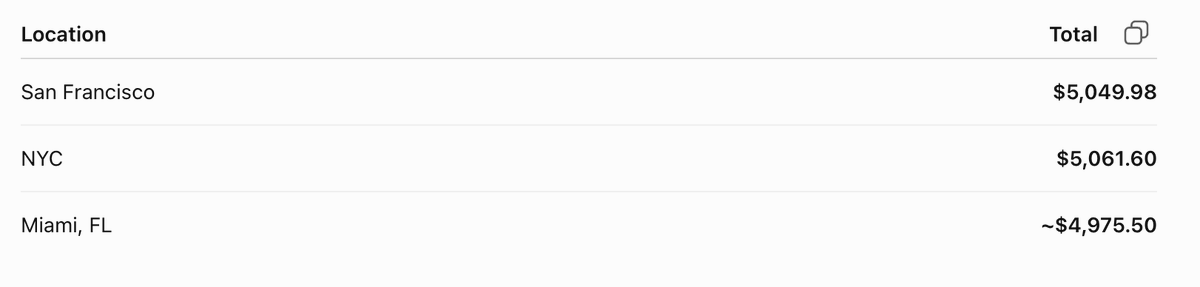
Got the f1 tickets basically for free in tax savings.
Shipping "garbage" is what finally grew my MRR.
I struggled to finish products.
As it turned out, garbage for me was not a bad product for users.
I always found something that needed to be done. A nice button icon was missing. A new bug made it impossible to hit publish.
Annoyingly, I saw indie hackers pushing out products at lightning speed.
I didn't like the products that they were releasing though. I thought they were never gonna be successful. Oftentimes the first replies on their initial launch were bug reports.
By not shipping, and not taking part in the game of finding users, I made the biggest mistake of all.
So I started to push myself and release earlier and earlier.
It was difficult. I was afraid of being blamed for a bad product. I was not happy with the product at all but I pushed anyway.
I went from perfectionist to half-finishing products.
First users started to take a look, and the problems and challenges were not what I thought they would be. I could start to learn and iterate with real users and feedback.
If I could turn back time I would do these 3 things and iterate way earlier:
1. Unlearn perfect icons and stick to ugly emojis
Every icon had to fit in shape and color with the other UI elements.
I tried to use emojis if in doubt. It's not as nice as a well-designed icon, but better than not having an icon at all.
Users were still coming and not complaining at all.
2. Unlearn free, don't even think about freemium and set a price
For an unfinished product, I couldn't get myself to charge money for it.
I tried to convert free users to paid users in the beginning. As it turns out, free users are a different breed.
Set a price right away. This was the best filter that I could get. Serious users started to show up. They not only paid but also gave feedback, and I could iterate with them.
Without money you can't grow and expand your business anyway. Free and Freemium are only for the go-big-or-go-home mentality of huge funding rounds. There is nothing wrong with that, but I believe in profitable businesses from day 1.
3. Trust fellow shippers
I was not trusting the advice of builders, even ones with high MRRs. I thought for a long time that their products wouldn't succeed because I didn't find their designs and products perfect.
As I learned by shipping quicker and less finished, it is easier to find user feedback.
If you find advice from trusted builders whose revenue is proven, follow it. I was questioning it for too long. Use their learnings as a base and grow with it.
You can find verified Stripe revenue through Indie Hackers or TrustMRR. Look for those builders.
I am sure many of us had to unlearn a lot too.
What did you have to unlearn?
The People Who Have Influenced Me in Investing:
I have been interested in investing for a while now. But I owe a lot of the progress I've made to these people:
Charles Ellis — author of Winning the Loser's Game
The comparison of tennis to the game of investing really stuck with me. In professional tennis, the winner is the one with the winning shots. In amateur tennis, the winner is the one who makes fewer mistakes and returns the balls. So I learned that, as an amateur investor, the goal is to minimize costs, taxes, and fees. I learned that index funds are the game that I should be playing.
Benjamin Graham
Warren Buffett studied Benjamin Graham's books and was later a student of his as well. I learned a lot about Mr. Market in Graham's book The Intelligent Investor. I thought for some time that an intelligent investor is one who picks the right companies, but instead it meant having the mental upper hand and staying calm through turbulent times. This helped me to not sell, but rather buy in market corrections.
John Bogle
John Bogle founded the first index fund nearly 50 years ago and made low-cost investing on autopilot possible.
These people have taught me so much—and, just like they did with me, I hope to pass along my own learnings to the next person.
I have been investing in ETFs and stocks since 2015 and manage my portfolio myself. I live off the capital growth and dividends, so it is important for me to be mentally prepared for a recession. That is why I have studied more than 20 investment books in the last 10 years.
Stock market valuations are at an all-time high right now. Warren Buffett is holding record-high cash reserves. Many top investors argue that the market is at a record high, and some predict a crash soon. No one really knows when, or if, a crash is coming — so what should you do?
I set myself a stock allocation target of 50–60%. My stock portion consists mainly of an MSCI World ETF, an MSCI Emerging Markets ETF, and some blue-chip companies. The recent growth of the stock market has pushed my holdings above my limits.
I remember the sentiment during the 2009 crash very well, but I was not invested at that time. I was building a company from zero, so every bit of growth felt new to me, and I had no stocks or ETFs. I also lived through Covid and the 2022 downturn, but both were short-lived. I am fortunate that I stayed the course and did not sell.
My biggest lesson from The Intelligent Investor is that it is very hard to stay the course when you have not experienced a recession that lasted many years, or even decades. That is why I set a comfortable stock percentage.
These tips help me feel okay about a possible recession:
- Re-reading some of my favorite investment books. When I am unsure and too much noise is bothering me, I grab one of my favorite books and read it again.
- Journaling my thoughts and putting my fears on paper. I write down my fears and thoughts so I can come back to them later.
- Using ChatGPT to run simulations of recession scenarios based on my current holdings. This has been the biggest help for me. I let ChatGPT do the math for various outcomes, including what would happen if I reduced my stock positions now. I don't let it make the decision — I use it to work through the possibilities.
My conclusion is that I would survive the worst-case scenarios, and reducing now would trigger taxes. So I decided not to reduce my positions and to stay the course.
Helpful prompt:
Act as an investment committee including Warren Buffett, Ray Dalio, Howard Marks, John Bogle, and Morgan Housel.
Stress-test my portfolio using historical evidence and scenario simulations — not predictions.
Simulate crashes of -20%, -35%, -50%, and -65%. For each, briefly cover:
- Historical frequency and examples
- Main causes
- Approximate years of gains erased
- Recovery time
- Performance of stocks, bonds, cash, and gold
- Likely actions of disciplined long-term investors
- Scenario simulations: portfolio drawdown paths, rebalancing effects, and sequence-of-returns risk
- Tax implications (for simulation comparison only): evaluate the differences between reducing the current portfolio now versus not reducing it, focusing on realized gains/losses, timing of taxation, and effects across taxable and tax-advantaged accounts
Conclude with key lessons and the most resilient long-term portfolio strategy based on history.
My favorite books:
- The Intelligent Investor — Benjamin Graham / Jason Zweig
- The Psychology of Money — Morgan Housel
- The Most Important Thing — Howard Marks
- Antifragile — Nassim Taleb
- The Little Book of Common Sense Investing — John C. Bogle
Happy investing!
I'm bullish on open source AI.
Was paying $15/month for a popular AI voice to text tool.
But switched to an open source one where you download the model to your computer, and everything is done locally.
It's better, faster, more private, and it's free!
I wonder what other subscriptions I can get rid of?
I’m 53% through my 4,000 weeks.
[██████████░░░░░░░░░░] 53%
I just finished reading 4,000 Weeks by Oliver Burkeman, and this hit me harder than expected.
At age 40, I’m on week 2,104 today.
Totaling at 77 years. I’m optimistic that I’ll live longer than that, but maybe the better goal is to outlive your bucket list and still have room to extend it.
For me, seeing it visually pushed me to become more intentional with the weeks I have left.
I used it to rethink what I want to do in the next weeks, the next years, and the next decades.
I now like to print monthly checklists with the things I want to do in the coming weeks, and put a checkmark next to each one.
Here is the prompt I used in Claude Cowork to create the PDFs and schedule a monthly review:
"Build me a 'Life in Weeks' system as printable PDFs: a 4,000-week poster of my life, a monthly Life Sheet (habit grid + weekly compass + budget envelopes), and a fill-in yearly week planner — all generated from plain-text plan files, plus a scheduled monthly review check-in."
Post your percentage below (pls only if you’re further ahead, so I feel better haha).
Many smart people/AI insiders are saying GLM-5.2 is the first Chinese AI model to match and often beat the American big lab public AI models with no compromises. Incredible timing given current events.
@GoldilocksOrbit I agree. It's great if you know what you want already. To find customers for your apps, you first have to learn how to find them yourself, and then delegate follow-ups and reminders using agents.
You don't need an AI agent to start delegating work.
95% of your tasks can be delegated to ChatGPT and Claude.
Since the launch of OpenClaw, I've been addicted to AI agents and have been using them constantly since the end of January.
These self-hosted, open-source agents come with a steep learning curve, security trade-offs, and regular maintenance that you have to handle yourself. I end up consuming more time than the work they're supposed to automate for me.
That's why I recommend starting by delegating smaller tasks with ChatGPT and Claude Cowork.
Scheduled and recurring tasks like:
- Scheduling replies to DMs
- Scheduling social media posts
- Delegating follow-up replies to suppliers
- Automatically cleaning up your computer when storage is running low
- Creating daily short videos from your latest photos
Both ChatGPT Desktop and Claude Desktop now support scheduled tasks, making it easy to delegate recurring work.
Claude Cowork also includes a built-in virtual machine, so you don't have to worry about the code it runs. It integrates with your browser as well, allowing you to grant access to individual tabs on a granular basis.
What makes Cowork comfortable to use:
- Easy-to-use, maintained application
- Sandboxed code execution
- Automatic model updates
- Memory across projects
- Task scheduling
- Chrome integration
If you eventually want to let your AI run more autonomously and tackle the last 5%, then I'd recommend picking up an older Apple Silicon Mac mini or MacBook Pro and installing OpenClaw and Hermes. Paperclip to build an AI team of agents.
Why I'm using local models:
I bought an nvidea DGX and use it for my hermes agent (like openclaw but written in python).
Here are a few reasons why:
- Privacy-focused (I can experiment with bank statements etc.)
- Never running into 4-hour limits
- Free to run 24/7
Over the next 30 days, I plan on writing about local setups, my setup, and models.
Join me on this adventure—and let me know if you have any questions along the way!
I'm excited to start sharing what I learn about it.