Nunca faça essas coisas com pressa:
1. Comer uma boa refeição
2. Tomar decisões importantes
3. Julgar o caráter de alguém
4. Escutar um amigo que precisa de ajuda
5. Se apaixonar
6. Criar expectativas
7. Dar sua confiança a alguém.
That’s it.
It’s not about “figuring it out.” I literally make a living from the market, lol. But I think you’re going to continue ignoring the fact that there are multiple reasons why people seek out these products, simply because those reasons aren’t important or convenient for your argument. Who cares, right?
Good for you that you know how to press “sell” to generate your income. However, I don’t know if you’re aware of how this actually works.
Every time you actively trade a position enter, hold, exit, and then re-enter you’re essentially assuming you can be right multiple times: when to get in, how long to hold, when to take profit or exit, and when to re-enter that position or move into a different one.
Meanwhile, someone who simply wants to get in, hold, and collect the premium only needs the core thesis to be right. Can you see why that might be easier for the average person?
And every time you repeat that trading cycle, especially if you generate your income through active trading like you said, you’re assuming you’ll continue making those decisions correctly over and over again. If you actively trade, you already know that’s not easy. You also have to factor in taxes and transaction costs associated with frequent trading.
Most people simply don’t have the skill set, the time, or the desire to spend a significant portion of their lives doing that. There can be many reasons, but they may still want income from their investments.
Should those people be excluded from the market simply because they don’t want to constantly trade but still want distributions?
Again, good for you if you can do it on a daily basis. I do it myself too. At the same time, I build positions that generate income because eventually I don’t want to spend my entire fucking day analyzing charts and looking for trades. Plenty of other people are doing the same thing for different reasons.
I’m sorry to be the one breaking this down for you, but the world doesn’t revolve around you, what you do, or what you want. That’s exactly why the market offers different products for different investment objectives, strategies, risk tolerances, and types of investors.
You’re comparing pure growth funds with a hybrid fund. They have different objectives. Even though $BLOX seeks upside participation, it also has a distribution and options strategy that directly affects its equity exposure and overall risk/return profile.
Your comparison is like criticizing SCHD for underperforming SPY during a growth led rally. Sure, you can compare their performance, but judging SCHD as if it were designed to accomplish the same objective as SPY completely ignores why the fund exists in the first place. Just because some companies held by SCHD are also in SPY doesn’t mean the two funds are pursuing the same objective.
Different funds, different strategies, different risk/return profiles, and different types of investors.
If I wanted pure growth exposure, I’d simply invest in a pure growth fund. Isn’t that obvious?
Under a specific time frame, you can make absolutely anything look bad. It doesn’t matter if it’s the Qs, metals, bonds, dividend stocks, or emerging markets.
But let’s actually break down the data.
From inception through mid-October, $BLOX delivered roughly a 41% return. Then, during the peak of the bear market, thanks in part to the AI equity sleeve and the way the fund managed its positioning, $BLOX experienced a less significant drawdown than $BTC, $IBIT, and many other crypto/BTC related funds.
That was followed by another roughly 31% gain, driven largely by AI equities, while BTC and several crypto related funds were basically moving sideways.
So the fund has existed for about 14 months. During two major windows, it delivered strong gains, and during another major window, it provided meaningful downside protection. Is that really “always being shitty” to you? I genuinely wonder what your definition of good performance is. You must be one hell of a trader better than the rest of us.
A lot of people also criticized $BLOX and @DavidANicholas for not capturing the full upside of the most recent rally. But it still participated meaningfully, while the portfolio was positioned with hedges against a potential full retracement and further downside. On top of that, miners barely participated in the rally at all.
And if you actually look at previous crypto bear markets, summer rallies of roughly 25–43% are not unusual, and many of them eventually gave those gains back in the following months.
Until BTC breaks and holds the $83K level with real follow through, strong volume, and meaningful spot buying, I don’t see why a professionally managed fund should suddenly go fully long and remove its hedges.
If you guys want to trade like retail and chase every move, go for it. But don’t expect the same behavior from a fund manager whose job is to manage risk across different market regimes.
For God’s sake, I’m completely open to debate and criticism. But if we’re going to have that discussion, at least start from a place of intellectual honesty and use actual data.
I don’t know what’s going on with some of these so-called “influencers,” but at this point, the constant goalpost moving changing the subject, changing the comparison window, and changing the narrative just to find another reason to attack the fund without presenting substantial data driven arguments makes it increasingly difficult to see it as objective criticism.
It starts to look like clear bias or personal motivation.
And at this point, it’s getting really lame.
Not daily, because it makes no sense to have an active management team if I’m going to do everything myself on a daily basis. However, I have a tab on Robinhood with every $BLOX holding in case I need to do a quick check.
During the weekend, when I’m not actively trading, I do a deep dive into every holding and active trading position in my portfolio to decide how I’m going to approach the week ahead.
I also have a pretty good understanding of macroeconomics and how it affects different asset classes and the trades I take. So, during the week, I actively keep track of everything I’m trading, while I review my other positions more thoroughly over the weekend.
But I’m constantly on top of what’s going on so I can judge whether the thesis remains intact, whether my risk management is appropriate, and whether I need to trim, add to, or exit any position.
I may not be 100% accurate all the tim, but I have a solid understanding of what’s going on, why I’m positioned the way I am, and why a fund or position is performing the way it is during a particular period. When you combine all of that macro data, fundamentals, charts, sentiment analysis, and retail positioning it gives me a framework for making decisions.
Like I’ve said on my profile before, my trading strategy is essentially betting against retail when I believe the crowd is wrong, while using fundamentals, macro, and technical analysis to validate the trade.
I’d say that gives me a level of understanding above the average person on X, and more importantly, it gives me the conviction I need to manage my trades/and the fund managers I delegate those trades to and trust with my money and that includes $BLOX and @XFunds_
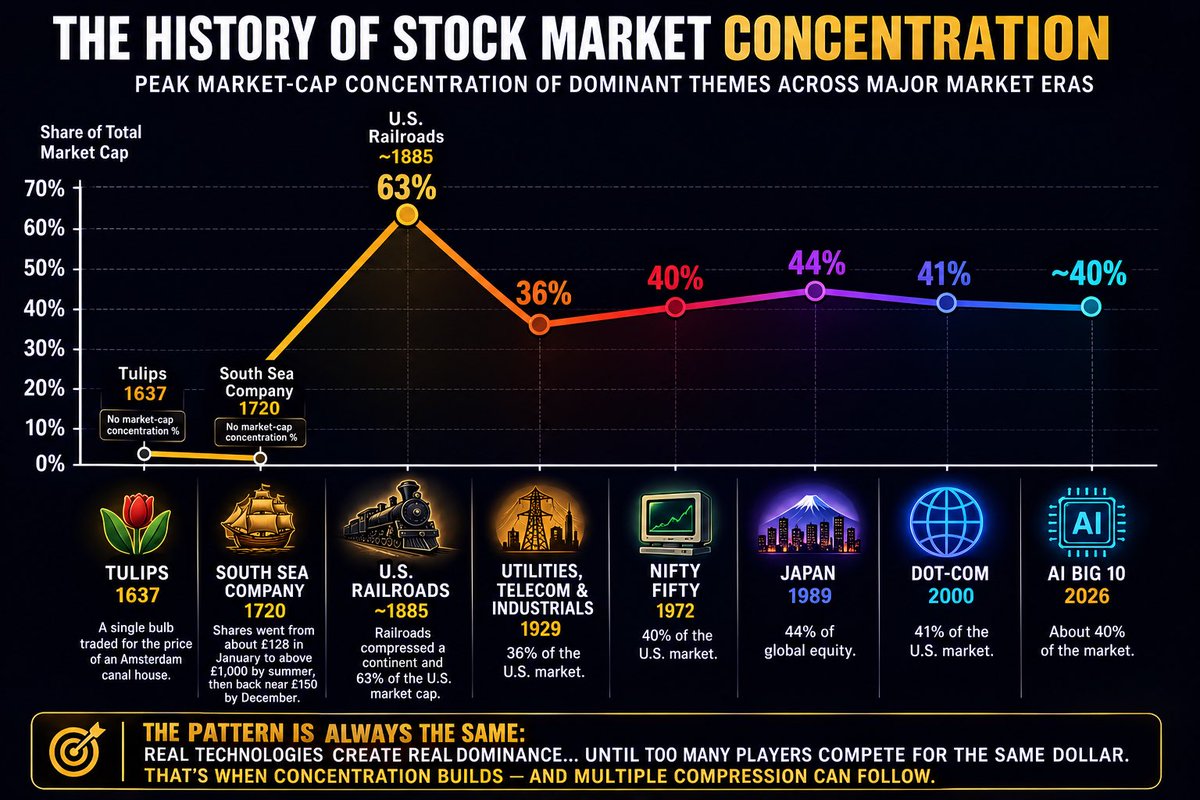
Railroads were once 63% of the entire U.S. stock market.
Not 63% of transportation stocks. 63% of the market.
The history of market concentration rhymes:
Tulips, 1637: a single bulb could reportedly trade for the price of an Amsterdam canal house.
South Sea Company, 1720: shares went from around £128 in January to above £1,000 by summer, then collapsed toward £150 by December.
U.S. railroads, 1840s: around 63% of U.S. market cap.
Utilities, telecom and industrials, 1929: around 36%.
Nifty Fifty, 1972: around 40%.
Japan, 1989: around 44% of global equities.
Dot-com era, 2000: around 41%.
AI/Big Tech today: approaching 40%, depending on how you define the group.
Almost every one of these episodes was built around something real.
Railroads really did compress a continent. Electricity transformed civilization. The internet really did rewire commerce.
Being right about the technology was never what protected investors from paying the wrong price.
Even the tulip story is less clean than the legend. Modern research suggests the broader economic damage was relatively modest and much of the popular story was exaggerated later.
Now look at the MAG7:
AAPL: consumer ecosystem
MSFT: enterprise software
GOOGL: information/search
AMZN: commerce + cloud
NVDA: AI compute
META: social attention
TSLA: EVs, energy and physical-world AI
This is what makes the MAG7 so unusual.
You’re not simply buying seven tech companies. Collectively, you’re getting exposure to consumer devices, advertising, cloud infrastructure, enterprise software, e-commerce, AI compute, social media, entertainment, automobiles and energy storage.
Six of the seven also have enormous existing businesses, powerful moats and significant recurring cash flows. Tesla is more dependent on automotive revenue and future optionality.
But here’s where it gets interesting.
These businesses are becoming increasingly interconnected and increasingly competitive.
Microsoft, Meta, Amazon and Alphabet are enormous Nvidia customers.
Amazon, Microsoft and Google compete for cloud workloads.
Meta and Google compete for advertising dollars.
Apple and Google control major mobile ecosystems.
And virtually all of them are pouring enormous amounts of capital into AI.
Their apparent diversification starts shrinking when the same factor, AI CapEx and future AI monetization, increasingly drives their valuations.
The crucial transition is from complementary spending to competitive spending.
Eventually, these companies aren’t just expanding the AI economy. They’re competing with each other for the same marginal dollar.
And that’s where shareholder economics can change even while the technology succeeds.
Revenue goes up.
EPS goes up.
FCF goes up.
But at the same time, CapEx and depreciation increase, competition intensifies, expected margins decline and incremental ROIC deteriorates.
The businesses don’t have to collapse.
AI doesn’t have to fail.
The market simply has to decide that a business once deserving 35x earnings because of extraordinary growth and monopoly-like economics now deserves 24x because growth has become more capital-intensive and competition is increasing.
That’s multiple compression.
And when a handful of companies represent an enormous percentage of the index, multiple compression in those companies becomes an index-level problem.
That’s why I don’t think the biggest risk to the AI trade is that AI fails.
AI could succeed beyond almost everyone’s expectations while some AI investments still produce mediocre shareholder returns.
Railroads changed America.
The internet changed the world.
Neither technological revolution guaranteed that every price investors paid to participate in it was rational.
The bubble was never necessarily in the idea.
It was in how many people decided to own the same idea, at the same price, at the same time.
Every scary moment of the last 27 years is on this one chart. Follow with me...
The dot com crash... $QQQ fell 75%. 13 YEARS to break even. The worst stretch in its history & the reason I never buy at any price & never over leverage.
2008... crushed again. Financial system collapse. Recovered.
2020... the world literally closed. Circuit breakers. Recovered in months.
2022... down 36%. "Lost decade" headlines everywhere. All time highs a year later.
This past year alone... a drop to about $552 & a new high at $748.
& through ALL of it... roughly 20% a year over the last decade.
Two things are true on this chart at the same time, & you need to understand both:
The market punishes anyone who overpays & over leverages... sometimes for a decade.
& it has rewarded every single person who bought quality at fair prices, kept ratios in check, & only did options when it was compelling to do so.
LEARN FROM THIS.
Another sucking of liquidity incoming, despite basically every macro signal screaming at us to stay alert.
To me, these IPOs with insane, unjustified, and largely unproven valuations are one of the biggest red flags that we may be getting close to the top of this cycle.
That doesn’t mean the market is necessarily going to correct right after the Anthropic and OpenAI IPOs it could but I wouldn’t be surprised if we entered a bear market sometime soon, or at least got a meaningful correction that brings valuations back to healthier levels before the market continues climbing higher.
The problem with the “healthy correction” thesis is the potential domino effect.
We’re already trapped between debt, inflation, housing, credit, private equity, Treasuries, and pressure on the dollar. Everything is interconnected and under stress, and it’s impossible to save everything at the same time.
Like Jamie Dimon once said: “When you see one cockroach, there are probably more.”
Something eventually has to give or break. How much that break impacts everything else will determine how severe the damage is and how long it lasts.
That’s why I can’t emphasize enough how important risk management and hedging are in the current market and economic environment.
We’re betting way too heavily on AI and robotics magically fixing all our problems. Historically, major technological disruptions come with a period of adaptation and often an economic reality check after excessive hype. First we hype the technology, then expectations crash into reality, and only afterward do we begin collecting the real long-term benefits. We’ve seen versions of this pattern for centuries.
Probably one of the most dangerous phrases in finance and economics is: “This time is different.”
Well, I’m more inclined to believe that human psychology and therefore market psychology isn’t suddenly going to change.
So I’m bullish on the future, but cautious about the path we take to get there: managing risk, hedging positions, hoping for the best, and preparing for the worst.
LOL, bro is an elite grappler with a 100-lb weight advantage and is 8–9 years younger. What’s with all the celebration? The only reason it lasted 60 seconds is because it was DJ…
Weight divisions exist for a reason, and the impact is even greater when it comes to grappling.
If it were some random blue belt doing this, I’d be very impressed. But it’s FUCKING KHAMZAT CHIMAEV. 😂
I genuinely don’t understand why people are so impressed by this.
Lista de gente que não deveria poder votar:
1) Quem farma aura
2) Não bota os pesos de volta no lugar na academia
3) É grosso com garçom/porteiro
4) Trai em relacionamento
5) Quem recebe mais dinheiro de imposto do que paga imposto
Aceito sugestões
I really don’t understand what point you’re trying to make with all of this.
You clearly cherry-pick the timeframes you use in the charts to make one fund look better than another. When you don’t do that, you rely on recency bias and ignore the fund’s overall performance to better suit your narrative.
You also keep bringing up leverage when put credit spreads have clearly defined risk, potentially much lower than funds that are leveraged 1:1 BTC/stocks or BTC/gold. Nothing against those funds, but they’re clearly more leveraged and carry significant risk. And when that comparison doesn’t work, you switch to comparing it with pure BTC plays.
Look, I’m not married to any asset or fund manager. In fact, when $BLOX was released, I was in multiple posts asking the exact same question: “30%+ yield looks insane, but how is this strategy going to perform during the bear market we’re likely to face soon?”
Fast-forward: we got the final push higher and eventually the downturn. In both environments, the data so far shows that the strategy worked: the fund captured a meaningful portion of the upside, reduced the downside, and paid the yield along the way.
That being said, I don’t know if you have something personal against @DavidANicholas or the fund itself, but the arguments you’re making and especially the specific windows you’re choosing to support them are coming across as extremely biased. It doesn’t look like an objective search for “the truth” or an attempt to protect investors when you selectively use the data that supports your argument while ignoring data that doesn’t, or use even more leveraged funds as the “standard” for what a good fund should look like.
If the goal is genuinely to evaluate the fund objectively, then use consistent timeframes, comparable strategies, and the same risk-adjusted criteria for everyone.
I find the “victim mentality” some people have around markets really interesting.
A man or a private entity Ken Griffin or Citadel, for example expresses an opinion about the market, and suddenly people want to blame them for whatever consequences follow.
You can argue, “But it creates FOMO,” “It influences sentiment,” “People followed what they said,” etc. Sure. Someone with that level of influence can absolutely move sentiment and even prices in the short term.
But influence ≠ manipulation, and market impact ≠ wrongdoing.
Unless someone is deliberately spreading false information, engaging in fraud, or using deceptive practices to manipulate prices, expressing a bullish or bearish market opinion is simply that: an opinion.
And when it comes to Leopold, if the fund was excessively leveraged, concentrated, or poorly positioned for the move that followed, that’s ultimately a risk-management failure. That’s on the person managing the portfolio.
Now, I wouldn’t say everyone operates on an equal playing field. They don’t. Institutions have better access to information, liquidity, financing, execution, technology, and sometimes significantly greater ability to influence markets.
But every investor still controls the most important decisions involving their own capital: buy, sell, hold, hedge, position size, use leverage or don’t.
Ultimately, you’re responsible for pulling the trigger and, more importantly, for determining how much you can lose when you’re wrong.
Markets can remain irrational or mispriced for much longer than expected, but over time, competition and arbitrage tend to correct significant mispricing. The problem is that if you’re overleveraged, you might not survive long enough to be proven right.
That’s why fundamentals, charts, data, position sizing, and risk management exist: to help you filter out the noise instead of blindly reacting to whoever is talking the loudest.
If someone’s opinion is enough to make you FOMO into a position, overleverage yourself, or abandon your entire strategy, active trading probably isn’t for you.
Buy an index and chill.
This game is ruthless. Being right eventually isn’t enough you have to manage risk well enough to still be in the game when you’re right.
Citadel and Ken must be stopped.
They caused the fear.
They stopped everyone
This is where they bought
Then they erased the fear and said "BUY"
This caused FOMO move up
Exactly where they were selling
So they made many years worth of profits in two weeks fucking with people.
Got it.
@GronkyTonkMan58@DavidANicholas Same. Gotta see the distribution first, but I’m planning to make it a core position alongside VTVX, which I see more as a defensive/diversification play. I strongly believe VGT and VGTX will continue to outperform QQQ and the overall market over the long run.
Talvez a característica que eu mais goste em mim mesmo seja minha total desilusão e conexão com a realidade. Para muita gente, isso pode parecer arrogância. Mas eu vivo de uma maneira em que o medo não me paralisa, desafios me motivam, pressão me aprimora e eu encaro absolutamente tudo como algo possível o que não significa que seja fácil ou que eu vá, de fato, realizar tudo.
Porém, eu genuinamente acredito em tudo o que faço e que vou conseguir realizar, por mais absurdo que seja o objetivo ou a ideia.
E, por consequência, isso gera dois desdobramentos.
O primeiro é que isso é contagioso. As pessoas próximas a mim passam a pensar de forma semelhante: a não desistir até alcançar aquilo que se propuseram a fazer ou, no mínimo, até terem dado 100% de si.
O segundo é que, sendo assim, a facilidade com que se “vira a página” e se encerram fases e ciclos é absurda. Porque não existe a ideia do “e se?”. Simplesmente houve entrega e devoção total, de maneira que a única coisa que resta é a certeza:
“É, eu consegui.”
Ou, no pior dos cenários:
“É, eu fiz absolutamente tudo o que podia.”
Quando paro para refletir sobre todas as fases e tudo o que vivi até aqui, vem a paz e a consciência tranquila de quem não deixou assuntos pela metade. De quem nunca ficou sem saber até onde poderia ter ido.
What a hell of a ride. 🤌🏻