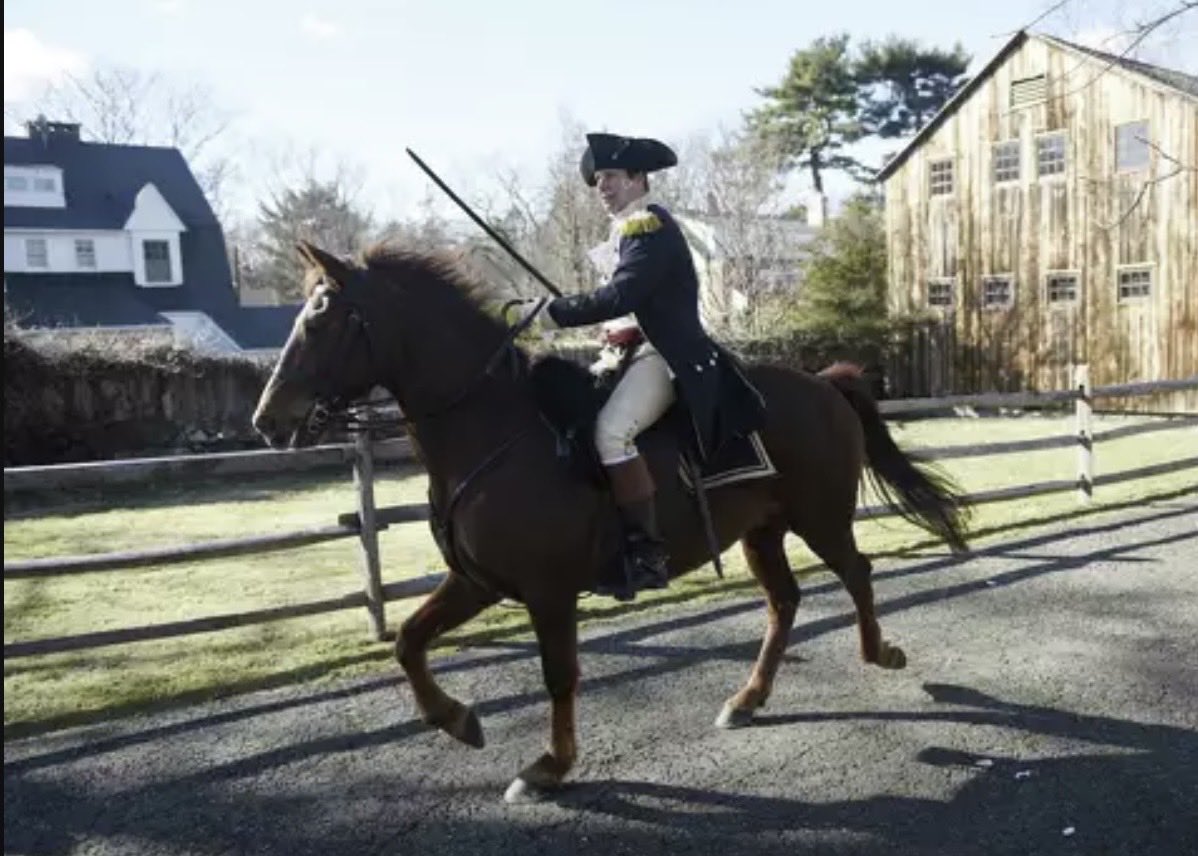
Timing is everything - especially when it comes to taking down a deeply embedded Fifth Column in our institutions. When laying an ambush, you don't shoot the moment some of the enemy becomes exposed. As the order was given during the Battle of Breed's (Bunker) Hill)... "Hold steady lads, and don't fire until you see the whites of their eyes!"
When it happens, it will be unexpected, lightening fast and done with unprecedented force and scope.
Hold the line.
We should all try to set a recurring reminder that what happened to our military wasn’t some changing of the political winds from one party to the next.
It was, by textbook definition, an attempted Marxist takeover of the institution.
The DEI, wokeness, lawfare, etc.
These are not simple character quirks from an election switching power over. I mean, they look like it on the surface. But they’re not.
We’ve desensitized ourselves to it. Which is exactly their plan. But it should never be perceived as normal.
Why do you think I come unglued like a vegan atheist college student from Berkeley at a church BBQ when I see it?
When I see the “leaders” divide us and the media try to shame us into supporting it, yes, I come unglued.
And you should too.
The whole reason why we’re in this mess is because we let them run roughshod without consequence for too long.
My fellow brothers and sisters: You all swore an oath. It is your duty to BECOME that consequence in the face of what aims to destroy you and your countrymen.
@drawandstrike Fifth Column Saboteurs run deep throughout our government and institutions. AI enabled forensic auditors like this is dismantling and exposing their networks in real time.
On this night in 1781, one man on a horse saved the American Revolution from losing Thomas Jefferson, Patrick Henry, and half of Virginia's government in a single morning.
You were never taught his name.
June 3, 1781. The British had chased Virginia's entire government out of Richmond. Jefferson, in his final days as governor, and the legislature had fled to Charlottesville, thinking they were safe in the foothills.
They were wrong.
That evening, 26 year old militia captain Jack Jouett was at a tavern in Louisa County when roughly 250 of the most feared cavalry in the British army came pounding down the road. Their commander: Banastre Tarleton, nicknamed "The Butcher," the man whose dragoons had cut down surrendering Americans at Waxhaws.
There was only one place they could be going. Charlottesville. 40 miles away. And the capture of Jefferson, the author of the Declaration of Independence, would be the prize of the war.
Jouett couldn't outrun them on the main road. So he didn't use it.
He swung onto overgrown backwoods trails and the abandoned Old Mountain Road, riding 40 miles through the dark with only the full moon for light. Legend says low hanging branches whipped and scarred his face for life.
Tarleton stopped his men for a 3 hour rest. Jouett never stopped.
Before sunrise on June 4, he came up the mountain to Monticello and woke Jefferson. Then he rode down into Charlottesville and warned the legislature.
Jefferson got out with minutes to spare. British dragoons were coming up his mountain as he left. The legislature escaped over the Blue Ridge to Staunton. Tarleton caught only seven stragglers, one of them a frontiersman serving in the legislature named Daniel Boone.
Paul Revere rode about 12 miles in 1775 and got captured before reaching Concord. Longfellow wrote him a poem and made him immortal.
Jack Jouett rode 40 miles, lost nothing, saved everything, and got a thank you gift of two pistols and a sword from the Virginia Assembly.
No poem. No fame. Almost no memory.
Per Grok: "Openly homosexual people in Revolutionary-era Boston (roughly 1770s) faced severe legal prohibition, intense social stigma, and strong religious condemnation, making public openness extremely rare and dangerous. Same-sex acts were criminalized under longstanding colonial laws, rooted in Puritan biblical interpretations, though actual prosecutions were infrequent compared to the harsh penalties prescribed. https://t.co/KRHZjiWDja
Legal Framework
Massachusetts Bay Colony (which included Boston) had sodomy laws dating back to the 1630s–1640s. These drew directly from Leviticus in the Bible, declaring that “if a man lyeth with mankind, as he lyeth with a woman, both of them have committed abomination; they both shall surely be put to death.” Similar provisions covered “buggery” (often including bestiality). These remained capital offenses into the Revolutionary period. https://t.co/rkwzhYmOwd
• The 1780 Massachusetts Constitution retained sodomy as a crime, based on English precedents like the Buggery Act. https://t.co/KRHZjiWDja
• The death penalty for sodomy was not removed until 1805 (replaced by imprisonment and hard labor). https://t.co/KRHZjiWDja
• Enforcement required strict evidentiary standards (often two witnesses), which limited convictions. Historians note that while laws were severe, prosecutions for sodomy in New England were relatively rare overall, with only a handful of executions across the colonial era. https://t.co/QAjcp4bc91
Related behaviors, such as “lewd and sodomitical practices” or cross-dressing, could lead to whipping, fines, public humiliation, or banishment. There were occasional cases involving cross-dressing or gender nonconformity in the broader colonial period (e.g., a 1771 Boston assault case tied to perceived cross-dressing). https://t.co/KRHZjiWDja
Social and Cultural Attitudes
Boston was a deeply religious, Puritan-influenced city where sexual activity was ideally confined to procreative marriage within heterosexual norms. “Sodomy” was viewed as an abomination that could invite divine wrath on the community, reflecting broader concerns about moral order during times of political upheaval. https://t.co/KRHZjiWDja
• Open expression was virtually nonexistent: Surviving records show no prominent “openly homosexual” individuals or couples in Revolutionary Boston. People who engaged in same-sex relations (if at all) did so discreetly to avoid ruin. Terms like “sodomite” or accusations of “vicious and immoral behaviour” were weapons for character destruction. https://t.co/spl1I3FWnY
• Military and broader Revolutionary context: In the Continental Army, Lt. Gotthold Frederick Enslin was dismissed in 1778 for homosexuality—the first known such U.S. military case. British forces had courts-martial for similar accusations (e.g., chaplain Robert Newburgh’s 1774 trials involving buggery rumors, though not in Boston). Americans showed somewhat less zeal for prosecution than the British, with emerging Enlightenment-influenced tolerance in some quarters. https://t.co/spl1I3FWnY
• Broader evidence: Executions and trials were sporadic earlier in the colonial period (e.g., rare 17th-century cases). By the late 18th century, enforcement appears to have been even lighter amid revolutionary priorities. https://t.co/WqbWLt1ZCH
Everyday Realities
Most queer individuals (in modern terms) lived hidden lives, married heterosexually for cover, or faced ostracism, job loss, violence, or legal peril if discovered. “Boston marriages” (close female friendships that might have included romantic elements) are sometimes discussed in later contexts, but evidence for the Revolutionary era is limited and interpretive. https://t.co/9dr1e57hfH
In short, Revolutionary Boston offered no public space for openly homosexual identities. Laws and society treated such acts as grave sins/crimes, though the chaos of war and shifting republican ideals may have begun subtly loosening enforcement in practice.
This is another part of the army of Saboteurs who are trying to destabilize our country. Fifth Column operatives whose funding and organizational underpinnings are clearly exposed by @DataRepublican. Amazing insights!
X is censoring our Right To Know campaign. Monday's post got 5k views, Tuesday's post got 300. CT SOTS 'misinformation' censorship is still active, per my FOIA hearing, through National Association of Secretaries of State. This is why we launched the digital billboard in Hartford for the month of June. Please share the posts when you see them, especially to FB if you're on there. Citizens have a right to know!
@KristiTalmadge@Kimberl63981557 I knew the owner of the flight school at that time because I had my business office down the hall from him. He was adamant the student tried to suicide them both.