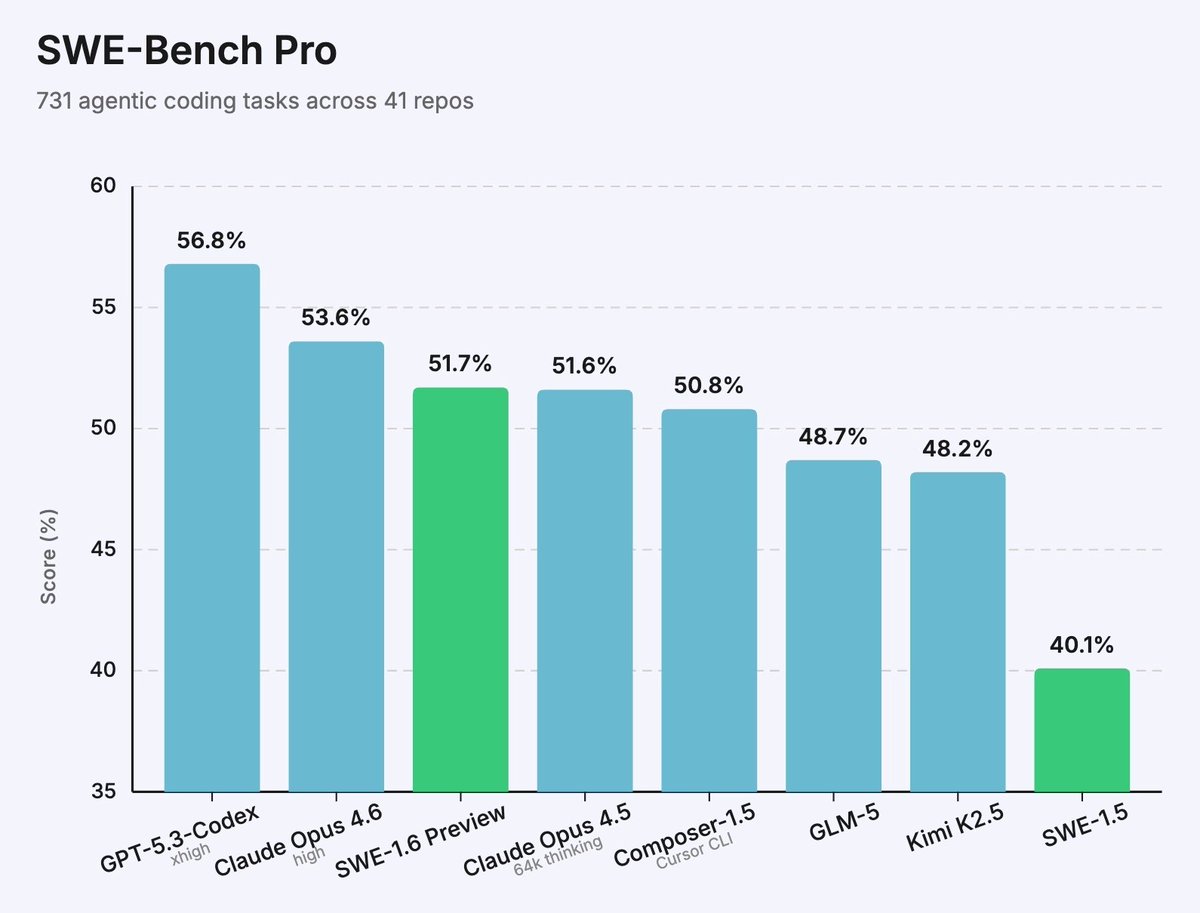
We are sharing an early preview of our ongoing SWE-1.6 training run.
It significantly improves upon SWE-1.5 while being post-trained on the same pre-trained model - and it runs equally as fast at 950 tok/s. On SWE-Bench Pro it exceeds top open-source models.
The preview model still exhibits some undesirable behaviors like overthinking and excessive self-verification, which we aim to improve. We are rolling out early access to a small subset of users in Windsurf.
Introducing Arena Mode in Windsurf: One prompt. Two models. Your vote.
Benchmarks don't reflect real-world coding quality. The best model for you depends on your codebase and stack. So we made real-world coding the benchmark.
Free for the next week. May the best model win.
Here is a good example why we will never get to 100% on the verified set of SweBench from @OpenAI:
"django__django-10999" is "undoable" because the problem statement omits key behavior changes that are tested in the FAIL_TO_PASS test cases
Introducing SWE-grep and SWE-grep-mini:
Cognition’s model family for fast agentic search at >2,800 TPS.
Surface the right files to your coding agent 20x faster.
Now rolling out gradually to Windsurf users via the Fast Context subagent – or try it in our new playground!
cognition has been ripping while maintaining the highest talent bar: since 1 year ago, revenue has grown more than 100x – but our core engineering team is still only around 30 people
we're hiring exceptional people in any role but I wanted to highlight two roles in particular:
- product design: cognition is known for many things but not (yet!) for its design. we're looking for a world-class designer to change that
- research & RL infra: we have a small & excellent research team and lots of compute. looking for researchers who can own large scope across product x models x infra
ok life update: i'll be joining @Cognition!
• Cog just went from 0 to $10b in 2 years
• Net burn $20m in company history
• Avg successful Devin impl sees >5x growth, $1.5m/yr customer expanded >10x in 8 months (not typo)
• Windsurf x Cog cross sell going great, looking fwd to cross build. Lighthouse customers in every vertical.
• Windsurf's polish + Wave 13/14 are looking v HYPE! more work to do on Windsurf Tab
Here's the 5 decision points I had to cross to "buy" Cognition's rise as an Agent Lab that has the potential to be as dominant in the Decade of Agents:
• Short Code timelines, Long AGI timelines
• The rise of Agent Labs
• Owning the Sync/Async spectrum
• Start high, go low
• Cracked Engineers + Ramped GTM
This is probably TMI but I like to record thoughts in public so I can learn when I am wrong, and for others to follow along. Happy reading, in reply tweet.
also: Most of @smol_ai capital base is rolling over to Cognition's round today. I'll be returning the rest. AINews and SmolTalk will remain my passion projects.
I will continue to operate @aiDotEngineer and @latentspacepod ferociously independent of Cognition. All Cognition competitors were given ample heads up + red carpet to AIE CODE. Ben and I are BEYOND excited to have Lia step up as the new General Manager of AIE!
We’ve raised over $400M at a $10.2B post-money valuation to advance the frontier of AI coding agents.
The round was led by Founders Fund with other existing investors including Lux, 8VC, Neo, Elad Gil, Definition Capital, and Swish VC all doubling down. We’re also joined by new investors including Bain Capital Ventures and D1 Capital.
Two of our early investors, Christian Lawless of Conversion Capital and Emily Cohen of Neo, have even joined our team full-time.
To put it mildly, the past week at Windsurf has been crazy. There have been a lot of different rumors and reports, so I want to share a transparent account of how it actually went down.
Before I start, I just want to say that Varun and Douglas were great founders and this company meant a lot to them, and it should be acknowledged that this whole situation must have been difficult for them as well.
One week ago, last Friday, I walked into the office for our all-hands, where our ~250 people were expecting to hear that we were getting acquired by OpenAI. By that time, I had already learned what was really about to happen and had broken the news to Graham, the new President, and Kevin, the new CTO. You can imagine the shock when the team found out.
It was my job to explain to the company our path forward as a company. In my view, there were a few options: try to raise more money (VCs were offering), try to sell the company (we had interest from multiple parties), try to distribute (although there were liabilities to wind down), or try to keep running the company. Although we had lost some great people and taken a serious blow to morale, we still had all of our IP, product, and strong talent including an excellent GTM machine - the core components of the company were still there.
The mood was very bleak. Some people were upset about financial outcomes or colleagues leaving, while others were worried about the future. A few were in tears, and the Q&A had been understandably hostile. In distress, people asked if we could distribute the cash immediately, but we also needed it to pay bills and keep the product working for customers.
After trying to steady the team as much as we could, Graham and I spent the rest of the evening on calls, trying to identify every available option.
Out of the blue, we got a text and email, from Scott and Russell, with the message, “Chat?” It was around 5:30pm, exactly this time last week.
I immediately called Graham and told him I thought this combination made sense. Cognition had been the one team our people had respected the most. While they had overinvested in engineering, they had frankly underinvested in GTM and Marketing, and our teams in those functions are nothing short of world class. On the other hand, we now were missing a Core Engineering team, and there’s no better group of AI engineers than the lineup Cognition has assembled.
Then, there was the product logic. Devin would benefit from a foreground synchronous agent, while we needed a remote asynchronous agent. The teams and products together would be able to create an unrivaled end to end platform.
We took the Cognition approach very seriously from the start and launched right into negotiations. Scott and his team moved fast, and while the timeline was exploding with memes and commentary between Friday and Monday, Scott and Russell spent that time in our office, working tirelessly to get a deal done in record time. Saturday rolled in, and I brought Kevin to the office. At this point, we were still having 1:1s with our enterprise engineers to retain them, and at the same time, we were trying to get more information to diligence Cognition while reviewing other potential partners.
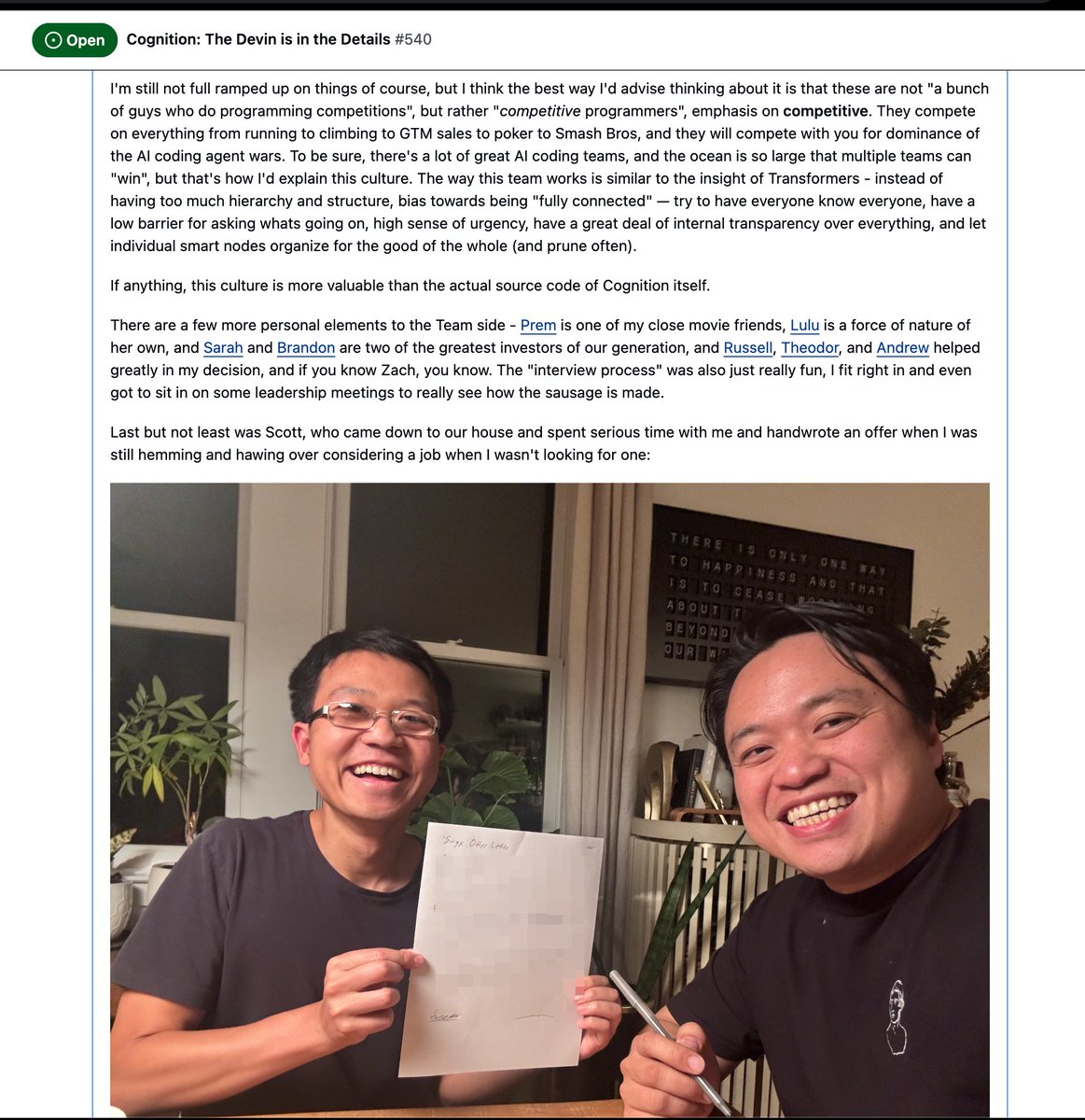
Saturday, I was still getting inbound interest from potential acquirers, including one we had all looked up to for a long time. But by then, Scott was already in our conference room with physical papers to sign and was handing me a pen. We had already made up our minds that there was no better partner than Cognition, even with other excellent and impressive companies interested. We quickly brought in lawyers to review the LOI and signed that day, a little over 24 hours after Scott’s cold outreach.
Saturday had been spent understanding each other’s businesses, and when the sun came up Sunday morning while we were in the office, we prepared to move on to getting the deal finalized. The Windsurf team had been through too many twists and turns, so both Scott and I felt that the next transition for them had to truly be final.
The other priority during this process, which Scott and I aligned on and was one of the things that helped me realize he was the right partner, was that we needed to take care of all Windsurf employees. Their work and talent had gotten us to this point; they deserved to be paid for that, and we wanted to give them a better price than any of the previous scenarios. That resulted in a key part of the deal: structuring it to give a payout to every employee, to waive all cliffs, and to accelerate all vesting for Windsurf equity.
On Sunday, an army of lawyers from both sides descended on the office, having been challenged by Scott and Russell to get this deal finalized within 24 hours. We ate and slept (or at least tried to grab quick naps between discussions) in the office through the weekend to get it done. Our teams and lawyers stayed up all night Sunday working out the final details. On Monday morning, we went over every detail again, got board approvals, and the documents were ready to sign. One of our lawyers said it was one of the fastest deals they’d seen.
Monday 9:30am, we signed our definitive agreement for Cognition to acquire Windsurf. Scott had given a heads up to Cognition employees, and we had another all-hands scheduled for Windsurf employees at 10am that morning. After the traumatic announcement on Friday, Scott and Russell wanted us to be able to open Monday with good news and we wanted to handle this new announcement in a much better way for employees. In fact Russell took a red eye the night before and somehow made it to the Austin office just in time.
We held Monday’s all-hands in the same room as Friday’s, and this time Scott was by my side at the front of the room. It was a blur, but the highlights I’ll always remember were getting to tell employees what we had negotiated for them (“We’ve decided to give you 1 year of vest, OH, and years 2, 3, and 4 as well!”) and Scott saying, “A founder goes down with the ship.” The applause from our people seemed to last forever, and I was on the verge of tears myself.
Now comes the real work. We are officially one company, operating as two entities, but with much to do both internally and externally. We have work to do on both our team and on our product, to realize our shared ambitions. It was a wild ride this week, and now the story has been told. We are excited to move on to the next chapter. We’re putting our heads back down to focus on building the future of AI together.
Claude Sonnet 4 is back via first party support from @AnthropicAI!
Available at 2x credits (limited time discount) per request for Pro and Teams users. That’s 250 requests a month!
We just updated Windsurf's pricing to be the most affordable, simplest, and most transparent on the market.
No more flow action credits for tool calls - just pay per prompt.
The Pro plan is still $15/mo and comes with 500 prompt credits, and $10 for 250 add-on prompt credits.
Teams now starts at $30/user/mo and Enterprise at $60/user/mo. $40 gets you 1000 add-on prompt credits (pooled) for both.
Plus, we are extending free GPT-4.1 & o4-mini for another week!
We’ve removed flow action credits. In fact, we’ve fully revamped our pricing structure with 1 goal in mind: simplicity.
And, we’re extending free GPT 4.1 and o4-mini for another week.
Listen to the full announcement below.
For the next seven days, get free unlimited GPT-4.1 on Windsurf, on us.
That’s right, free.
We are very excited about GPT-4.1 given our internal evals. We have rate limits to prevent abuse, so go build without worrying about credits.