China’s first prefabricated computing power hub has started operations, offering a faster and lower-cost way to build and supply electricity to data centers, according to a report from China Central Television https://t.co/fkK2eL906g
Huawei has outlined a new approach to chip design — a departure from the decades-long industry focus on shrinking transistors to improve performance. Here's why it has investors buzzing. https://t.co/DyaFd4KvwQ
Build and deploy your agents through the Claude Console, Claude Code, or our new CLI: https://t.co/E9xQ7xd4rG
Read more on the blog: https://t.co/omWjJ4fK88
Introducing Project Glasswing: an urgent initiative to help secure the world’s most critical software.
It’s powered by our newest frontier model, Claude Mythos Preview, which can find software vulnerabilities better than all but the most skilled humans.
https://t.co/NQ7IfEtYk7
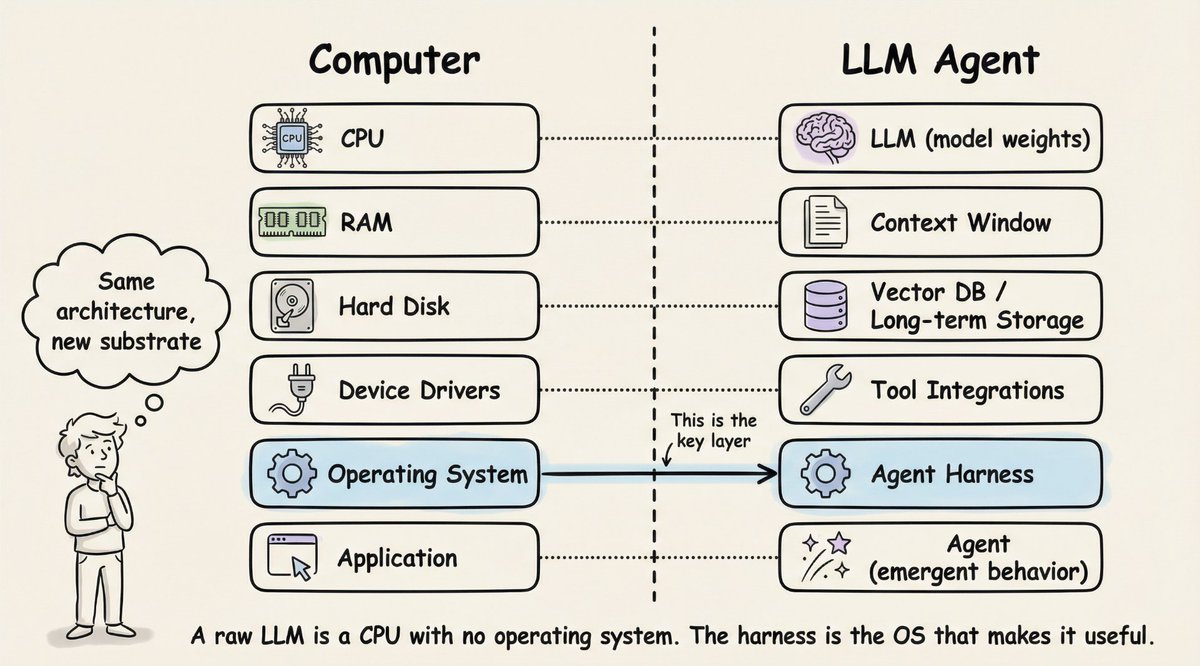
A raw LLM is just like a CPU without OS.
It can compute. But it can't do anything useful on its own.
This analogy is the clearest way I've found to understand what an agent harness actually does.
Here's the mapping:
• 𝗖𝗣𝗨 → 𝗟𝗟𝗠 (model weights). The raw compute engine. Powerful, but useless without infrastructure around it.
• 𝗥𝗔𝗠 → 𝗖𝗼𝗻𝘁𝗲𝘅𝘁 𝘄𝗶𝗻𝗱𝗼𝘄. Fast, always available, but limited. When it fills up, you start losing things.
• 𝗛𝗮𝗿𝗱 𝗱𝗶𝘀𝗸 → 𝗩𝗲𝗰𝘁𝗼𝗿 𝗗𝗕 / 𝗹𝗼𝗻𝗴-𝘁𝗲𝗿𝗺 𝘀𝘁𝗼𝗿𝗮𝗴𝗲. Large capacity, but slow to access. You retrieve from it, not compute in it.
• 𝗗𝗲𝘃𝗶𝗰𝗲 𝗱𝗿𝗶𝘃𝗲𝗿𝘀 → 𝗧𝗼𝗼𝗹 𝗶𝗻𝘁𝗲𝗴𝗿𝗮𝘁𝗶𝗼𝗻𝘀. The interfaces that let the model interact with the outside world. Code execution, web search, file I/O.
• 𝗢𝗽𝗲𝗿𝗮𝘁𝗶𝗻𝗴 𝘀𝘆𝘀𝘁𝗲𝗺 → 𝗔𝗴𝗲𝗻𝘁 𝗵𝗮𝗿𝗻𝗲𝘀𝘀. This is the key layer. It manages everything: which tools to call, what fits in memory, when to retrieve, how to recover from errors, and when to stop.
And then there's the 𝗮𝗽𝗽𝗹𝗶𝗰𝗮𝘁𝗶𝗼𝗻 layer. That's the "agent" itself. Not a piece of software you install, but emergent behavior that arises when the OS does its job well.
This is why two products using the exact same model can perform completely differently. LangChain changed only their harness infrastructure (same model, same weights) and jumped from outside the top 30 to rank 5 on TerminalBench 2.0.
The model didn't improve. The operating system around it did.
The article below is a deep dive on agent harness engineering, covering the orchestration loop, tools, memory, context management, and everything else that transforms a stateless LLM into a capable agent.
Pour moins de 2 euros, ce petit composant USB-C me dit quand mes agents IA travaillent et quand ils attendent une réponse de ma part.
Je l’ai mis en place avec Claude, ça fonctionne même avec plusieurs terminaux (en local ouremote), et ça ouvre des possibilités assez folles pour presque rien.
Si ça vous intéresse, demandez-moi le fichier Blinky.MD : il permet à l’IA de faire le setup automatiquement.
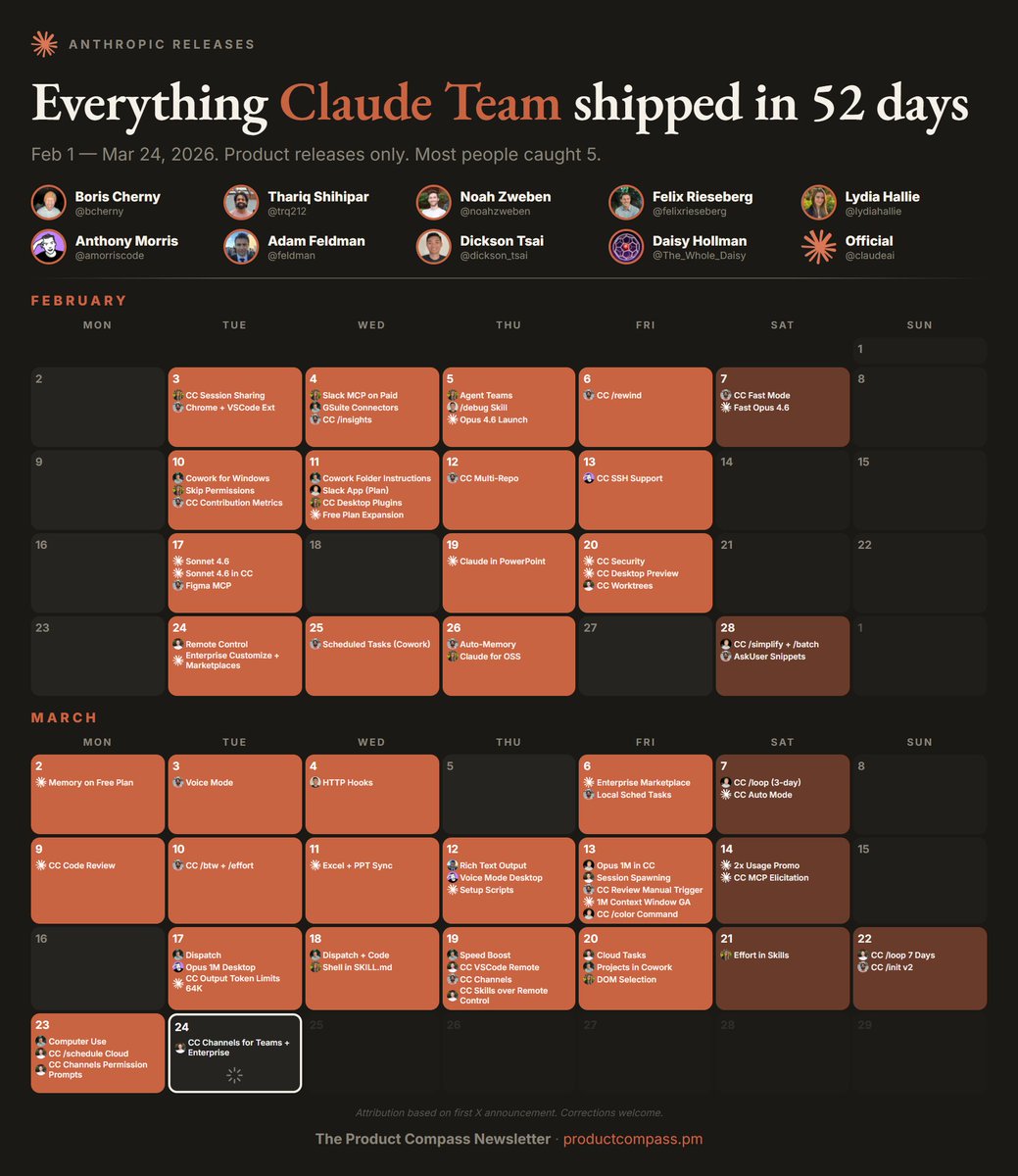
73 product releases in 52 days. That's not a launch cadence — that's a different kind of company.
I tracked every Anthropic release from Feb 1 to Mar 23 by going through @bcherny, @trq212, @noahzweben, @felixrieseberg, @lydiahallie, @amorriscode, @feldman, @dickson_tsai, and @claudeai. Built a calendar with first-announcement attribution.
Look at the acceleration. February had bursts with gaps between them. March 9 onward is almost every single day — Code Review, Channels, Dispatch, Computer Use, back to back.
The individual features get coverage. The shipping velocity doesn't. It should.
We just released Claude Code channels, which allows you to control your Claude Code session through select MCPs, starting with Telegram and Discord.
Use this to message Claude Code directly from your phone.
Elon Musk: “AI and robots will replace all jobs.”
Sam Altman: "Entire classes of jobs will go away."
Jensen Huang: “You are going to lose your job to somebody who uses AI.”
The function of technology must be to improve human life, not just line the pockets of billionaires.