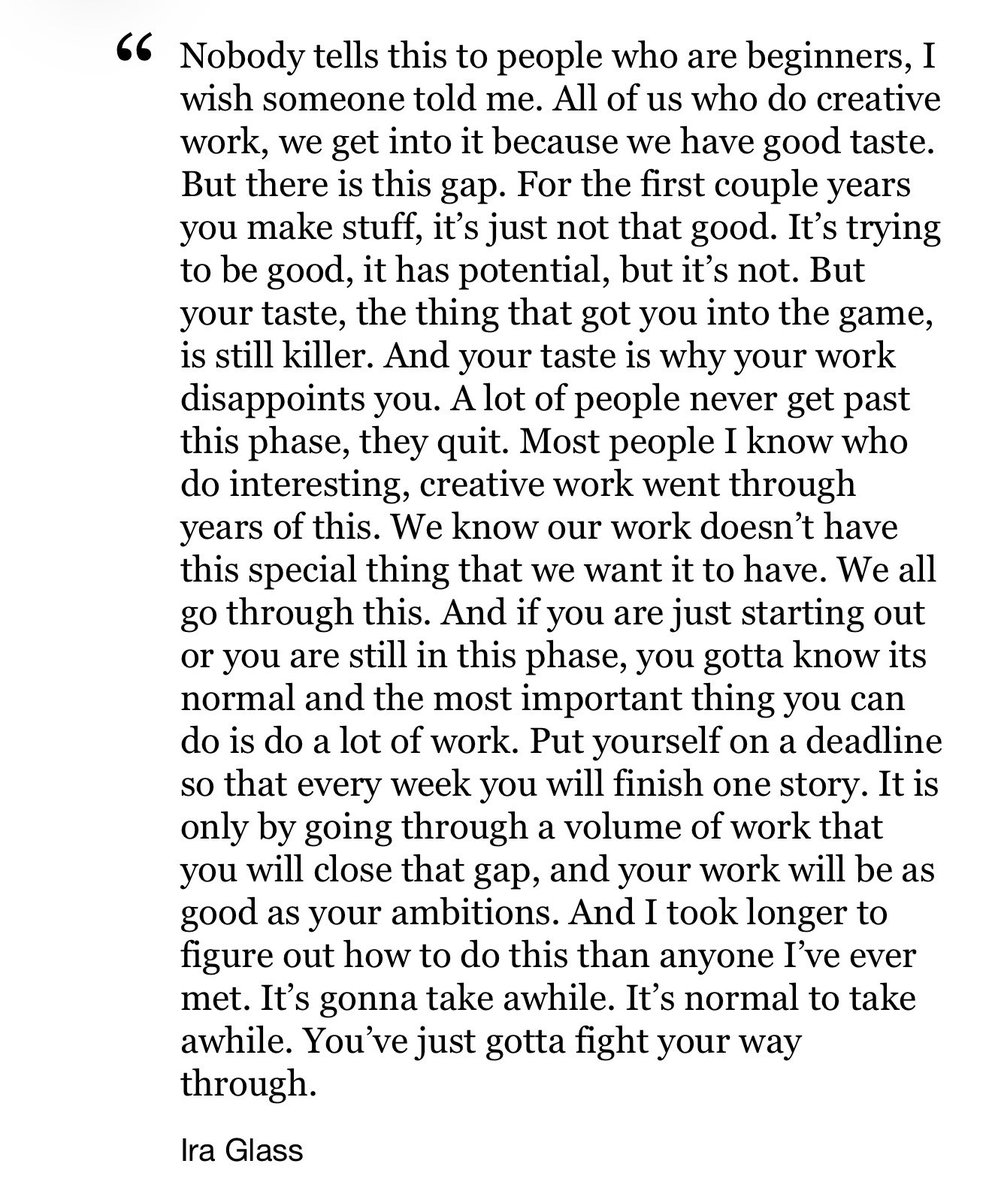
Develop a taste for the world around you. Develop a refinement, a sophistication that guides your artistry in the matters of excellence.
Do not be one-track. Be excellent in everything your hand touches that pleases your soul. Let your excellence be your signature trademark.
@Thecreativemena With some effort I can still see important items, like, you know, transaction details, on the screen. That’s unacceptable; who needs to see useful information on a tx receipt? Old school. Make the logo eat up 98% more of the screen. Then we’re talking.
@joshm is there a specific constraint preventing full screen on Dia? Seems to me like it’s a missed opportunity that costs nothing while simultaneously elevating the experience for users who prefer full screen immersion as they browse pages.
This was one of the highlights of Arc. And it’s literally maybe the one thing preventing many of us from going all-in on Dia.
Maybe that and the non-dismissible “chat” menu tacked on to the top bar.
@joshm is there a specific constraint preventing full screen on Dia? Seems to me like it’s a missed opportunity that costs nothing while simultaneously elevating the experience for users who prefer full screen immersion as they browse pages.
This was one of the highlights of Arc. And it’s literally maybe the one thing preventing many of us from going all-in on Dia.
Maybe that and the non-dismissible “chat” menu tacked on to the top bar.
@tbsrnstrm's Spatial is handsdown one of the best pieces of software I've tried in a really, really long time! It sparks a different type of sheer delight and joy one does not find easily.
It's a beacon of hope and light, that in a world of cookie-cutter, weapons-grade slop, there are still mad men consumed by the gods of pure craft and skill. Sparialis so buttery smooth I want to eat it!
Remember, kids, the corporations are not your friends. Regardless of what they'd like you to believe, and whatever moral arguments they try to advance, it is perpetually incumbent on them that they ultimately advance their interests as fiercely as they can get away with.
It is a tale as old as time. Google eventually gets rid of "don't be evil", Apple eventually denies "it's better to be a pirate than join the navy", and Anthropic eventually becomes, well, Anthropic.
Reminds me of this excerpt from @mbutterick's 'Practical Typography':
Remember, kids, the corporations are not your friends. Regardless of what they'd like you to believe, and whatever moral arguments they try to advance, it is perpetually incumbent on them that they ultimately advance their interests as fiercely as they can get away with.
It is a tale as old as time. Google eventually gets rid of "don't be evil", Apple eventually denies "it's better to be a pirate than join the navy", and Anthropic eventually becomes, well, Anthropic.
Reminds me of this excerpt from @mbutterick's 'Practical Typography':
ok, this is really cool. some ideas off the top: integrate sub-tl to main tl? rather than have events clutter the main tl, represent them as a branch from the main tl to transition into, idk, a sub-exploration? at the end of the sub-tl it collapses into a transition back into the next line on the main tl?
@tymzap I'm sorry, it's straight hot garbage. First off, the fixed icon rail breaks the immersion of the page and distracts you, among manny other unforgivables. Basically they tried to copy Arc's legendary sidebar and then got too creative. Now it's just a cheap, badly done clone.
thank you for sharing, Jason. please make more essay monologues!
this sparked some thoughts and I spent a good hour making entries in my notes: taste is having its zeitgeist moment; so much emphasis has been placed on taste recently that people forget it’s less a predictor of success than a signal of value (ask Zuck/Gates, then ask Jobs!). some of the most valuable companies within the last several decades have been demonstrably subpar in taste and style.
it was always possible to brute-force success by providing the bare minimum, because the bottleneck was not taste but simply working. the concept of taste was a superficial novelty. i imagine it’s why apple made a cult-like distinction by imposing a superior emphasis on this intangible asset that execs and industry leaders at the time (re: Ballmer, most notably) sneered at.
why take the time to craft 10 tasteful products if you could ship 100 subpar ones for much less effort than that? this approach assumed, after all, people didn’t care. it was a misread. it wasn’t so much that people didn’t care as it was simply a constraint born of a lack of alternatives. wasn’t a surprise when apple showed up and stole the smartphone and notebook market from under everyone.
there will always be a premium on taste.
taste is deceptively tied to ability, not so much the other way, interestingly (although that’s a different conversation).
one way to build it is through obsessive exposure to the surfaces where expressions of it live. unironically, this drives you to acquire ability as part of your toolkit, to validate your taste profile by exploring your interpretations of what you’ve “tasted,” running experiments, and critiquing them.
but then again, it begs the question: how much of the working definition of taste reduces to pattern recognition?
heck, maybe that’s the point. pattern recognition at that density isn’t cheap, it takes obsessive exposure over time to build, which is why it’s even more of a big deal now, which is what makes it scarce, which is why it’s only going to get even more valuable.
if we assume everyone can access the same surfaces now, it therefore follows to assume that fewer would put in the reps to actually see the differences that matter. the exposure is abundant; the discernment isn’t.
historically, scarcity has (and will) always be a feature of value; doesn’t matter how much abundance tries to replace scarcity, the bottleneck simply moves upstream, or further out.
maybe i'll try to distill my thoughts even further into an essay sometime.
thank you for sharing, Jason. please make more essay monologues!
this sparked some thoughts and I spent a good hour making entries in my notes: taste is having its zeitgeist moment; so much emphasis has been placed on taste recently that people forget it’s less a predictor of success than a signal of value (ask Zuck/Gates, then ask Jobs!). some of the most valuable companies within the last several decades have been demonstrably subpar in taste and style.
it was always possible to brute-force success by providing the bare minimum, because the bottleneck was not taste but simply working. the concept of taste was a superficial novelty. i imagine it’s why apple made a cult-like distinction by imposing a superior emphasis on this intangible asset that execs and industry leaders at the time (re: Ballmer, most notably) sneered at.
why take the time to craft 10 tasteful products if you could ship 100 subpar ones for much less effort than that? this approach assumed, after all, people didn’t care. it was a misread. it wasn’t so much that people didn’t care as it was simply a constraint born of a lack of alternatives. wasn’t a surprise when apple showed up and stole the smartphone and notebook market from under everyone.
there will always be a premium on taste.
taste is deceptively tied to ability, not so much the other way, interestingly (although that’s a different conversation).
one way to build it is through obsessive exposure to the surfaces where expressions of it live. unironically, this drives you to acquire ability as part of your toolkit, to validate your taste profile by exploring your interpretations of what you’ve “tasted,” running experiments, and critiquing them.
but then again, it begs the question: how much of the working definition of taste reduces to pattern recognition?
heck, maybe that’s the point. pattern recognition at that density isn’t cheap, it takes obsessive exposure over time to build, which is why it’s even more of a big deal now, which is what makes it scarce, which is why it’s only going to get even more valuable.
if we assume everyone can access the same surfaces now, it therefore follows to assume that fewer would put in the reps to actually see the differences that matter. the exposure is abundant; the discernment isn’t.
historically, scarcity has (and will) always be a feature of value; doesn’t matter how much abundance tries to replace scarcity, the bottleneck simply moves upstream, or further out.
maybe i'll try to distill my thoughts even further into an essay sometime.
Just saw a comment on Karpathy’s LLM Wiki gist:
“hilarious how hundreds of people with ai psychosis have pointed their slopcannons at this gist - "implement this gist, make no mistakes"”
Lmao!