1/ Stablecoins act as fiat proxies bridging traditional currency and distributed networks. Designed to maintain a strict one to one peg with real world assets like the US dollar, they provide absolute price stability. This offers investors a safe harbor during market turbulence and gives merchants a reliable medium of exchange, rejecting the wild volatility typically associated with cryptocurrencies.
2/ The lifecycle relies on a continuous mint and burn cycle to ensure virtual supply matches physical reserves. Users wire fiat to an issuer, who mints equivalent tokens on a blockchain. For redemption, users return the tokens, the smart contract permanently destroys them, and the issuer wires the physical cash back from reserve accounts.
3/ Dominant players like Tether and USD Coin lead the market with fully backed reserves. The 2022 collapse of the algorithmic TerraUSD model highlighted the dangers of unbacked systems. This failure forced the entire industry to adopt transparent, fully backed models holding actual cash and short term treasury bills.
4/ Traditional financial institutions now view stablecoins as next generation payment infrastructure. Recent legislative frameworks explicitly separate compliant payment instruments from volatile cryptocurrencies. Regulators treat them as private payment instruments rather than securities, provided they maintain fixed values and do not pay interest, inviting traditional asset managers to participate safely.
5/ Policymakers view dollar backed stablecoins as strategic tools that increase global demand for US currency and Treasury bills. Furthermore, public ledgers enhance law enforcement tracking. Daily transaction volumes now exceed one hundred billion dollars, empowering users in failing economies and freelancers with borderless, instant financial settlement.
https://t.co/VStNExY5BQ
There is no need for alt szn to come to make money.
You need knowledge- understand economics, know math and follow the community.
It is not complicated.
1/ Bitcoin trades at $77,374.70 despite a massive $216.7 million net inflow into United States spot exchange-traded funds on September 1. Rising Brent crude oil prices above $92 and multi-year-high Treasury yields create intense macroeconomic headwinds that currently overpower this strong institutional demand.
2/ Excessive leverage triggered a violent flush across derivative markets. Total perpetual open interest surged 18.72% before the reversal. This overextension caused $98.71 million in total liquidations. Long positions absorbed $85.34 million of this selling pressure, accelerating the downward momentum of the leading digital asset.
3/ Technical indicators confirm bearish short-term momentum as the asset tests the lower Bollinger Band near $77,473. The relative strength index sits at a weak 40.85. Bitcoin must reclaim the $78,262 pivot level to shift the trend. A failure to hold the $76,500 to $77,000 foundation zone risks a drop toward $75,000.
4/ Ethereum broke below the critical $2,400 support level, triggering a massive wave of forced selling. Traders lost over $70 million in long positions within 1 hour during this flash crash. The specific network recorded $32.78 million in direct liquidations, as high leverage amplified the sudden drop in valuation.
5/ United States markets currently price in a 67% chance of a September Federal Reserve rate hike. This hawkish monetary expectation forces investors to seek safety. Ethereum moved strictly as a high-beta risk asset during this downturn and maintained a nearly 1:1 correlation with Bitcoin over the last 24 hours.
6/ Technical charts reveal a critical juncture as Ethereum tests the 78.6% Fibonacci retracement level of $2,340. Bulls must defend this specific valuation point to prevent a deeper correction. A successful defense could spark a rebound toward the $2,500 to $2,540 resistance zone where significant liquidation clusters currently sit.
7/ The future direction of the digital asset space hinges entirely on upcoming economic data releases. Market participants eagerly await the August employment report and the September 11 inflation data to gauge future monetary policy. A strong employment print on September 4 could reinforce hawkish central bank expectations and sustain downward pressure.
1/ Bitcoin trades at $77,260.09 with a massive $26,479,119,535 daily volume. The asset gained 0.22% recently. Buyers pushed the price above $80,000 before sellers dragged it back to $76,000. High trading volume proves that immense capital continues to flow into the ecosystem. Smart investors use these minor dips to accumulate more assets at discounted prices.
2/ Kalshi participants favor an $82,000 target for September. Traders expect the asset to climb 7% from the current $76,000 level. This collective mood suggests speculators view the short-term pullback as a minor hurdle. The asset maintained a consistent record of September gains over the past 4 years. Seasonal strength often drives investor confidence and attracts fresh capital.
3/ ethereum:native dropped 0.93% to $2,389.35 over 24 hours. A massive cascade of leveraged long liquidations drove this underperformance. Exchanges wiped out $96 million in Ethereum long positions. The broader crypto market saw exchanges liquidate over $367 million in total positions. Algorithms automatically sold assets to meet margin calls, pushing the valuation below the critical $2,400 support level.
4/ Ethereum shares a strong 67.8% correlation with the S&P 500. Traditional stock market movements heavily influence digital asset valuations. Geopolitical tensions pushed Brent crude oil prices above $95. Higher oil prices ignite inflation fears and drive Treasury yields higher. Investors typically sell risk assets when inflation fears rise and bond yields offer better returns.
5/ Spot selling pressure increased alongside macro headwinds. A major market participant moved 70,739 Ethereum tokens worth roughly $174 million to exchanges over 2 days. Large holders usually signal an intent to sell when they transfer assets to exchanges. I interpret these whale movements as strategic portfolio rebalancing rather than a complete loss of faith. Smart money takes profits after strong rallies.
6/ Market participants watch critical support levels to gauge the future direction of valuations. The immediate technical structure looks bearish after sellers broke $2,400. The next major support cluster sits between $2,350 and $2,320. Buyers must defend this area to prevent a deeper correction. A successful defense could allow the asset to consolidate and range between $2,320 and $2,440.
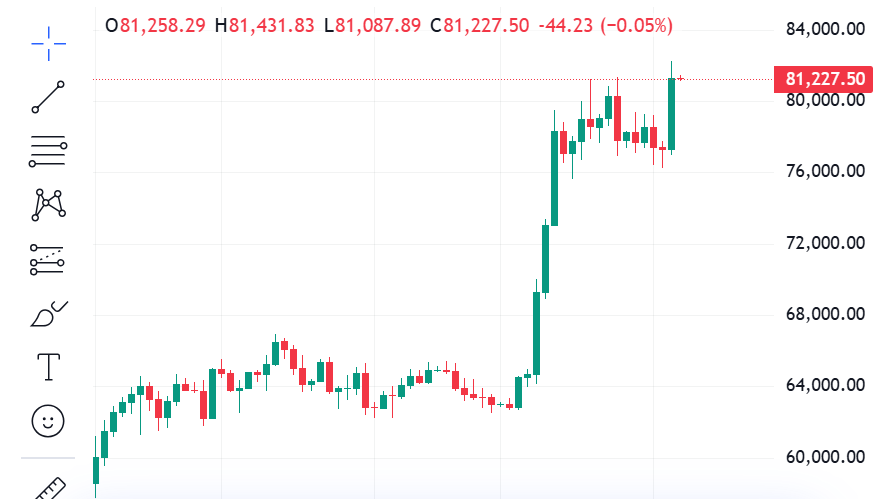
1/ Bitcoin rose 5.08% to $81,106.29 in 24 hours, outperforming the broader crypto market's 4.83% gain to $2.72 trillion. Its 97% correlation with the S&P 500 and 86% correlation with gold show a macro-driven repricing rather than a crypto-specific breakout.
2/ Federal Reserve Governor Christopher Waller signaled support for holding rates steady if inflation improves. Market-implied odds of a September rate hike fell from 63% to around 50%. A pause in U.S.-Iran tensions also eased oil and inflation fears, boosting risk assets.
3/ A short squeeze amplified the move. Over $415 million in Bitcoin short positions were liquidated in 24 hours, with $164 million gone in 4 hours. Another measure showed $271 million liquidated in 24 hours, shorts at 95%, a 425% surge. Forced buying created a feedback loop.
4/ Sentiment overheated quickly. The Fear and Greed Index hit 78, signaling greed. Influential voices declared a crypto supercycle, fueling retail fear of missing out. High leverage means the rally may lack staying power without fresh spot demand.
5/ Bitcoin broke above $78,000 resistance with high volume. The next major hurdle is $83,000, aligned with long-term holder supply. Holding above $80,000 to $81,000 could target $83,000 to $85,000. A clear break above $83,000 opens a path toward $86,500.
6/ Spot ETF inflows are the key institutional signal. September 2 saw a net inflow of $101 million. That is positive but not a trend. Sustained inflows above $80,000 would confirm the rally. Without them, the squeeze could fade.
7/ The August Non-Farm Payrolls report on September 4 is the next major trigger. Soft jobs data supports the dovish case and could extend gains. A strong report revives fears of a rate hike and pressures the whole complex. Bitcoin's near-term path hinges on $80,000 to $83,000.