🤖 Browser Use: Web AI
A powerful open-source library that lets AI agents naturally interact with websites. Using LangChain and GPT models, it automates complex web tasks from navigation to form-filling, making browser automation seamless.
Learn more: https://t.co/x9hRshF6ux
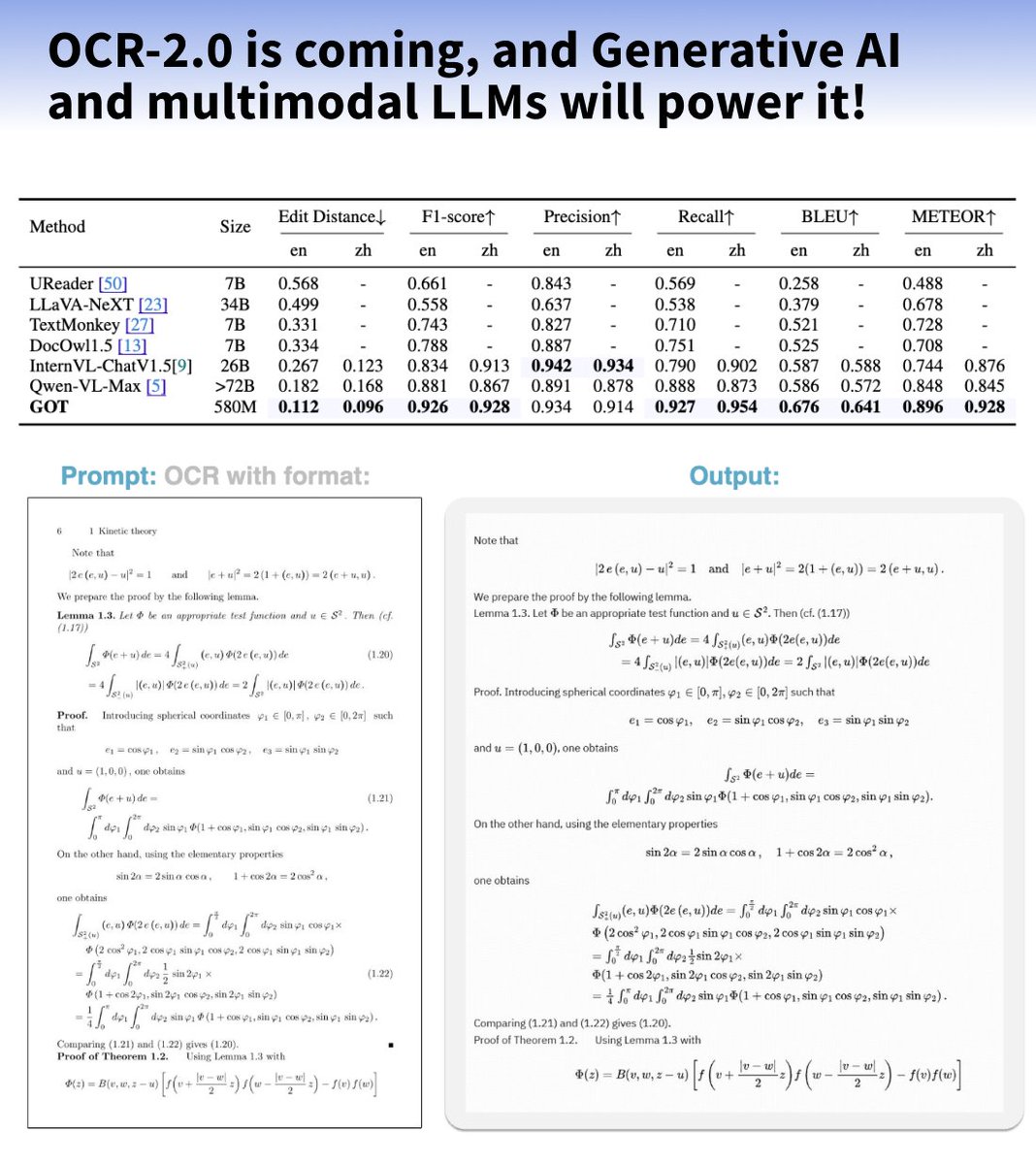
OCR-2.0 is coming, and Generative AI and multimodal LLMs will power it! 🔍 GOT (General OCR Theory) is a 580M end-to-end OCR-2.0 model that outperforms all existing methods.
GOT consists of a Vision-Encoder to convert images into transformers images into tokens and a decoder for generating OCR outputs in various formats (e.g., plain text, markdown, Mathpix). GOT is designed to handle complex tasks like sheets, formulas, and geometric shapes
Implementation
1️⃣Vision Encoder Pre-training: The encoder (VitDet) trained using scene text and document OCR data to recognize both slice and whole-page inputs.
2️⃣ Joint-Training: The encoder is connected to the decoder (Qwen-0.5B) and both are trained on more general OCR tasks (e.g., formulas, sheet music, geometry).
3️⃣ Post-Training: Fine-tuned the model with specific tasks, such as fine-grained OCR, multi-page PDFs, and dynamic resolution, using new synthetic datasets.
Insights
🧠 Encoder-Decoder with 80M (VitDet) Encoder and 500M (Qwen2) Decoder with 8k context
🥇 Achieves a 0.035 edit distance and 0.972 BLEU score on plain OCR
📊 Outperforms LLaVA-NeXT and Qwen-VL-Max in document and scene text OCR
🧮 Can extract LaTeX formulas from Arxiv and convert them to Mathpix format
📃 Supports dynamic resolution and multi-page OCR
🖼️ Input resolutions up to 1024x1024
Paper: https://t.co/QeiihLPfp5
Github: https://t.co/rGodXsI0KF
Finding quality OCR datasets was a huge challenge 🤔
And then I see that one of the largest OCR datasets are now available to the public as open @huggingface dataset 🔥
With over 26 million pages , 18 billion text tokens, and 6TB of data. 🤯
These resources are just goldmine for document AI research.